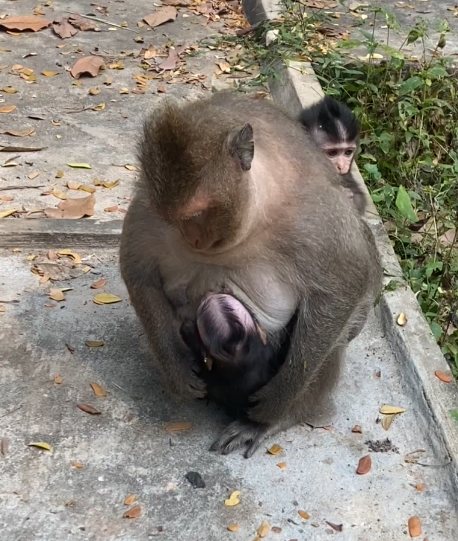
The forest was alive with sound, yet for the little monkey, it felt strangely empty.
Morning sunlight filtered through the tall trees, painting shifting patterns on the ground. Birds called to one another high above, and the wind whispered through leaves like a soft lullaby. But none of it comforted him.
He sat on a low branch, eyes scanning every direction, searching for a familiar shape—a gentle face, warm arms, the soft scent that meant safety.
His mother was nowhere to be found.
He called softly, a small trembling sound that seemed to disappear into the vast forest. He waited, ears perked, hoping to hear her answering call.
Nothing.
Days earlier, they had been moving with the troop, leaping through branches as they always did. But in the confusion of sudden movement—loud noises, startled cries, branches shaking—he had lost sight of her. Since then, he had wandered, driven by instinct and hope.
He still believed she would come.
But survival in the forest was not kind to those who were alone.
Nearby lived an older monkey—larger, stronger, and territorial. At first, the little one had approached cautiously, hoping for guidance or at least tolerance. Instead, he was met with harsh stares and aggressive gestures.
The older monkey would chase him away from fruit, snatch food from his hands, and sometimes push him aside with impatient swats. The message was clear: you do not belong here.
Yet the little monkey did not leave.
Partly because he didn’t know where else to go. Partly because he was stubborn in a quiet, unyielding way.
One afternoon, hunger drove him toward a patch of fallen fruit beneath a tree. He approached slowly, glancing around. Just as he picked up a small piece, the older monkey appeared, baring his teeth.
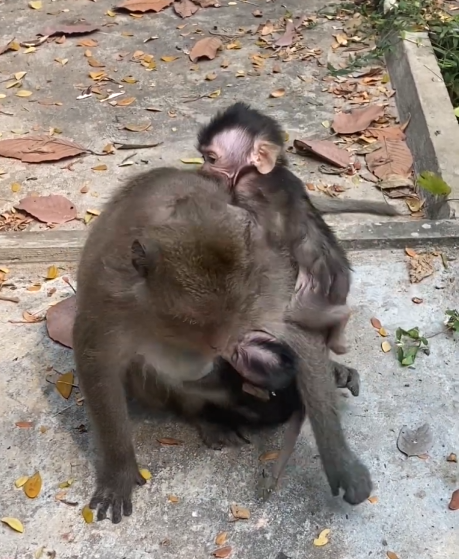
The little one froze.
The larger monkey lunged forward, snatching the fruit and shoving him back. The small monkey stumbled but didn’t cry out. Instead, he watched, eyes wide yet determined.
After the older monkey moved away, he searched again, finding a tiny leftover piece hidden among leaves. He ate it slowly, savoring every bite.
That was his way.
He endured.
Sometimes, he would sit quietly at a distance, observing the troop dynamics, learning when it was safest to approach and when to stay hidden. Despite being pushed aside, he kept returning—drawn by the faint hope of acceptance or at least survival.
But at night, loneliness settled heavily.
He curled into himself beneath thick foliage, hugging his small body for warmth. Occasionally, he would lift his head and listen, imagining he heard his mother’s voice carried on the wind.
He never stopped hoping.
One evening, a sudden commotion erupted among the trees. A loud crack echoed as a branch fell, sending leaves fluttering down. The little monkey instinctively scrambled to safety, clinging tightly to a nearby trunk.
As he steadied himself, he noticed something surprising.
The older monkey—usually so confident—seemed unsettled, glancing around nervously. For a moment, their eyes met, and the little one sensed something unexpected: uncertainty.
In that instant, the forest felt less divided.
Later, rain began to fall, first gently, then steadily. Water dripped through leaves, creating a steady rhythm. The little monkey found shelter beneath a thick branch, shivering slightly.
To his surprise, the older monkey settled not far away, also seeking cover.
They sat in silence.
The little one watched cautiously, ready to move if threatened. But the older monkey simply rested, occasionally glancing over without aggression.
For the first time, there was no hostility.
As the rain continued, the little monkey edged slightly closer—not too near, just enough to share a sense of shelter. The older monkey did not react.
Perhaps even in the wild, moments of quiet understanding could exist.
Days passed, and though the older monkey still displayed dominance, the intensity softened slightly. The little one remained persistent, returning again and again, adapting, learning.
His stubbornness was not defiance—it was resilience.
One morning, while foraging, the little monkey discovered a cluster of small berries hidden beneath low leaves. He picked one, then another, glancing around.
When the older monkey approached, he hesitated… then did something unexpected.
He left one berry on the ground and stepped back.
The larger monkey paused, watching. After a moment, he took the berry without aggression.
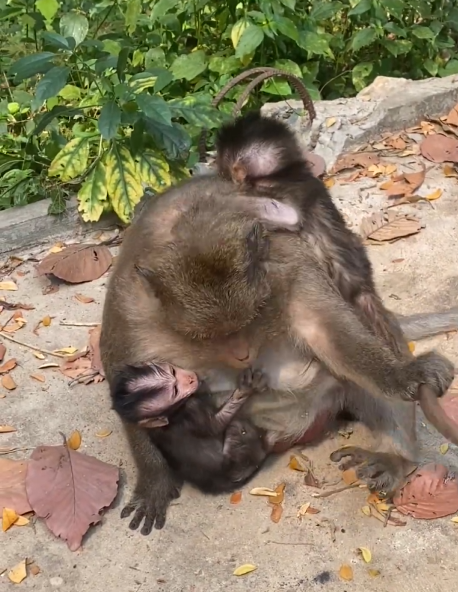
It wasn’t friendship.
But it wasn’t rejection either.
As weeks turned into months, the little monkey grew stronger. His leaps became more confident, his eyes brighter. Though he still missed his mother deeply, he had learned to navigate a challenging world with quiet determination.
Sometimes, he would sit high on a branch at sunset, watching the sky glow orange and pink. In those moments, he seemed thoughtful, as if remembering or dreaming.
He still listened for her.
And perhaps, somewhere deep inside, he carried her presence—guiding him, giving him strength.
The older monkey, too, seemed to change subtly. While still dominant, he no longer chased the little one away so fiercely. Occasionally, they foraged in the same area without conflict, sharing space in a silent agreement.
Life in the forest moved on.
One golden afternoon, as sunlight shimmered through leaves, the little monkey climbed to a high branch and looked out across the vast green world. He felt the breeze on his fur, heard distant calls, and sensed something new.
Confidence.
He had survived loss, hardship, and loneliness. He had endured mistreatment without losing his gentle spirit. And through it all, his stubborn heart had carried him forward.
Though he still longed for his mother, he was no longer helpless.
He was strong.
And somewhere in the whispering forest, hope remained—quiet, steady, and alive.
Because sometimes, the smallest creatures teach the greatest lessons:
That even when the world feels unkind, perseverance can light the way.
That gentleness can survive hardship.
And that a stubborn heart, guided by hope, can endure more than anyone expects.