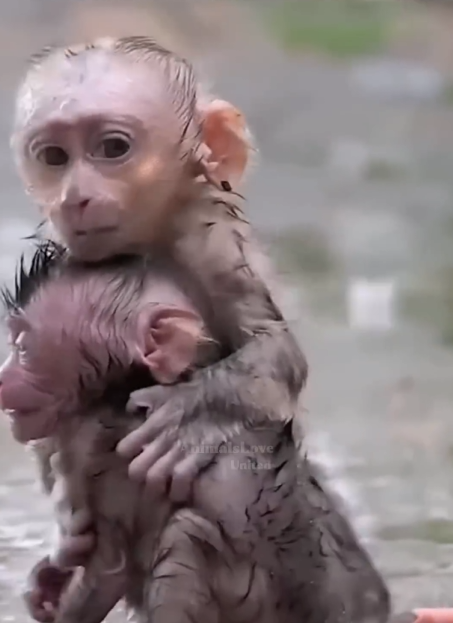
In the quiet aftermath of a storm that had swept through the forest with fierce winds and relentless rain, the world felt strangely still. Leaves lay scattered like forgotten memories, branches hung broken, and the air carried that heavy silence that follows chaos.
At the base of a fallen tree, two tiny monkeys huddled together.
They were small—too small to face the vastness of the forest alone. Their fur was damp, their bodies trembling not only from the cold but from a fear they couldn’t understand. They pressed close, arms wrapped around each other, as if trying to create warmth from their shared heartbeat.
They had lost everything.
No comforting call from their mother echoed through the trees. No familiar scent guided them back to safety. Only the endless rustle of leaves and distant sounds of an unfamiliar world surrounded them.
So they clung to each other.
The slightly older one, with a faint stripe of darker fur across his back, kept his arm protectively around the younger. Whenever a branch creaked or a bird cried out suddenly, he tightened his hold, eyes wide with alertness.
The younger monkey buried his face against his companion’s chest, seeking comfort in the only presence that remained.
Hours passed.
Sunlight filtered weakly through the canopy, drying the forest floor. Hunger began to gnaw at their tiny bellies. They ventured cautiously from their hiding place, never letting go of each other for more than a few steps.
They searched for food the only way they knew—sniffing fallen fruit, picking at leaves, tasting cautiously. But without guidance, everything felt uncertain.
As evening approached, the forest grew darker, and with it came unfamiliar sounds. The two found a hollow near a cluster of roots and curled up together once more, their tails loosely entwined.
That night, they slept lightly, waking at every noise.
Days blurred together.
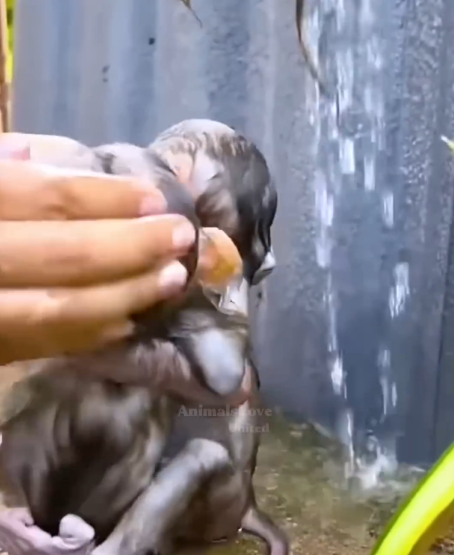
They learned to move slowly, to stay hidden, to rely on one another. When one found a small berry, it was shared. When one grew frightened, the other offered silent reassurance through touch.
Their bond became their survival.
One morning, as they sat near the edge of the forest where tall grasses met a dusty path, they noticed something unusual.
Footsteps.
Slow, steady, accompanied by the soft crunch of gravel. The monkeys froze, instinct urging caution. They watched from behind a bush as a man approached, carrying a small bag slung over his shoulder.
He paused when he noticed movement.
Their eyes met.
For a moment, no one moved. The monkeys pressed closer together, ready to flee if necessary. The man crouched slowly, lowering himself to appear less threatening.
“Oh… you two,” he murmured softly, voice gentle as a breeze.
He didn’t reach out immediately. Instead, he sat quietly, giving them time.
From his bag, he took out a piece of fruit and placed it on the ground, then leaned back slightly. The sweet scent drifted through the air.
The older monkey watched carefully.
Hunger urged him forward, but caution held him back. He looked at his companion, then back at the man.
After a long pause, he took a tentative step.
The younger followed closely, refusing to be left behind. They approached together, never breaking contact. The older monkey reached out, grabbed the fruit, and quickly retreated.
They ate side by side, glancing up often.
The man smiled softly.
“I won’t hurt you,” he said quietly. “You’re safe.”
Over the next few days, he returned.
Each time, he brought food and sat patiently, speaking in a calm voice. Slowly, the monkeys began to associate his presence with comfort rather than fear.
One afternoon, rain began to fall unexpectedly. The man noticed the two huddled under a thin branch, shivering.
He approached slowly, holding out a cloth.
“Come on,” he whispered.
The older monkey hesitated, then stepped forward. The younger followed, clinging tightly. With gentle care, the man wrapped them loosely, shielding them from the rain.
For the first time since they had been alone, they felt a new kind of warmth.
Trust.
He carried them to a small shelter nearby—a simple wooden structure with a roof that kept out the rain. Inside, soft bedding awaited, along with fresh water and food.
The monkeys sat close together, looking around with wide eyes.
The man placed the food nearby and stepped back, allowing them space. Gradually, they relaxed, curiosity replacing fear.
That night, they slept deeply, still curled together but no longer shivering.
Days turned into weeks.
The man cared for them patiently, never rushing their progress. He spoke softly, offered nourishment, and allowed them to explore at their own pace. Though they grew more comfortable with him, they never lost their habit of staying close.
They groomed each other, played gently, and often sat side by side watching the world.
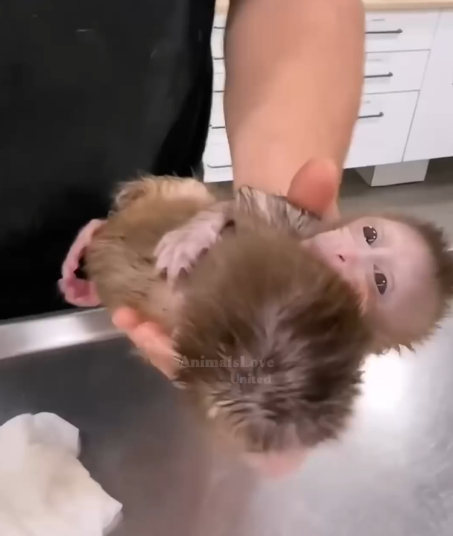
One evening, as golden sunlight streamed through the trees, the man watched them quietly. He noticed how they still reached for each other whenever something startled them, how their connection remained unbreakable.
“They saved each other,” he said softly.
Indeed, through fear and loneliness, their bond had been their strength.
Over time, their fur grew healthier, their movements more confident. They began climbing nearby branches, exploring with playful energy, yet always returning to sit together near the man.
Visitors who came to see them were often moved by their closeness.
“Look at them,” someone whispered. “They never let go.”
The man would smile gently.
“They held on until they found help,” he would say.
Years later, the two monkeys were no longer fragile or frightened. They moved with grace and curiosity, yet their connection remained as strong as ever.
Sometimes, they would sit together in the quiet afternoon light, tails draped loosely, watching the forest sway in the breeze.
And not far away, the kind man would sit too, grateful that their paths had crossed.
Their story became a quiet reminder to everyone who heard it:
Even in the darkest moments, companionship can be a lifeline.
When the world feels uncertain, holding onto one another can make all the difference.
And sometimes, kindness arrives gently—one patient step at a time—changing fear into hope and loneliness into belonging.