It started with a message—short, urgent, and impossible to ignore.
“Please help. There’s a puppy behind the old shop. Something’s wrong with him. He just sits there… like he’s frozen.”
We get calls like this often, but something about the words lingered. Just sits there. Not running, not barking, not hiding—just sitting.
By late afternoon, we pulled up to a quiet street where rows of small shops stood half-closed, their faded signs creaking softly in the breeze. A few people watched us curiously as we stepped out, scanning the area.
“Over there,” a woman said, pointing toward a narrow alley beside a shuttered storefront.
We walked slowly, footsteps echoing faintly against the concrete walls.
Then we saw him.
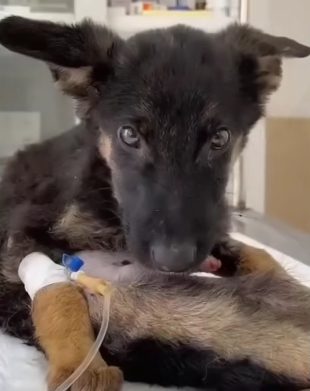
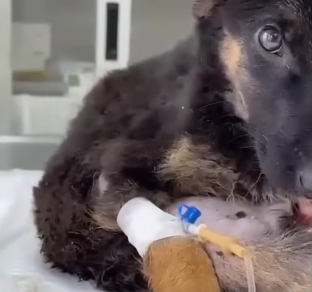
At the far end of the alley, a tiny puppy sat in a posture that immediately stopped us in our tracks. His body was stiff, back slightly hunched, legs tucked awkwardly beneath him as though he had forgotten how to move naturally.
But it was his eyes that held us.
Wide. Glossy. Filled with a quiet terror that seemed far too heavy for such a small creature.
He didn’t bark.
He didn’t run.
He simply watched us.
“Oh… wow,” my colleague whispered. “That’s not normal.”
We crouched several feet away, careful not to startle him.
“Hey, little guy,” I said softly.
No reaction—just those eyes, tracking every movement.
A small bowl of water sat nearby, half-filled and dusty. Someone had clearly tried to help, but the puppy hadn’t touched it.
As we observed him, we noticed something else. He wasn’t shifting his weight or adjusting his position like most puppies would. It was as if he had learned to stay perfectly still.
“Let’s go slow,” I said.
I placed a piece of food on the ground and gently slid it toward him.
He flinched.
Not dramatically—just a tiny tightening of his muscles, like a reflex he couldn’t control.
Minutes passed.
Finally, he leaned forward slightly and sniffed, then took a cautious bite without breaking eye contact.
“Good boy,” I murmured.
As he ate, we looked closer. His fur was dusty but not severely matted. He wasn’t dangerously thin, yet there was a tension in his body that suggested prolonged stress.
“Something happened to him,” my colleague said quietly.
We carefully approached, speaking in low tones.
When I extended my hand, he didn’t retreat—but he didn’t lean in either. He simply froze, eyes widening further.
Gently, I touched his shoulder.
He trembled.
Not the trembling of cold, but a deep, involuntary shaking, like a memory echoing through his body.
“It’s okay,” I whispered.
We wrapped him in a soft blanket and lifted him slowly. He remained stiff, posture unchanged, as if he didn’t believe he was allowed to relax.
At the clinic, the veterinary team examined him with care.
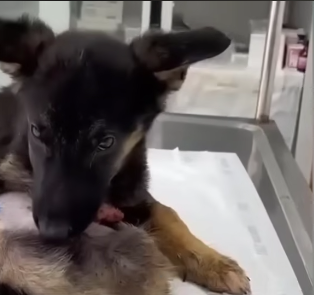
Physically, he showed no major injuries—no fractures, no obvious illness. Yet his strange posture persisted. He sat with the same rigid stillness, eyes constantly scanning the room.
“What do you think?” I asked the veterinarian.
She sighed softly.
“This looks behavioral,” she said. “Severe fear response. Possibly learned helplessness.”
“From what?” I asked.
She hesitated.
“Let’s observe him for a bit.”
Over the next few days, we learned more.
The puppy barely moved unless necessary. Loud sounds caused him to freeze completely. When someone raised their voice—even in normal conversation—he would shrink, pressing himself into the corner.
One afternoon, a local shopkeeper visited.
As soon as she saw the puppy, her expression changed.
“Oh no,” she said quietly. “It’s him.”
“You know him?” I asked.
She nodded slowly.
“He belonged to someone who lived nearby… not a kind person.”
We listened as she explained.
The puppy had spent most of his early life tied in a small space behind the shop. Whenever he moved too much or made noise, he was scolded harshly. Sometimes objects were thrown near him to “keep him quiet.”
“He learned to stay still,” she said, voice heavy. “It was the only way to avoid trouble.”
The truth settled over us like a weight.
His strange posture wasn’t random.
It was survival.
Back at the shelter, we looked at him differently—not with pity alone, but with a deeper understanding of the invisible scars he carried.
Healing wouldn’t be quick.
We created a quiet, predictable environment. Soft bedding. Gentle voices. No sudden movements.
At first, he remained cautious.
But small changes began to appear.
One morning, I noticed his ears perk slightly when I entered the room.
“Good morning,” I said.
His tail gave the faintest twitch.
Progress.
Days later, while sitting quietly nearby, I rolled a soft toy across the floor. It stopped a few inches from him.
He stared at it for a long time.
Then, slowly, he reached out with one paw and touched it.
My heart leapt.
“That’s it,” I whispered.
Gradually, he began to explore—taking a few tentative steps, sniffing corners, discovering the world beyond stillness.
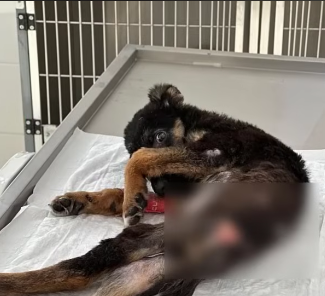
His posture softened.
The rigid tension eased, replaced by cautious curiosity.
One afternoon, as sunlight streamed through the window, he surprised us all.
He stretched.
A long, full-body stretch, like a puppy finally remembering how to exist freely.
We exchanged smiles.
“He’s starting to feel safe,” my colleague said.
Weeks passed, and the transformation continued.
He learned that hands could offer comfort instead of correction. That voices could soothe instead of threaten. That movement didn’t have to lead to fear.
The scared eyes grew brighter.
One day, during a play session, he did something we had been waiting for.
He wagged his tail—fully, joyfully.
Laughter filled the room.
“That’s our boy,” I said.
Soon after, a family visited the shelter.
They were patient, sitting quietly as he approached at his own pace. The father spoke softly, the mother offering gentle smiles, their son sitting cross-legged on the floor.
The puppy watched them carefully.
Then, step by step, he walked forward.
He sniffed the boy’s hand.
And for the first time, he leaned in willingly.
The decision was clear.
“He’s perfect,” the mother said softly.
As they completed the adoption process, we shared his story—his fears, his progress, his need for patience.
“We’ll give him all the time he needs,” the father promised.
On the day he left, he walked beside them with cautious confidence, posture relaxed, eyes hopeful.
Weeks later, we received an update.
Photos showed him running in a yard, playing with toys, sleeping peacefully on a soft bed.
One message read: He follows us everywhere. He loves watching the sunset and curling up near us at night. He’s learning to trust more every day.
Looking at those images, I thought back to the puppy sitting frozen in that alley, carrying the silent weight of his past.
His strange posture had once shocked us.
But the truth behind it taught us something deeper—that behavior is often a language shaped by experience, and patience can help rewrite even the most fearful stories.
Because sometimes, healing begins the moment someone sees beyond the fear… and chooses kindness instead.