The morning sun had barely risen above the treetops when the noise began. What started as a few sharp squeaks quickly turned into a chorus of shrill cries, rustling leaves, and thumping branches. High in the forest canopy, a group of young monkeys were in the middle of a chaotic battle—not against predators, not against danger, but against each other.
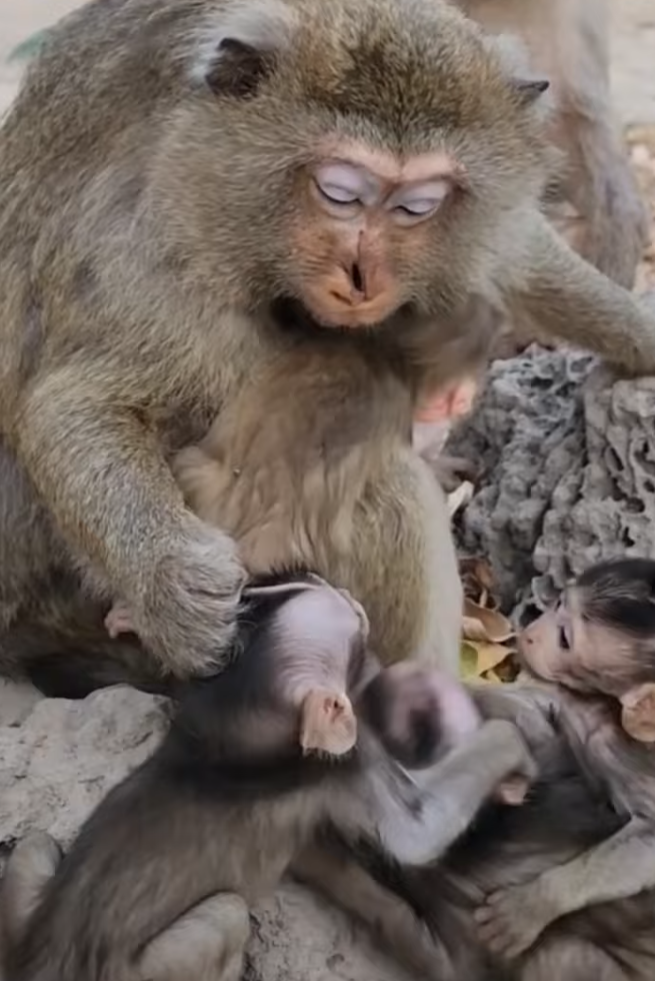
They were the children of one strong mother monkey, born in different seasons but raised under the same watchful eyes. Now growing fast and full of energy, they had reached the age where play often turned into rivalry. And today, rivalry had turned into a full-blown fight.
It began over something small. It always did.
A ripe fruit had fallen onto a wide branch, landing perfectly between two siblings. Both saw it at the same moment. Both lunged forward. And both grabbed it at the same time.
For a second, they froze, staring at each other with wide, stubborn eyes. Then came the pulling.
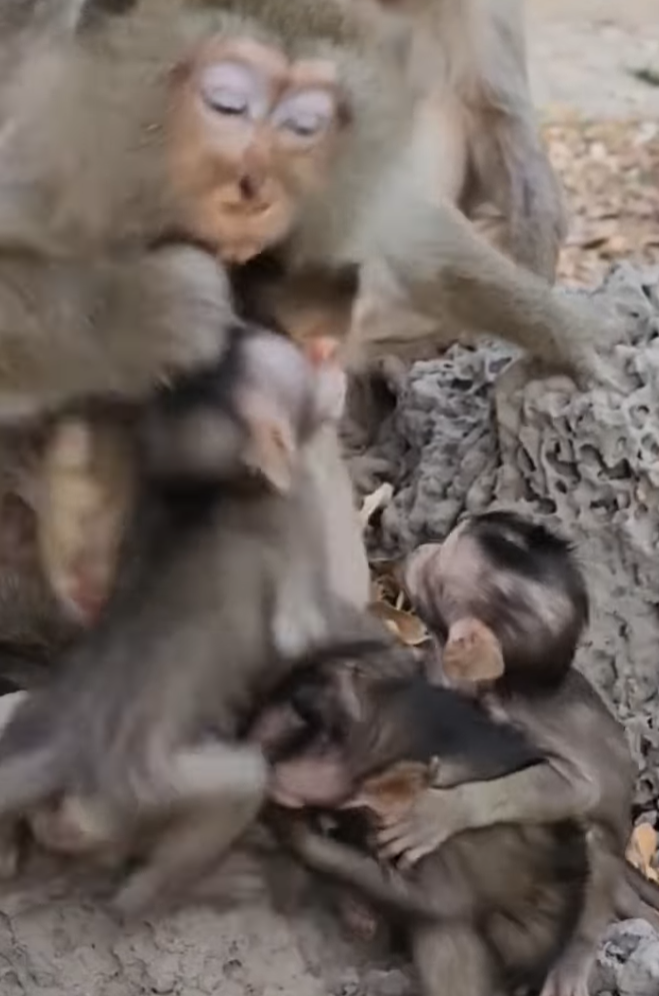
One tugged left. The other yanked right.
Soon, loud screeches filled the air. A third sibling rushed in, perhaps hoping to claim the fruit for himself. Instead, he ended up grabbing one of their tails. Within seconds, three young monkeys were tangled in a rolling, squealing mess of limbs and fur.
The fruit dropped unnoticed.
Nearby, two more siblings paused from grooming and rushed over. They didn’t know what started it—but they didn’t want to miss the excitement. One jumped on top of the pile. The other tried to separate them but got dragged in instead.
Leaves rained down as the branch shook violently.
The mother monkey, resting on a higher branch, opened one eye. She watched without immediately intervening. This wasn’t real danger—not yet. It was a storm of energy, of pride, of growing independence.
Below her, the chaos continued.
One young monkey finally escaped the pile, only to turn around and leap back in, determined to prove something. Perhaps it was about dominance. Perhaps it was about attention. Or perhaps it was simply about testing strength.
They nipped at each other’s fur—not hard enough to wound, but sharp enough to warn. Tiny hands pushed and grabbed. Tails whipped through the air. One monkey climbed higher and jumped down dramatically onto the others, as if declaring himself the winner.
But there were no winners.
Only noise.
The troop watched from nearby trees. Older monkeys shifted positions, occasionally glancing over with mild annoyance. They had seen this before. Growing young ones needed to challenge each other. It was part of learning boundaries, part of building resilience.
Still, the energy was rising.
One of the smaller siblings was pushed aside and landed awkwardly on a lower branch. He let out an offended squeak and bared his tiny teeth. For a moment, the playful fight looked more serious. His fur puffed slightly, and his movements became sharper.
That’s when the mother decided it was enough.
She descended swiftly, landing between the fighting group with a firm thud. Her presence alone created a pause.
The young monkeys froze.
She didn’t scream. She didn’t strike. She simply stood tall and steady, her eyes scanning each of them in turn.
The message was clear: Calm down.
For a few seconds, no one moved. Then one sibling cautiously reached for the fallen fruit, as if hoping the argument could quietly reset. But before he could grab it, another shot him a warning glance.
The tension wasn’t fully gone.
The mother stepped forward and gently pushed two of the older juveniles apart. She gave a sharp but brief bark—a reminder that play must not turn into harm.
Gradually, the energy shifted.
The siblings began to separate, each retreating to a nearby branch. One groomed his own arm as if pretending he had never been involved. Another swung lightly from a vine, trying to look uninterested. The smallest one, who had been knocked aside earlier, climbed back up carefully and sat alone for a moment, watching the others with cautious eyes.
The fruit lay in the middle of the branch, untouched.
After a quiet pause, something surprising happened.
One of the older siblings picked up the fruit and broke it into smaller pieces. Without making eye contact, he placed a portion near the smaller monkey who had been pushed earlier. Then he kept a piece for himself and moved away.
It wasn’t an apology in words.
But it was something close.
The tension dissolved as quickly as it had appeared. Soon, light chatter replaced angry squeaks. One monkey began playfully tugging on a vine again. Another chased after him—not in anger this time, but in laughter.
The fight had burned off their excess energy.
High above, the mother climbed back to her resting branch. She watched them resume their games with softer movements now. They leaped and rolled again, but with less intensity. The earlier storm had passed.
So many children, all full of life.
Fighting among themselves wasn’t just about fruit or pride. It was about discovering strength. Learning limits. Understanding each other’s reactions. Testing how far they could go—and when to stop.
In the wild, these lessons mattered.
The forest would not always be kind. They would face real dangers one day—predators, storms, scarcity. Knowing how to defend themselves, how to compete, and how to reconcile would be crucial.
As the sun climbed higher, the siblings gradually settled into calmer play. Grooming replaced wrestling. Quiet chattering replaced shrieks. One by one, they moved closer together again.
By midday, they were resting side by side, the earlier fight already fading from memory.
So many children of a monkey, fighting among themselves.
It looked chaotic. It sounded wild.
But beneath the noise, it was simply part of growing up in the forest—where even fights can strengthen bonds, and every argument is another step toward becoming strong.