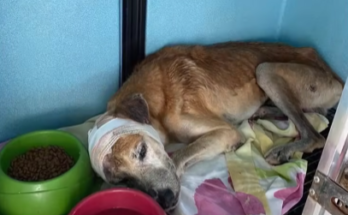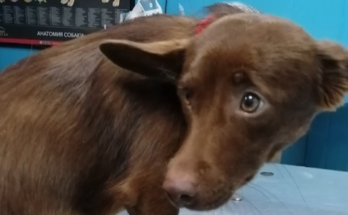
She was barely more than skin and bone when we found her, standing at the edge of a muddy field as rain began to fall. Her body trembled, not just from the cold, but from exhaustion so deep it seemed woven into her very bones. At first glance, she looked like many others we had seen before—another abandoned soul, another quiet tragedy left behind. But when she lifted her head and looked at us, we realized this rescue was different. There was something fierce in her eyes. Something protective. Something maternal.
She was carrying life.
Her belly, though small from malnutrition, was unmistakably round. Beneath her fragile frame were five unborn puppies—five tiny miracles depending entirely on a mother who herself had been pushed to the edge of survival. She had every reason to give up, yet she was still standing. Still breathing. Still fighting.
No one knows how long she had been alone. The area was isolated, far from homes, far from kindness. There were signs she had been wandering for weeks, maybe longer. Her paws were cracked and bleeding, her fur matted with dirt. Hunger had hollowed out her face, but despite everything, she had not curled up to disappear. She stayed upright, alert, guarding her unborn babies with the last strength she had.
When we approached, she didn’t run. She stepped back slightly, positioning her body sideways—instinctively shielding her belly. It was a silent but powerful message: You can help me, but you will not harm them.
We spoke softly, moving slowly. She watched every step, every hand movement, calculating whether we were a threat. Trust did not come easily to her—and how could it? Somewhere along the way, humans had failed her badly. Yet, after a long moment, she allowed us closer. Her body shook as we placed food near her. She didn’t rush to eat. Instead, she sniffed, hesitated, then finally took small bites, never breaking eye contact.

It was clear: she wasn’t just surviving for herself.
She was surviving for five unborn miracles.
Getting her into the car was a challenge, not because she was aggressive, but because she was terrified. Every unfamiliar sound made her flinch. Eventually, wrapped gently in a blanket, she allowed herself to be lifted. As we drove to the veterinary clinic, she rested her head down but kept her body curved protectively around her belly, as if even then she was guarding lives no one else could see.
At the clinic, the urgency became real. The veterinarian confirmed what we feared—she was severely malnourished, anemic, and dangerously dehydrated. Her body was under immense strain. Pregnancy alone is demanding, but pregnancy combined with starvation can be deadly. An ultrasound revealed five healthy heartbeats. Five tiny pulses flickering on the screen like fragile stars.
The room fell silent.
The vet looked at us and said gently, “She’s holding on with pure will.”
Treatment began immediately. Fluids, supplements, and careful monitoring became her new reality. Every step had to be slow and controlled to avoid putting her into shock. There were moments when her condition dipped suddenly, when her breathing became shallow and her temperature dropped. Each time, the fear returned—fear that her body might not be able to keep going.
But she did.
Day after day, she kept going.
Despite her weakness, she responded to her babies’ movements with soft shifts of her body, adjusting herself to make them more comfortable. When she rested, her paws instinctively curled inward, framing her belly. Even in sleep, her ears twitched at every sound, always alert, always protective.
As the days passed, her strength slowly began to return. Her appetite improved. Her eyes, once dulled by exhaustion, started to brighten. She learned the routine of the clinic, the gentle voices, the hands that brought food instead of harm. She allowed herself to relax—just a little.
What amazed everyone was her calm.
Many animals rescued in such conditions are understandably fearful or reactive. But she carried herself with quiet determination. She accepted care not just for herself, but because she knew she had to. Her body was no longer just her own—it was a shelter, a heartbeat, a lifeline for five unborn lives.

Weeks later, she was transferred to a foster home where she could finish her pregnancy in peace. The environment was warm and quiet, filled with soft blankets and gentle light. For the first time in a long while, she slept deeply. She no longer had to stay alert through the night. She no longer had to choose between hunger and safety.
And still, she waited.
When labor began, it was long and exhausting. Her body was small, still recovering, and every contraction took effort. But she did not panic. She trusted. With each puppy that arrived, she licked them clean, nudging them closer, counting them without knowing it. One. Two. Three. Four. Five.
Five miracles.
All alive.
Tears filled the room as we watched her transformation. The weak, trembling dog from the muddy field was gone. In her place was a mother—focused, calm, endlessly gentle. Despite everything she had endured, she knew exactly what to do. She curled around her babies, offering warmth, milk, and protection with a devotion that needed no teaching.
In the weeks that followed, she thrived alongside her puppies. Her body gained strength as theirs grew. She learned how to play again, how to relax, how to accept affection without fear. Her eyes softened. The constant tension she once carried slowly faded.
The terrible truth is that she should never have had to fight this hard. No mother—human or animal—should be abandoned while carrying life. Yet, her story is also proof of something extraordinary: the unstoppable power of maternal love.
She had nothing—no food, no shelter, no safety.
But she had will.
And that will saved six lives.
Today, her puppies are healthy, curious, and full of joy. They will never know hunger or fear. Their mother watches them with calm pride, no longer guarding them from the world, but guiding them into it.
Her rescue was miraculous not because it was dramatic, but because it revealed something deeply powerful: even at the edge of survival, love can endure. A mother’s instinct can outlast pain, hunger, and abandonment. And sometimes, when compassion finally meets that will, miracles don’t just happen—
They multiply.