I didn’t plan to find a puppy that day. I was just driving home, following the same familiar road I had taken hundreds of times before. The overpass loomed ahead, gray and noisy, cars rushing overhead like distant thunder. It was a place people passed without noticing—dirty, loud, and forgotten. But that day, something made me slow down.
At first, I thought it was a piece of trash moving in the wind.
Then it moved again.
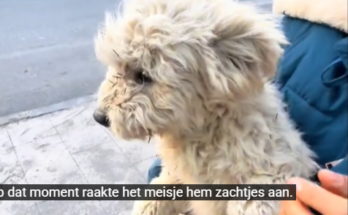
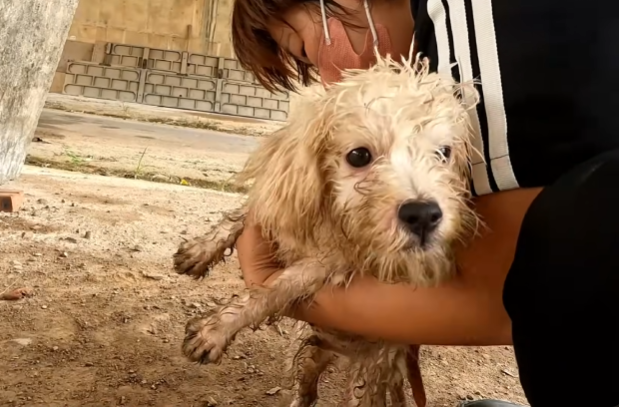
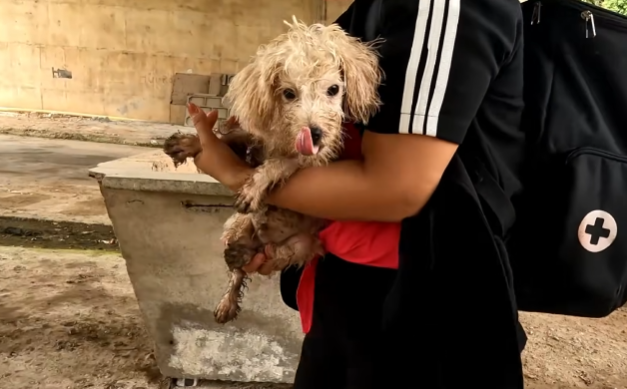
I pulled over, heart suddenly pounding, and stepped out of the car. Beneath the overpass, in the shadow where sunlight barely reached, was a tiny puppy curled against a concrete pillar. His fur was muddy and matted, his body shaking, his eyes far too big for his thin little face. When he saw me, he didn’t run. He didn’t bark. He just lifted his head slightly and let out the smallest, saddest whimper.
That sound broke something inside me.
The puppy looked lost in every possible way—not just physically, but emotionally. His ribs showed through his fur, and one of his ears was folded awkwardly, as if it had never learned how to stand up. There was no mother nearby, no siblings, no box or blanket. Just cold concrete, dust, and the roar of traffic above him.
I crouched down slowly, afraid I might scare him. “Hey, little one,” I whispered, keeping my voice soft. “It’s okay.”
At the sound of my voice, his tail moved. Just once. A weak, uncertain wag, like he wasn’t sure he was allowed to hope. He tried to stand, but his legs wobbled, and he sat back down with a quiet huff of frustration.
That was it. I knew I couldn’t leave him there.
I took off my jacket and laid it on the ground a few feet away, giving him space. Then I sat down too, ignoring the dirt, the noise, the strange looks from passing cars. We stayed like that for a minute—two strangers under an overpass, learning each other’s presence.
Slowly, inch by inch, the puppy crawled toward me.
When he reached the jacket, he sniffed it carefully, then looked up at me. His eyes were full of questions. Are you safe? Are you staying? Are you real? I held my breath, barely moving.
Finally, he climbed onto the jacket and pressed his tiny body against my leg.
I felt tears sting my eyes.
I scooped him up gently, half-expecting him to panic. Instead, he melted into my arms like he had been waiting for this exact moment his whole life. His tail started wagging harder now, thumping weakly against my arm. He licked my hand once, then twice, as if to say thank you in the only way he knew how.
I checked the area carefully, just in case someone was looking for him. There were no signs, no collars, no houses nearby. Just the endless hum of traffic and the smell of oil and rain. Someone had either lost him and never come back—or worse, left him there on purpose.
I carried him to my car, wrapping him in my jacket. The moment I opened the door, he perked up, eyes wide with excitement. He sniffed everything—the seats, the air, the steering wheel—like the world had suddenly expanded beyond concrete and fear. When I set him gently on the passenger seat, he did the most unexpected thing.
He sat up straight and wagged his tail so hard his whole body wiggled.
It was pure joy. Unfiltered. Explosive.
I laughed through my tears. “Are you excited?” I asked.
He answered by trying to climb into my lap.
The drive to the vet was quiet, except for his tiny snorts and happy little whines. Every red light was an opportunity for him to paw at my arm or lick my fingers. It was as if he knew—somehow—that he was safe now. That this car was not taking him somewhere bad, but somewhere new.
At the clinic, the vet confirmed what I suspected. He was underweight, dehydrated, and covered in fleas. No microchip. Probably around eight weeks old. Too young to be alone. The vet shook her head gently as she examined him.
“He’s lucky you found him,” she said.
I looked down at the puppy, who was now chewing enthusiastically on my shoelace, tail wagging like he’d never known fear a day in his life.
“No,” I said quietly. “I think I’m the lucky one.”
They cleaned him up, gave him fluids, and wrapped him in a small towel. When they handed him back to me, he let out a squeaky bark—his first real bark since I’d found him—and started licking my chin like he was afraid I might disappear.
That’s when I made the decision.
I wasn’t going to foster him. I wasn’t going to “see how it goes.”
I was going to adopt him.
When we got home, everything was new to him. The floor, the couch, the sounds of the house. He explored each room carefully, stopping every few steps to look back at me, making sure I was still there. If I stepped out of sight, he hurried after me, nails clicking on the floor, tail wagging furiously once he found me again.
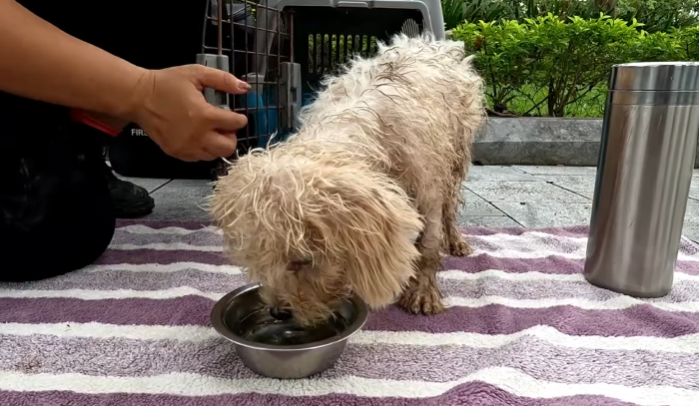
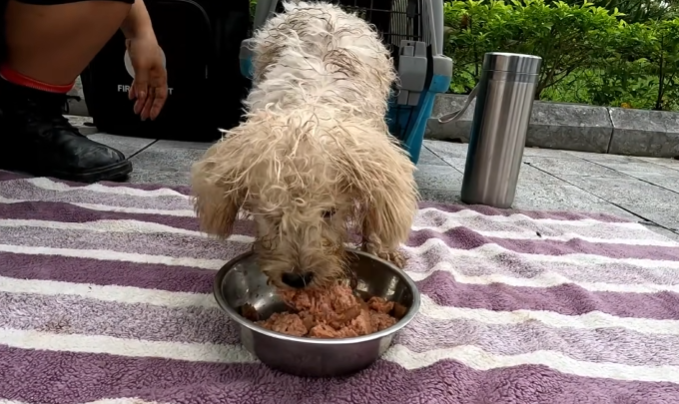
I filled a bowl with puppy food and set it down. He stared at it like it was a miracle. Then he looked up at me, wagged his tail, and dove in like he hadn’t eaten in days—which, heartbreakingly, was probably true.
After he finished, he ran in a small, clumsy circle, tripped over his own paws, and fell onto his side. Then he rolled onto his back, belly exposed, legs in the air.
I laughed again. “I guess that’s a thank you.”
That night, he refused to sleep anywhere except right next to me. I made him a soft bed on the floor, but he cried softly until I lay down beside him. The moment I did, he crawled onto my chest, curled into a warm little ball, and fell asleep instantly. His breathing was slow and steady, his tiny heart beating against mine.
Under that overpass, he had been silent and scared.
Now, he snored.
In the days that followed, his personality bloomed. He chased his own tail. He barked at his reflection. He greeted every morning like it was the best day of his life. Every time I picked up my keys, he lost his mind with excitement. Every time I came back—even if I’d only been gone five minutes—he acted like I’d returned from a long journey.
When I signed the adoption papers, the shelter volunteer smiled. “Looks like he already chose you.”
The puppy wagged his tail so hard he nearly fell over.
I named him Milo.
Sometimes, when we drive past that overpass, I glance at the spot where I found him. It looks the same—gray, loud, forgettable. But for me, it will always be the place where two lost souls crossed paths.
Milo presses his nose against the window, tail wagging, completely unaware of how close he came to a very different ending.
I reach over and scratch his ear. He looks up at me with those same big eyes—no longer scared, just full of trust and excitement.
And every time he does, I’m reminded of something simple and powerful:
Sometimes, love finds you when you least expect it—shivering under an overpass, wagging its tail, ready to go home.