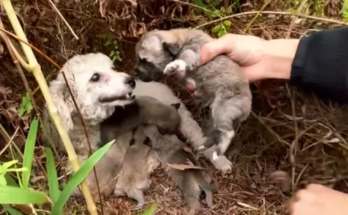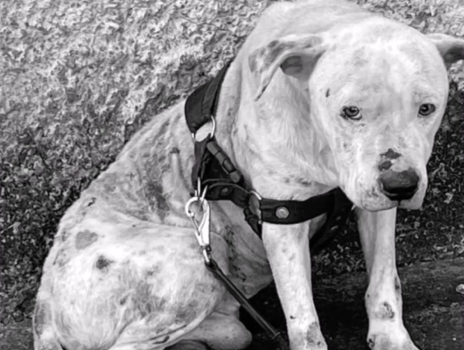
He sat in the same spot every day, pressed against the wall of an old bus station where people hurried past without slowing down. His body was there, but his spirit seemed far away. Dust clung to his fur, and his eyes—once bright, once hopeful—now stared into nothing. To the world, he was just another stray dog blending into the background of a busy place. To himself, he was simply tired of waiting.
No one noticed his despair.
The mornings were the hardest. Hunger gnawed at his stomach, and the cold ground stiffened his joints. When the sun rose, it brought light but not warmth, noise but not comfort. Shoes rushed by. Voices laughed. Children pulled at their parents’ hands. Sometimes someone tossed food in his direction without looking at him, as if feeding an object rather than a living soul. He ate slowly, carefully, always afraid the food would be taken away again.
He did not beg.
He had learned that begging changed nothing.
Once, long ago, he had a home. He remembered fragments: the sound of a gate opening, the smell of cooked rice, a hand resting on his head as he fell asleep. That life had slipped away quietly, without explanation. One day, the gate closed behind him and never opened again. Since then, he had wandered, hoping each new place might become home.
Hope, however, is fragile when it goes unanswered.
Days turned into weeks. Weeks into months. His body grew thinner. His heart grew quieter. He stopped barking, stopped wagging his tail, stopped reacting to the world. Even when rain soaked him to the bone, he did not move. Even when dogs fought nearby, he did not flinch. It was as if he had decided that disappearing inside himself hurt less than reaching out.
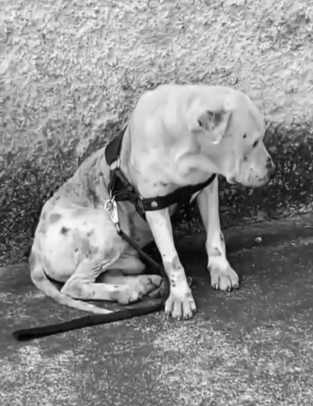
People noticed him—but only in passing.
“Poor dog,” some said, without stopping.
“Stray,” others muttered, stepping around him.
No one saw the way his eyes followed every kind face just a second too long. No one noticed how his ears lifted at gentle voices, then fell again when they walked away. No one noticed that he was not lazy, not sick—just deeply, unbearably lonely.
Until one afternoon.
The sun was low, casting long shadows across the pavement. A woman named Hana was walking home after a long day at work. She usually took a different route, but that day, something made her turn toward the bus station. She didn’t know why. She only knew that she suddenly felt the need to slow down.
That was when she saw him.
At first, she almost walked past. He didn’t move. He didn’t look at her. He was so still that he seemed like part of the building itself. But something about his posture—his curved spine, his lowered head—made her stop.
She crouched down a few steps away.
“Hey there,” she said softly.
He didn’t respond.
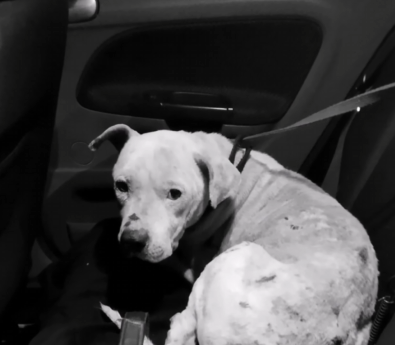
Hana waited. She didn’t reach out. She didn’t make sudden movements. She had learned that silence can be kinder than noise. After a long moment, the dog turned his head slightly. Just enough to let one eye meet hers.
And in that eye, Hana saw it.
Despair.
Not fear. Not anger. Not pain alone. But a deep, quiet sadness that came from being forgotten. From feeling like the world no longer had a place for you. Hana felt her chest tighten. She slowly extended her hand, palm open, letting it hover in the space between them.
“It’s okay,” she whispered. “I’m not going to hurt you.”
The dog watched her hand carefully. He didn’t pull away. He didn’t lean in. He simply watched, as if deciding whether hope was worth the risk.
Then, gently—almost imperceptibly—Hana’s fingers brushed his fur.
The reaction was instant.
His body trembled, not with fear, but with something he hadn’t felt in a very long time. He inhaled sharply, as if the simple touch had knocked the breath from his lungs. His head lowered further, pressing just slightly into her palm.
Hana felt tears sting her eyes.
“It’s been a long time, hasn’t it?” she murmured.
She stroked his head slowly, carefully, following the way his body responded. With each gentle movement, some invisible tension eased. His shoulders relaxed. His breathing slowed. For the first time in months, he closed his eyes.
And then he leaned fully into her hand.
That small movement broke something open inside him.
A soft sound escaped his throat—not quite a whine, not quite a sigh. His tail moved, just once, then again. He shifted closer, sitting upright now, his head resting against her knee. It was as if that gentle touch had reached straight into the emptiness inside him and whispered, You are still here. You still matter.
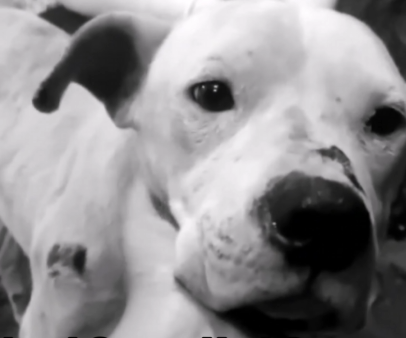
People passed by, glancing curiously at the scene. Some slowed. Some smiled. But Hana noticed none of them. Her entire world had narrowed to the dog beside her and the way his body clung to her touch like a lifeline.
She stayed with him for a long time.
She shared her water. She offered food she had in her bag. He ate slowly, stopping often to look at her, as if making sure she was real. As the sky darkened, Hana made a decision she had not planned, but somehow had always been waiting to make.
“You don’t have to stay here,” she said quietly. “If you want… you can come with me.”
She stood up slowly and took a step away, giving him space to choose.
For a moment, he hesitated.
Then he stood too.
His legs were stiff, his movements uncertain, but he followed. Not eagerly. Not fearfully. Just steadily. Trusting the gentle hand that had soothed his empty soul.
At Hana’s home, he was given a bath, a soft place to sleep, and silence—real silence, the kind that feels safe. That night, he curled up on a blanket near her bed. He didn’t sleep deeply at first. He kept waking, checking that she was still there. Each time, Hana reached down and rested her hand on his back.
Each time, he relaxed a little more.
Days passed. Then weeks.
The dog, now named Sora, began to change. His eyes grew brighter. His appetite returned. He started greeting Hana at the door, his tail wagging gently, then wildly. He learned the sounds of the house, the rhythm of their days, the joy of walks where no one chased him away.
But the biggest change was inside.
Sora began to seek affection—not desperately, not fearfully, but with quiet confidence. He rested his head on Hana’s lap while she read. He slept deeply, dreaming for the first time in a long while. Sometimes, when Hana stroked his fur, he would sigh—a deep, contented sound, as if releasing all the sorrow he had carried for so long.
One evening, as the sun set and painted the room in gold, Hana watched Sora sleeping peacefully at her feet. She thought of how close he had been to disappearing—not physically, but emotionally. How easy it would have been for the world to miss him completely.
All it had taken was a gentle hand.
Not every rescue is loud. Not every miracle comes with dramatic moments or grand gestures. Sometimes, the most powerful change begins quietly—with noticing. With stopping. With touching a soul that has almost forgotten how to feel.
No one noticed his despair.
Until one person did.
And because of that, an empty soul was filled again—not with promises, not with words, but with love that asked nothing in return.
Sometimes, that is enough to save a life.