The park was already awake when the sun began to rise, stretching pale light across the cracked sidewalk and dew-damp grass. Joggers passed with headphones in, parents pushed strollers, and birds hopped along the path searching for crumbs left behind from yesterday. Life moved forward in its usual rhythm—steady, busy, indifferent. And there, at the edge of the sidewalk near a weathered bench, lay a puppy so still that he seemed like part of the pavement itself.
He was small, far too small to be alone.
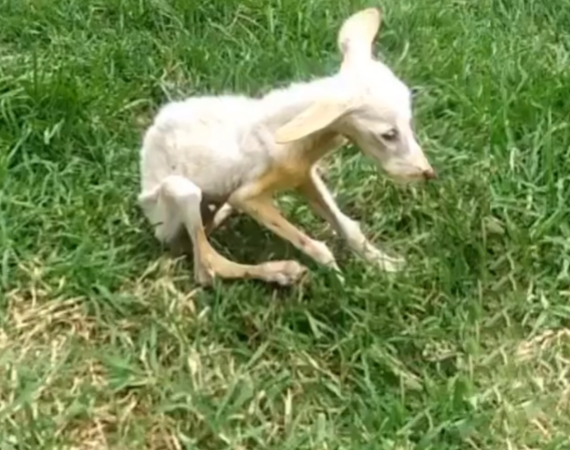
The puppy rested his head on the cold concrete, chin flat against the ground, eyes half-closed. His body curled inward, as if trying to take up less space in a world that had already decided there was no room for him. His fur, once soft, was clumped and dull, dusted with dirt and leaves. Each breath came slowly, shallow and uneven, as though breathing itself had become exhausting.
People passed him at first without stopping.
Some assumed he belonged to someone nearby. Others thought he was sleeping. A few noticed how thin he was, how his sides barely rose with each breath, but they kept walking anyway. The morning had places to be, schedules to keep. And the puppy—silent, motionless—made no sound to demand attention.
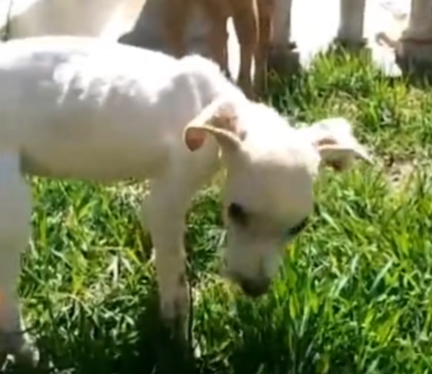
If he had a name once, it had been lost somewhere along the way. Lost with the warm bed he no longer remembered. Lost with the bowl that used to appear twice a day. Lost with the hands that might once have lifted him and promised protection. What remained was a body too tired to ask for help and a heart that had learned to endure pain quietly.
The puppy hadn’t always been on that sidewalk. At some point, he had walked there—or been carried, or dragged. No one knew how long he had been sick. His eyes told a story of long nights and hunger, of weakness that crept in slowly and then all at once. His legs trembled when he tried to stand, so eventually he stopped trying. Lying down was easier. Giving up felt natural.
The sidewalk was cold, but it didn’t matter anymore. Hunger and sickness had dulled his senses. The world felt distant, as if he were already fading from it.
Then, someone noticed.
A young woman slowed her pace as she approached the bench. Something about the puppy didn’t feel right. It wasn’t just that he was alone—it was the stillness. Dogs, even sleeping ones, usually react to footsteps or voices. This puppy didn’t lift his head. He didn’t twitch an ear. He simply lay there, breathing softly, eyes barely open.
She knelt beside him.
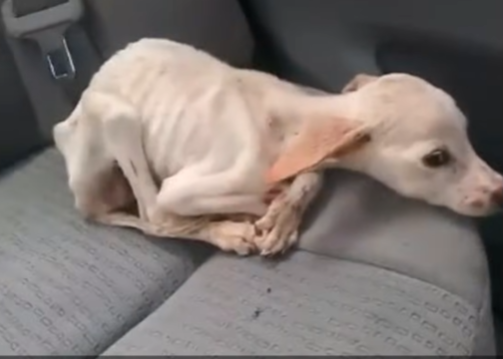
Up close, the reality was impossible to ignore. His ribs pressed sharply against his skin. His belly was tucked tight, empty. His nose was dry, his eyes clouded with exhaustion. When she gently spoke to him, he didn’t pull away. He didn’t wag his tail. He only shifted his eyes slightly, acknowledging her presence in the weakest way he could.
That small movement broke her heart.
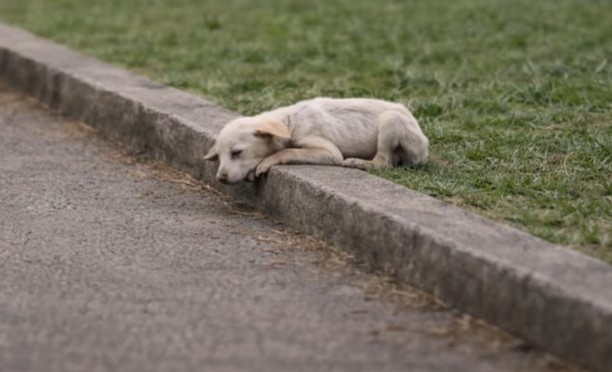
She reached out slowly, afraid she might scare him. Her fingers brushed his fur, light as a whisper. The puppy flinched—not from fear, but from the effort it took to react. Then he did something unexpected. He leaned into her hand, just barely, as if that tiny touch was more comfort than he’d felt in a long time.
For the first time that morning, the puppy was no longer invisible.
The woman checked around. No collar. No leash. No owner in sight. She pulled out her phone and made calls, her voice shaking as she described what she saw. A sick puppy. Not moving. Barely responsive. She stayed beside him, shielding him from curious passersby, using her jacket to block the cool morning breeze.
Time seemed to stretch. The puppy rested his head back on the sidewalk, eyes fluttering. He was so tired. Every part of his body ached. But the warmth of a human hand nearby gave him something new to focus on. Something gentle. Something safe.
When the rescuers arrived, they moved quickly but carefully. Even they, experienced as they were, paused when they saw how frail he was. This wasn’t a puppy who had missed a meal or two. This was a puppy whose body had been fighting alone for far too long.
They lifted him slowly, supporting his head and legs. He didn’t resist. He didn’t cry. He simply allowed himself to be carried, as if he understood that this might be his only chance.
Wrapped in blankets, the puppy was placed in the back of the rescue vehicle. The woman climbed in beside him, holding his tiny paw as they drove. The city blurred past the windows, but inside the vehicle, everything was quiet. The puppy’s breathing was still shallow, but steady. He was holding on.
At the veterinary clinic, the truth became clearer with every test. Severe dehydration. Malnutrition. Infection. His immune system was weak, his body overwhelmed. The vet spoke gently but honestly. The puppy was very sick. Survival was not guaranteed.
Still, no one gave up.
Warm fluids were administered slowly. Medication was given with care. He was placed on soft bedding under gentle heat. His tiny body, so used to discomfort, finally rested on something that didn’t hurt.
Hours passed. Staff checked on him constantly. The woman stayed as long as she could, whispering encouragement even though the puppy’s eyes remained mostly closed. “You’re safe now,” she said softly. “You don’t have to be strong anymore.”
As night fell, something subtle changed.
The puppy lifted his head—just a little. His eyes opened wider than before. He looked around the room, confused by the lights, the smells, the unfamiliar sounds. But he wasn’t afraid. He wasn’t alone on a sidewalk anymore. He was surrounded by warmth and quiet voices and gentle hands.
That small movement felt like a miracle.
Over the next days, progress came slowly. Tiny sips of food. Moments of alertness followed by long stretches of sleep. Some days were better than others. His body had endured so much that healing was not a straight path. But each morning he woke up was a victory.
They gave him a name—a soft, hopeful name meant to remind everyone that he was more than his suffering. With a name came identity. With identity came care. And with care came the possibility of a future.
The puppy began to recognize voices. His tail twitched when someone approached. One afternoon, he managed to stand for a few seconds before sitting back down, exhausted but proud. Everyone in the room smiled, some with tears in their eyes. Such a small act, yet so powerful.
Looking at him then, it was hard to imagine how close he had come to disappearing unnoticed on that park sidewalk.
His story spread. People asked how a puppy could end up so sick and alone in a public place. Some were angry. Some were heartbroken. But many were moved—to pay closer attention, to stop when something didn’t feel right, to understand that suffering doesn’t always cry out loudly.
Sometimes, it lies quietly with its head on cold concrete, too tired to move.
That puppy survived not because the world was kind, but because one person chose to care. One person chose to kneel down, to look closely, to refuse to walk away.
Today, when he rests his head, it is on a soft blanket instead of a sidewalk. When he closes his eyes, it is not from exhaustion alone, but from comfort. His body is still healing, his future still uncertain—but his life matters now.
And it mattered the moment someone stopped and saw him.