Charlie had once been a dog with a name spoken gently. At least, that’s what the neighbors believed. They imagined a time when someone knelt to his level, scratched behind his ears, and promised to take care of him. But by the time anyone truly noticed Charlie, the promise had long since rotted away, leaving only a body so thin it looked like it was made of shadows and bone.
He lived at the edge of town, behind a rusted gate and a fence patched with scraps of wire. The yard was bare earth, baked hard by the sun, scattered with trash and broken plastic bowls that once might have held food or water. Charlie lay there most days, barely moving. From a distance, some thought he was already dead. Up close, they realized something far worse: he was alive, and suffering in complete silence.
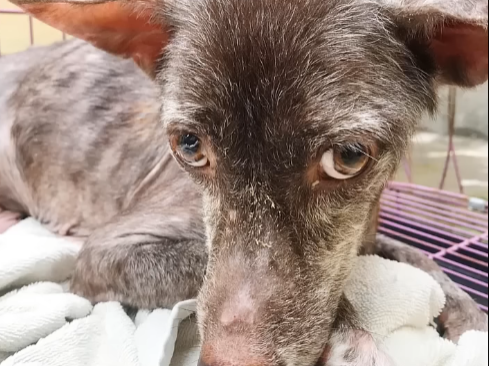
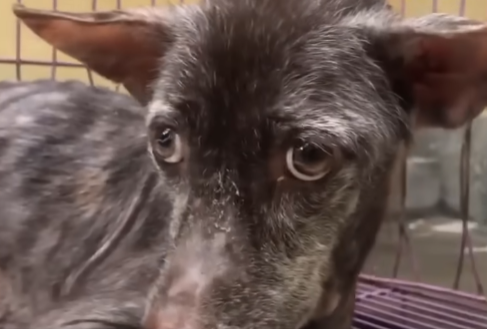
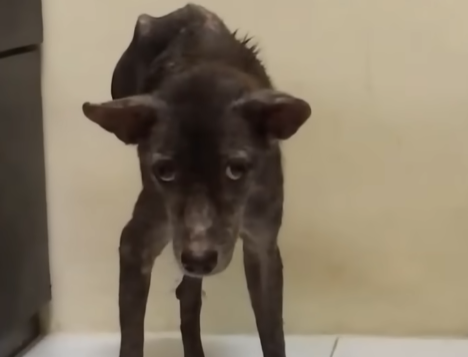
His ribs jutted out like the bars of a cage. His hips were sharp, his spine a cruel line under dull, matted fur. Every breath looked like work. Hunger had hollowed his eyes until they seemed too large for his face, eyes that no longer begged, no longer barked, no longer believed help would come. Charlie had learned that making noise changed nothing.
The owner—if that word can even be used—passed by him daily. Sometimes stepping over him. Sometimes glancing down with irritation, as if Charlie’s weakness were a personal inconvenience. Food was rare. Water was rarer. Veterinary care never came. To that owner, Charlie was not a living being with fear and pain; he was a problem to ignore.
Days blurred into weeks. Weeks into months. Charlie’s world shrank to a few square meters of dirt and the constant ache inside his body. Hunger gnawed not just at his stomach, but at his spirit. When you starve long enough, even hope burns away. All that remains is endurance.
No one knows exactly how long Charlie suffered like this. What is known is that people saw him. They walked past the fence. They looked away. Some told themselves it wasn’t their business. Others assumed someone else would step in. Silence became a shared decision, and Charlie paid the price for it with every painful breath.
Then came the night when everything changed.
It was late, and the air was heavy with humidity. A woman walking home took a shortcut past the yard. She had passed it many times before, but that night something stopped her. Maybe it was the way Charlie didn’t lift his head. Maybe it was the unnatural stillness of a body that should have moved when footsteps approached. She shone her phone’s light through the fence—and gasped.
What she saw didn’t look like a dog who was “a bit thin.” It looked like death waiting patiently.
Charlie didn’t react to the light. He didn’t flinch or whine. His eyes opened slightly, clouded with exhaustion. That small movement was enough. The woman knew, instantly, that this was wrong—terribly, urgently wrong.
She made calls. Then more calls. Animal welfare. Rescue groups. Friends of friends. She refused to leave. She stood by the fence as if her presence alone might somehow protect him. For the first time in a very long while, Charlie was not alone.
When rescuers arrived, even they struggled to hide their shock. They had seen neglect before. They had seen cruelty. But Charlie’s condition told a long story of suffering stretched thin over time. This was not an accident. This was not poverty. This was abandonment in plain sight.
As they approached, Charlie tried to lift his head. His muscles trembled. His body barely obeyed him anymore, but something flickered in his eyes—confusion, maybe, or the faintest spark of curiosity. Hands reached for him gently, carefully, as if he might shatter. When they lifted him, he weighed almost nothing.
In that moment, Charlie did not resist. He did not struggle. He simply let go.
The ride to the clinic felt like a race against time. Wrapped in blankets, Charlie lay quietly, his chest rising and falling in shallow motions. The rescuer held him close, whispering words he might not understand but could feel: “You’re safe now. You matter. We’ve got you.”
At the veterinary clinic, the reality became even harsher. Severe malnutrition. Dehydration. Muscle wasting. Parasites. Pressure sores from lying on hard ground for too long. His body was shutting down. The vet spoke carefully, honestly. Charlie was alive, but he was fragile in ways that couldn’t be fixed overnight. Maybe not at all.
Still, they tried.
Warm fluids flowed into his veins. Tiny amounts of food were introduced slowly, because feeding too much, too fast could kill him. His body had forgotten what normal felt like. Every system had adapted to starvation, and reversing that damage required patience, precision, and hope.
Throughout it all, Charlie remained quiet. But something had changed. When someone spoke to him, his eyes followed. When a hand rested on his chest, his breathing eased slightly. For the first time, human touch did not mean neglect or pain. It meant care.
The night stretched on. Monitors beeped softly. Staff checked on him again and again. No one wanted to be the one to leave him alone, even for a moment. Charlie had spent too much of his life unseen. That would not happen again.
As dawn approached, Charlie opened his eyes fully. He looked around, slowly, taking in the unfamiliar smells and sounds. He was still weak. Still terribly thin. Still hovering between life and death. But he was here. And now, his life finally mattered to someone.

Whether Charlie survived days, weeks, or years after that night is not the most important part of his story. What matters is this: he was seen. He was rescued. His suffering was acknowledged. He was no longer invisible.
Charlie’s skeletal body became a symbol—not just of cruelty, but of the consequences of silence. Of how easy it is to look away, and how devastating that choice can be. His story forces uncomfortable questions. How many others are suffering behind fences, behind closed doors, in plain sight? How often do we tell ourselves it’s “not our problem”?
Charlie didn’t need a hero with superhuman strength. He needed one person to stop and care. One person to break the silence.
That night, someone did.
And because of that, Charlie’s life—no matter how broken, no matter how brief—finally mattered.