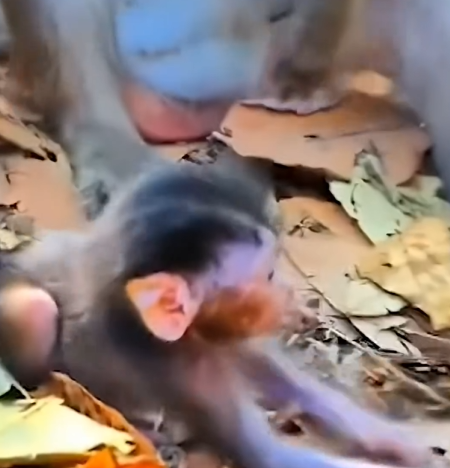
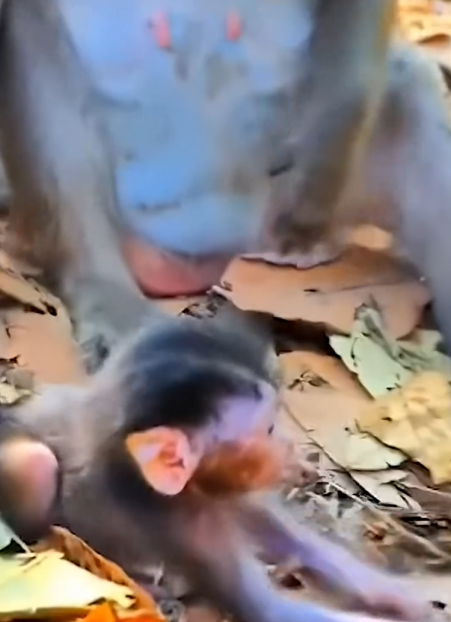
In the dense, green canopies of the forest, life for monkeys is rarely gentle. Every day is a struggle for survival, not only against the elements and predators but also within the complex social hierarchies of their own troops. Among these hierarchies, dominance and submission dictate who eats first, who gets the best resting spots, and who will receive protection or aggression from others. For a young monkey just learning the ways of the world, a single mistake can have devastating consequences.
This is the story of a little monkey who learned this lesson the hard way.
The little monkey, whom the older monkeys had nicknamed Chiku because of his small, quick movements and lively eyes, was only a few months old. He had lost his mother to illness when he was very young and had been struggling to find his place in the troop ever since. Young monkeys rely heavily on their mothers for safety, nourishment, and guidance. Without her, Chiku was vulnerable, lost, and desperate for care.
One afternoon, as the troop moved through a familiar stretch of forest, Chiku spotted a female monkey sitting under a large banyan tree. Her fur pattern and gentle eyes reminded him so strongly of his late mother that his heart leapt. Hungry for comfort and connection, he ran toward her with tiny, excited leaps, calling out softly in the high-pitched, pleading sounds only young monkeys make.
The female monkey, older and firmly established in the troop hierarchy, was startled. She had her own baby with her, and she was not used to strangers approaching her closely. In the wild, unfamiliar approaches can be perceived as threats, and mothers protect their young with extraordinary ferocity. When Chiku approached, she squealed and bared her teeth—warning signals that he, in his confusion and grief, did not understand.
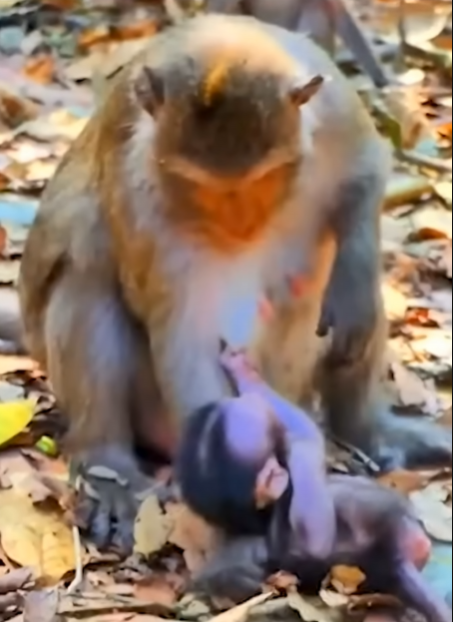
Chiku mistook her alarm for play. He pressed closer, reaching out to touch her and nestle against her, hoping for warmth and care. His tiny hands brushed against her fur, and in that moment, a misunderstanding escalated. The female, interpreting Chiku’s approach as aggression toward her own baby, lashed out. She grabbed him and struck him repeatedly with her forearms. Chiku shrieked, but he did not run immediately. His brain still tried to reconcile the idea that this could be his mother punishing him when he only sought comfort.
The beating was brutal and swift. Chiku’s small body was no match for the adult female. Around them, other troop members watched the scene unfold. In monkey societies, interventions vary. Sometimes, elders or dominant males step in to break up a conflict; other times, the aggressor is allowed to assert authority to reinforce social order. On that day, most of the troop stayed on the periphery, observing. Only Chiku’s older sibling, a slightly bigger juvenile, screeched and tried to approach, but the female chased him back as well.
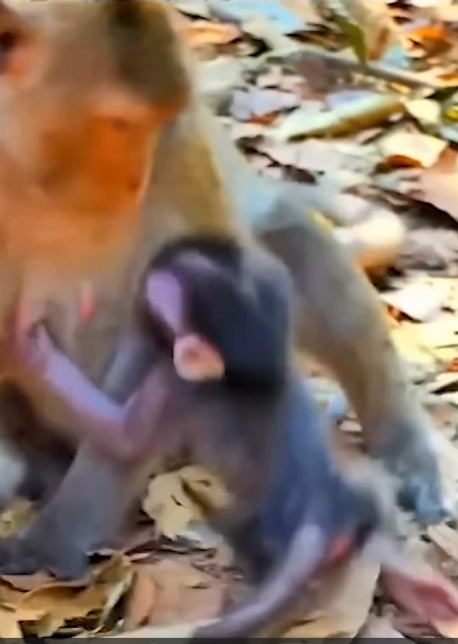
After the attack, Chiku was left trembling on the ground, his tiny frame bruised and battered. He whimpered softly, unsure whether to flee or search for protection. His eyes still held the hope of finding maternal care, even though the reality was painfully different.
It was in these moments that Chiku’s survival instincts began to sharpen. In the wild, young monkeys who endure social aggression either learn to retreat quickly or find alternative strategies to remain part of the troop. Chiku, despite his fear, clung to the nearby branches and watched carefully. He learned who posed a threat, who tolerated him, and which areas of the forest offered shelter from the stronger monkeys. Every scar and bruise became a lesson.
Over the next few days, Chiku’s behavior changed. He no longer approached female monkeys indiscriminately. Instead, he observed from a distance, waiting for signs of tolerance or warmth. He sought protection from juvenile males who were more playful and less aggressive than adult females. He learned to hide when dominant monkeys passed through the territory. Every movement was calculated, cautious, a stark contrast to the open-hearted curiosity he had shown before.
But the story doesn’t end in despair. Monkey societies, while harsh, are also resilient and adaptive. Over time, the female who had beaten Chiku softened. She realized that he posed no real threat and that his approach had been born of loss rather than aggression. She allowed him to sit near her at a safe distance and eventually accepted his presence as part of her periphery. Chiku, in turn, learned to respect her space while still receiving glimpses of the warmth he had desperately sought.
Chiku’s experience reflects the harsh realities of monkey life. Young monkeys often face brutal lessons as they navigate social structures. Mistakes are punished quickly, sometimes violently, and survival depends on learning these lessons and adapting behavior accordingly. Yet, within these challenges lies an incredible capacity for growth and resilience.
Monkeys, like Chiku, teach us about the delicate balance between vulnerability and strength. Chiku’s bruised body and cautious demeanor were not signs of weakness—they were the marks of experience, indicators that he was learning how to live in a complex, unpredictable world. By enduring aggression, understanding social cues, and adjusting his behavior, Chiku increased his chances of surviving into adulthood.
The incident also demonstrates the importance of empathy in social animals. The female monkey’s initial aggression was a protective response, driven by instinct and fear. Over time, her capacity for tolerance grew, showing that even in hierarchical societies, care and acceptance can emerge once trust is established. For Chiku, this shift was life-changing. From being brutally beaten to finding a cautious acceptance within the troop, he learned that relationships in the wild are negotiated and constantly evolving.
In the weeks following the incident, Chiku began exploring more confidently, approaching other juveniles for play and interaction. He learned the subtle language of gestures, facial expressions, and vocalizations that regulate monkey societies. Each interaction became a lesson in social navigation. His early trauma did not define him; it informed him.
Chiku’s story also highlights the role of observation in monkey life. Young monkeys watch adults closely, learning survival strategies that will serve them for years. By witnessing the consequences of mistakes, they internalize social rules without needing to endure every confrontation themselves. Chiku, having been directly affected, accelerated this learning process. His experience, though painful, gave him insights into boundaries, risk, and trust.
As the forest canopy shifted with the seasons, Chiku grew stronger. His muscles developed for leaping and climbing, his reflexes sharpened for evading danger, and his mind became attuned to subtle cues in the troop. He became adept at finding food without conflict, negotiating play without provoking aggression, and seeking comfort without overstepping boundaries.
Eventually, Chiku found a small patch of the forest where he could rest safely, play with peers, and receive care indirectly from adult monkeys. He continued to respect the older female who had beaten him, understanding that her authority was part of the social structure. At the same time, he learned to assert himself subtly in interactions with younger monkeys and peers, finding a balance between caution and confidence.
In the end, Chiku’s story is both tragic and inspiring. It illustrates the harsh realities of life in monkey societies, where mistakes are punished and lessons learned the hard way. Yet it also demonstrates resilience, adaptation, and the capacity for social healing. Even a young monkey who suffers violence can find ways to thrive if given time, observation, and the eventual acceptance of others.
For observers, Chiku’s life is a reminder of the complexity of animal behavior. Monkeys are not merely playful creatures; they navigate intricate hierarchies, emotional bonds, and survival challenges every day. Their world is a mirror of both vulnerability and strength, aggression and care. And like Chiku, every individual’s journey is shaped by experience, teaching us that growth often comes through endurance, observation, and learning from mistakes.
Chiku may have been brutally beaten, but he also survived, adapted, and learned. His story reminds us that even in the wild, where life is raw and unforgiving, there is room for resilience, understanding, and eventual acceptance. In his small, bruised body lived the spirit of determination, and in his cautious gaze, the intelligence of someone learning to navigate a complex world.
And so, in the forest canopy where Chiku swings, jumps, and observes, life continues. The challenges remain, but so does the hope, the growth, and the remarkable ability of a small monkey to survive and thrive despite the odds.