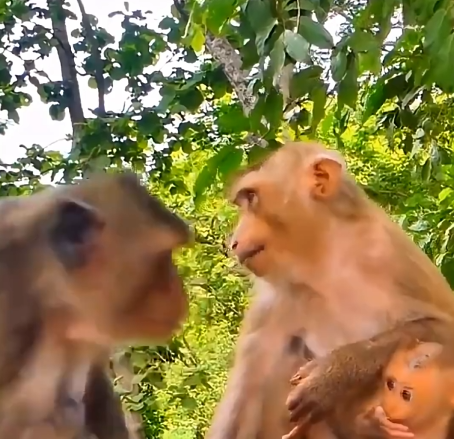
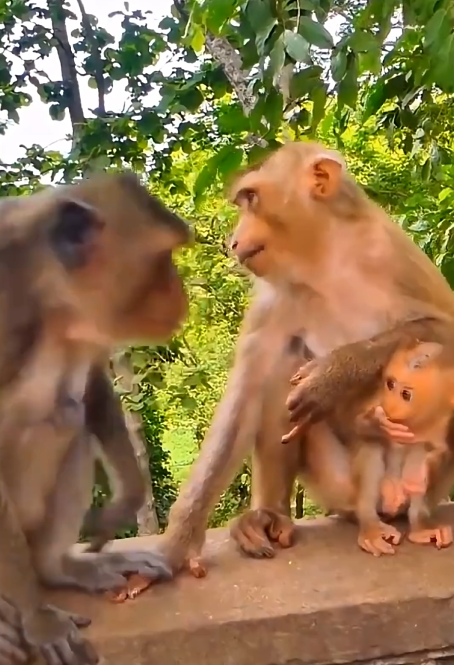
In the heart of the dense forest, where sunlight filters through the canopy in dappled golden patches, life thrives in intricate patterns. Among the oldest and most fascinating residents of this ecosystem are monkeys, creatures of intelligence, emotion, and complex social structure. Within these troops, family bonds are paramount, and none is more vital than the relationship between a mother and her baby. Observing these interactions offers profound insights into the behaviors, instincts, and protective nature of these remarkable animals. In particular, one striking behavior stands out: the wary vigilance of a mother monkey when larger monkeys approach her young.
From the moment a baby monkey is born, it is entirely dependent on its mother. This dependence is not merely physical but emotional and social. The mother provides nourishment, warmth, protection, and guidance, ensuring the infant can navigate the often-dangerous world around it. Within the troop, size, strength, and rank play crucial roles. Adult monkeys, especially larger males or dominant individuals, hold power over food, territory, and social interactions. While many of these interactions are neutral or even cooperative, a mother must constantly evaluate potential threats to her baby’s safety.
The forest is alive with subtle signals. Birds call in alarm, leaves rustle underfoot, and monkeys communicate with a variety of gestures, postures, and vocalizations. For the mother monkey, each movement of a larger troop member is scrutinized. Her eyes follow every step, ears perked, body tense. She positions herself strategically between the baby and any approaching larger monkeys. Her protective instincts are not limited to simple blocking; they include intricate social signaling. She may bare her teeth, emit low warning calls, or engage in subtle body movements designed to deter potential threats without initiating outright conflict.
These instincts are deeply rooted in evolutionary survival strategies. In many monkey species, larger males possess strength and dominance, which can pose risks to infants. Infanticide, though rare, occurs in some groups as a strategy to accelerate female fertility or assert dominance. Mothers are acutely aware of such risks. Their vigilance is constant, sometimes even when no immediate danger seems apparent. This wary behavior is both instinctual and learned; younger mothers often mirror the actions of experienced mothers, understanding the need for constant awareness around dominant troop members.
The behavior of the mother monkey is nuanced and adaptive. In some species, like rhesus macaques, mothers will hold their infants close, using their own bodies as shields while observing the approach of larger monkeys. They may rock back and forth, emitting soft vocalizations that signal attention and readiness to protect. The subtlety of these movements conveys both caution and confidence—warning larger monkeys to maintain distance while signaling to the baby that it is safe under maternal care.
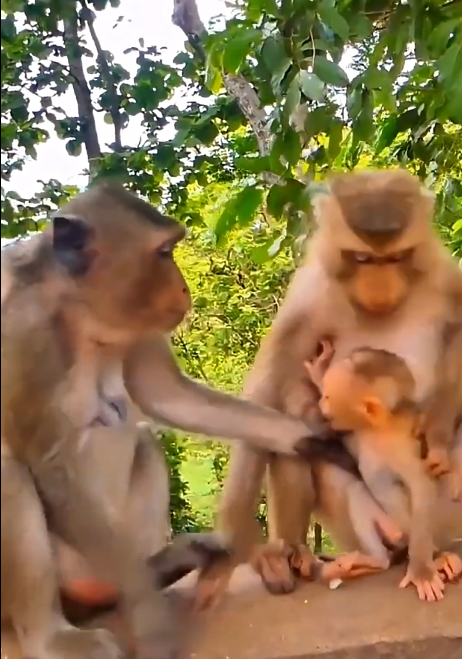
Interestingly, the response varies depending on the identity of the approaching monkey. Familiar adult females or non-threatening juvenile monkeys may be allowed closer access, sometimes even permitted to play with the baby under strict supervision. However, the mother’s posture changes noticeably when larger males or higher-ranking individuals approach. She stiffens, shifts her gaze directly onto the potential threat, and positions herself between the infant and the approaching figure. This combination of body language and vocalization communicates both warning and readiness.
Observation of these interactions reveals layers of social complexity. The baby monkey is not merely passive during these encounters. Even at a young age, it begins to recognize cues from its mother. The infant watches the mother’s posture, the angle of her eyes, and the tone of her calls, learning who in the troop poses risk and who can be trusted. In this way, the mother is not only providing immediate protection but also teaching the baby about social hierarchies, alliances, and caution.
Sometimes, the larger monkeys themselves respond to the mother’s signals. Dominant males or older individuals may halt their approach, respect the warning cues, or redirect their attention elsewhere. This dynamic highlights an important aspect of primate society: communication and respect for social signals often prevent physical conflict. A mother’s wary behavior, combined with her clear communication, frequently diffuses potentially dangerous situations before they escalate.
The physical environment also influences maternal vigilance. Dense foliage, uneven terrain, or open clearings present different levels of risk. In areas where cover is limited, the mother may hold her infant closer, using her body as a moving shield while scanning the surroundings with heightened alertness. In contrast, when surrounded by dense undergrowth, the mother can afford slightly more relaxed movements, knowing that concealment adds a layer of protection. Her adaptability reflects both experience and instinct.
Mother monkeys also employ subtle social strategies beyond immediate protection. In some species, mothers form temporary alliances with other adult females to safeguard infants from particularly aggressive troop members. These alliances may involve cooperative care, synchronized movements, or shared vigilance, demonstrating the social intelligence and community orientation of these primates. Such cooperation illustrates that maternal caution is not only an individual behavior but also part of a broader network of social strategies designed to enhance infant survival.
Observing these dynamics is particularly fascinating when the mother’s caution intersects with playful interactions. Even in moments of joy—when the baby monkey reaches for leaves, swings from branches, or attempts small exploratory movements—the mother remains partially vigilant. Her eyes flicker between watching the baby and scanning the surroundings for potential threats. This dual focus underscores the complexity of maternal behavior: she balances the child’s freedom and development with constant risk assessment.
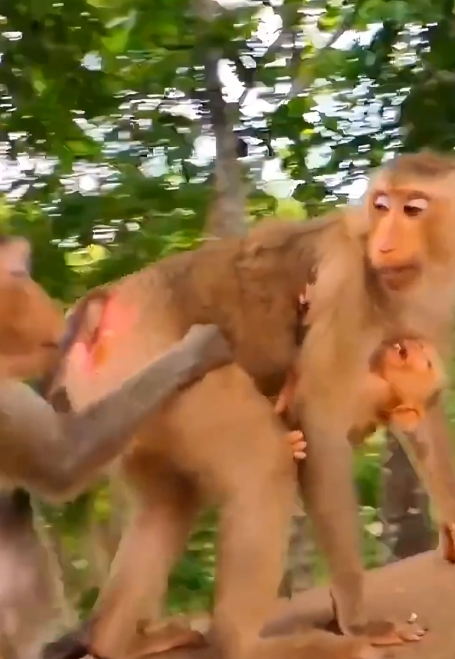
The impact of maternal caution extends beyond immediate survival. Babies who are consistently protected and guided by vigilant mothers often exhibit higher confidence, better social skills, and improved ability to navigate complex hierarchies as they grow. By observing their mothers’ interactions, they learn to interpret subtle signals, understand social boundaries, and respond appropriately to potential dangers. This early education in vigilance, risk assessment, and social negotiation becomes a critical survival skill within the troop.
Interestingly, studies of primate behavior suggest that maternal caution can even influence group dynamics over time. When mothers collectively monitor dominant males or aggressive individuals, the group may exhibit increased cohesion and reduced infant vulnerability. The careful, protective behavior of mothers sends a subtle social message to larger monkeys: infants are not to be approached carelessly. Over time, this contributes to a more stable troop hierarchy, where respect for maternal authority becomes a key aspect of social structure.
From a scientific perspective, the mother monkey’s wariness demonstrates the intersection of instinct, learning, and social intelligence. Instinct provides the immediate response to potential danger; learning allows the mother to interpret the behaviors of specific individuals; social intelligence enables her to communicate effectively, negotiate, and influence the actions of others. Together, these elements create a protective shield around the baby, ensuring that the infant’s early life is as safe as possible within a world full of potential risks.
Observation of this behavior also has broader implications for understanding primate cognition. The ability to anticipate threats, adjust responses based on social context, and communicate subtle warnings reflects advanced mental processing. Mothers are not merely reacting reflexively; they are analyzing the environment, predicting possible outcomes, and selecting behaviors that maximize safety. This strategic thinking demonstrates remarkable cognitive sophistication and highlights the evolutionary advantages of maternal care and vigilance.
One particularly illustrative scenario involves a mother rhesus macaque, sitting calmly with her baby in a sun-dappled clearing. A large male, curious and somewhat dominant, begins to approach. The mother immediately rises slightly, positioning herself between the baby and the male. Her eyes lock on his movements, while subtle low vocalizations signal alertness. The baby, sensing the shift, clings tightly to her chest. The male hesitates, reassessing the situation, before choosing to move around rather than confront. The mother allows the baby to explore briefly once the perceived risk has passed, returning to a relaxed posture while maintaining a watchful eye. This scene, repeated countless times across monkey species, epitomizes the combination of instinctive caution, learned experience, and social intelligence.
In addition to direct protective behaviors, mothers may employ diversionary tactics. Some species engage in playful gestures, enticing the larger monkey’s attention away from the infant. Others may move subtly, using body positioning, eye contact, and movement patterns to guide potential threats along a different path. These tactics reveal an extraordinary blend of creativity, foresight, and social awareness.
The bond between mother and baby is strengthened through these moments. The baby learns trust and safety, understanding that the mother’s vigilance is not a constraint but a source of security. This emotional attachment, reinforced through careful protection, forms the foundation for lifelong social competence, emotional resilience, and survival skills.
The interplay of maternal wariness and troop dynamics continues as the baby grows. Over time, the infant learns not only to interpret its mother’s signals but also to read the intentions of larger monkeys independently. The mother gradually grants more autonomy while maintaining protective oversight, fostering the development of independent decision-making and social intelligence.
In conclusion, the mother monkey’s wariness of larger monkeys approaching her baby is a complex, multi-layered behavior rooted in instinct, learning, and social cognition. It reflects a delicate balance between protection, teaching, and social negotiation, ensuring the infant’s safety while preparing it for life within a hierarchical troop. Through vigilant observation, strategic positioning, and nuanced communication, mothers provide both immediate security and long-term lessons in social awareness.
This behavior underscores the remarkable intelligence, emotional depth, and adaptability of monkey species. It highlights the critical role of maternal care in survival and social development and offers a profound window into the intricate lives of these extraordinary animals. Watching a mother monkey protect her infant is not merely a display of instinct—it is a lesson in care, strategy, and the enduring power of familial bonds.
The forest continues to thrive, filled with sunlight, laughter, and movement. Within it, the mother and her baby navigate a complex world, teaching and learning in equal measure. Each cautious glance, careful positioning, and protective gesture tells the story of love, vigilance, and the timeless bond between mother and child—an extraordinary dance of survival, intelligence, and trust that has captivated observers for generations.