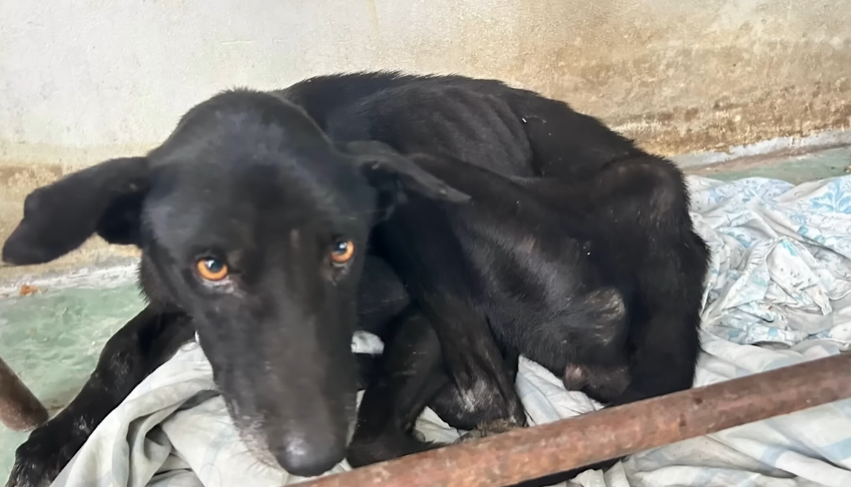
He was almost invisible at first glance, blending into the gray dust of the roadside like a shadow that had forgotten how to move. Cars passed, bicycles swerved around him, and people hurried by without slowing their steps. To the world, he was nothing more than another street dog. But when we stopped and really looked, it was impossible not to feel the weight of what stood before us. He was skin and bones—so thin that every rib showed clearly beneath stretched, fragile skin. And yet, inside that broken body, a fight for life was just beginning.
He lay near a small food stall that had already closed for the day. The smell of old rice and soup lingered in the air, but he did not have the strength to lift his head toward it. His legs were folded beneath him, awkward and stiff, as if moving them required more energy than he could spare. His eyes, large and sunken, followed us with a mixture of fear and quiet curiosity. He did not bark. He did not growl. He simply watched, waiting for whatever would happen next.
For a long time, hunger had been his constant companion. Hunger that gnawed, then burned, then became numb. At some point, even the pain of it faded into exhaustion. His body had begun to consume itself, muscle wasting away to keep his heart beating just a little longer. Each breath was shallow, careful, as if he was afraid that breathing too deeply might be the last thing he ever did.
We crouched down a few meters away, not wanting to scare him. Street dogs learn quickly that humans can bring danger as easily as help. A sudden movement can mean stones, kicks, or shouting. But we moved slowly, speaking softly. He flinched at first, shrinking back as much as his weak body allowed. Then he stopped. Running was no longer an option. All he could do was watch.
A bowl of water was placed in front of him. He stared at it for several seconds, confused, then leaned forward shakily and began to drink. The sound of his tongue against the water was frantic at first, then slower as his body struggled to process even that small relief. When he finished, he lifted his head and looked at us again. There was no gratitude in his eyes, no trust—just the fragile awareness that something had changed.
That moment was when we knew we couldn’t leave him there.
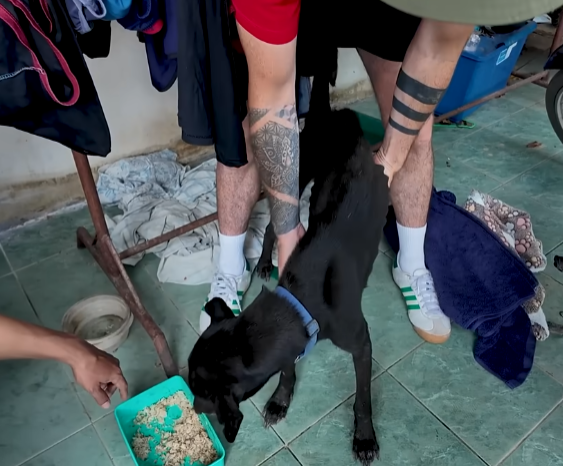
When we tried to help him stand, his legs gave way immediately. His body simply wasn’t strong enough to support itself. Lifting him was like lifting air; he weighed almost nothing. Beneath our hands, we could feel every bone—his spine, his hips, the sharp angles of his shoulders. He didn’t resist as we wrapped him in a cloth and carried him to the car. Fear had been replaced by something quieter: surrender.
At the veterinary clinic, the truth was even harsher than it looked on the street. Severe malnutrition. Dehydration. Anemia. Parasites. Old wounds that had healed poorly and new ones that had never healed at all. His body was shutting down, slowly and methodically, as if it had been preparing for this end for a long time.
“He’s been starving for weeks, maybe months,” the vet said gently. “We have to go very slowly. Too much food too fast could kill him.”
It felt cruel to hear that food—something he needed so desperately—could be dangerous. But starvation changes the body in terrifying ways. His organs were weak. His immune system barely functioning. Every step forward would have to be careful, measured, patient.
They placed him on a warm mat, started fluids, and gave medication to stabilize him. He lay still, eyes half-closed, chest rising and falling in shallow movements. We watched, afraid to hope too much, afraid that even now we might already be too late.
The first night was long.
He didn’t sleep deeply. Every so often, his body trembled, and his breathing became uneven. Alarms didn’t sound, but everyone watched closely, ready to act at the slightest change. More than once, we leaned in, checking to make sure he was still breathing.
By morning, he was still alive.
That simple fact felt like a victory.
They named him Bones, not as a reminder of what he was, but of what he had survived. Bones began to receive tiny meals—soft, carefully prepared food given in small portions throughout the day. At first, he barely reacted. Eating seemed to confuse him. Hunger had been a constant, but nourishment was unfamiliar.
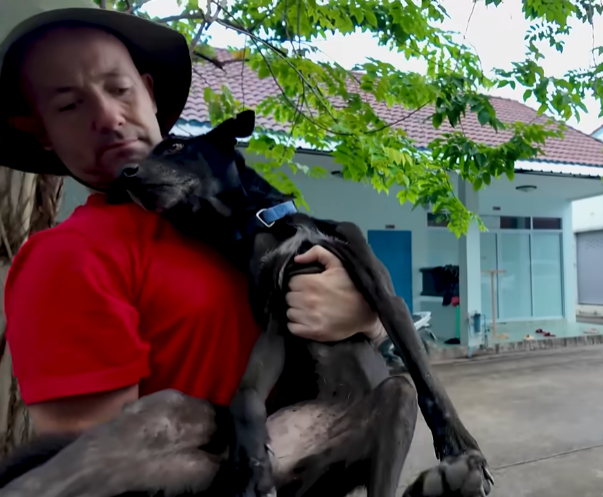
Slowly, though, something changed. He began to lick the food instead of ignoring it. Then he swallowed a few mouthfuls. His body accepted it, little by little. Each successful feeding was a step forward, though no one dared to celebrate too loudly.
Bones spent most of his time lying down, but his eyes became more alert with each passing day. He started to notice people moving around him. When someone spoke gently, his ears twitched. When a hand rested on his side, he didn’t pull away.
Pain was still part of his world. His joints ached from weakness, and his skin was sensitive, stretched thin from lack of muscle beneath it. But the constant, overwhelming misery began to ease. Warmth replaced cold. Fullness replaced the endless emptiness in his stomach.
The first time Bones tried to stand, he failed.
His legs shook violently, and he collapsed back onto the mat, breathing hard. No one rushed him. No one scolded him. He was praised anyway. Because trying mattered.
A few days later, he tried again.
This time, he stayed up for several seconds before lying back down. His tail moved slightly, as if surprised by his own success. It was a small thing, but it felt enormous.
As his body healed, his personality slowly emerged. Bones was quiet, observant, gentle. He didn’t demand attention, but he accepted it when offered. He leaned into soft touches and closed his eyes, as if memorizing the feeling of kindness. Sometimes, when he slept, his paws twitched, and his lips moved slightly, chasing dreams no one could see.
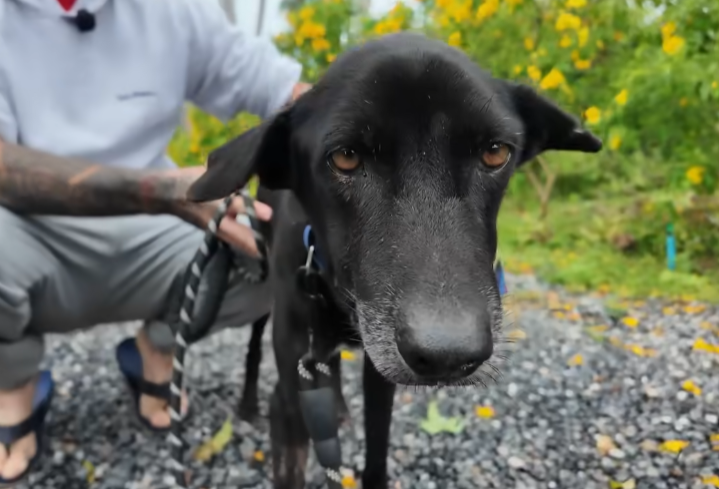
There were setbacks. His stomach struggled some days. Infections flared and had to be treated. Progress was never straight or simple. But each challenge was met with patience. Bones had waited a long time for help; now, there was time to give him what he needed.
Weeks passed, and the dog who had once been nothing but skin and bones began to change shape. Muscle returned slowly. His coat grew thicker. His eyes lost their sunken look and gained a quiet brightness. He could walk short distances without collapsing. He could lift his head proudly. He could wag his tail without fear.
One afternoon, Bones walked outside on his own for the first time.
The ground beneath his paws felt strange and wonderful. He paused, taking in the world—the sounds, the smells, the open space. He looked back at us, as if making sure this wasn’t a dream, then took another step forward. The sun warmed his back, and he stood there, breathing deeply, alive.
Bones would never forget the streets. The scars on his body and the caution in his movements would always tell that story. But they would not define his future.
His fight for life began when someone chose to stop, to see beyond the skin and bones, and to believe that even the weakest life was worth saving.
And Bones proved them right—one careful step at a time. 🐾❤️