The call came just after sunrise, when the city was only beginning to stir. A street dog had been spotted near the drainage canal, barely moving, surrounded by flies. Someone said he had been there since the night before. Someone else said he wouldn’t last much longer. The voice on the phone trembled with urgency, and before the call even ended, the decision was made. We had to go. Now.
When we arrived, the scene was worse than anyone had described.
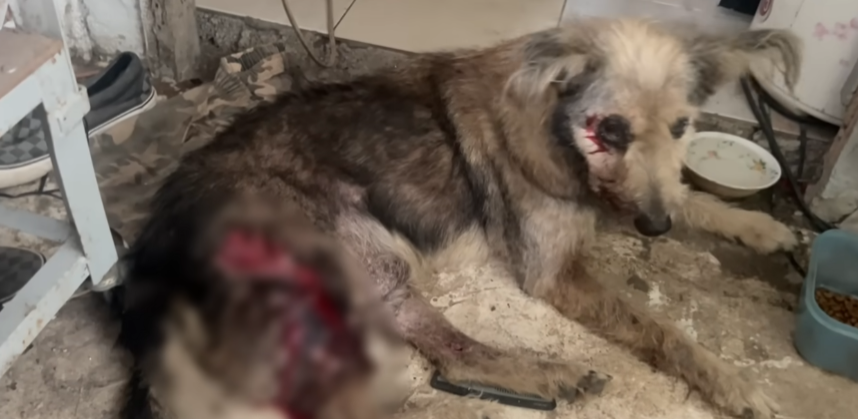
He lay on his side in the dirt, ribs rising sharply beneath skin stretched too tightly across his body. His fur was matted, stained with blood and mud. One eye was swollen shut, the other half-open, dull but still aware. His breathing was shallow and uneven, each breath sounding like a question mark hanging in the air. Was he holding on—or already letting go?
People passed by without stopping. Some glanced briefly, then looked away. Others stepped around him as if he were part of the street itself. To them, he was just another stray. To us, he was a life slipping away.
We knelt beside him carefully. He didn’t try to run. He didn’t growl or lift his head. He only flinched slightly when a hand came close, then relaxed, as if even fear had become too exhausting. His body was cold despite the warming morning air. That alone told us how critical his condition was.
“Hey, buddy,” someone whispered. “We’re here.”
Did he understand? No one knew. But his eye moved, slowly focusing on the faces around him. In that moment, there was no mistaking it—he was still fighting. Quietly. Desperately. With everything he had left.
We wrapped him in a blanket and lifted him gently. He weighed almost nothing. As we carried him to the car, his head lolled to the side, and for one terrifying second, his breathing seemed to stop. Hearts froze. Then, faintly, his chest rose again.
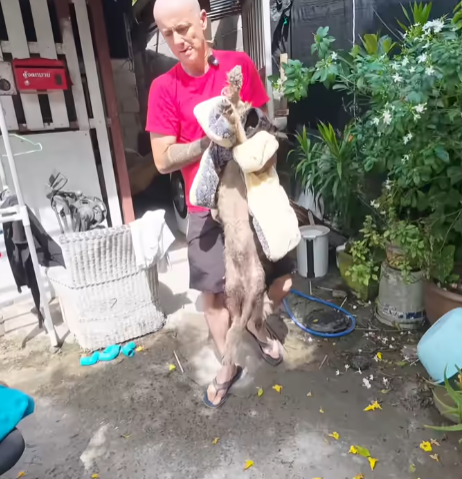
At the clinic, everything happened at once.
The vet didn’t sugarcoat the truth. Severe dehydration. Extreme malnutrition. Multiple infected wounds. Likely hit by a vehicle days ago and left untreated. His body was shutting down. Even with immediate care, survival was uncertain.
But uncertainty was not the same as hopelessness.
They rushed him inside, placing him on a warm surface, inserting IV lines, administering oxygen. Machines beeped softly. The room smelled of antiseptic and urgency. We stood back, watching hands move quickly, efficiently, with practiced compassion.
Time stretched painfully.
Minutes felt like hours as we waited for any sign—any indication that we hadn’t arrived too late. His heart rate was weak. His temperature dangerously low. Every so often, the vet glanced at the monitor, then back at the dog, adjusting something, murmuring instructions.
“He’s a fighter,” the vet finally said. “But he’s right on the edge.”
We named him Edge that day, because that was exactly where he was standing—on the thin line between life and death.
The first night was the hardest.
Edge drifted in and out of consciousness, his body trembling despite the warmth. Sometimes his breathing slowed so much that everyone in the room stopped moving, afraid to breathe themselves. Each time he inhaled again, it felt like a small miracle.
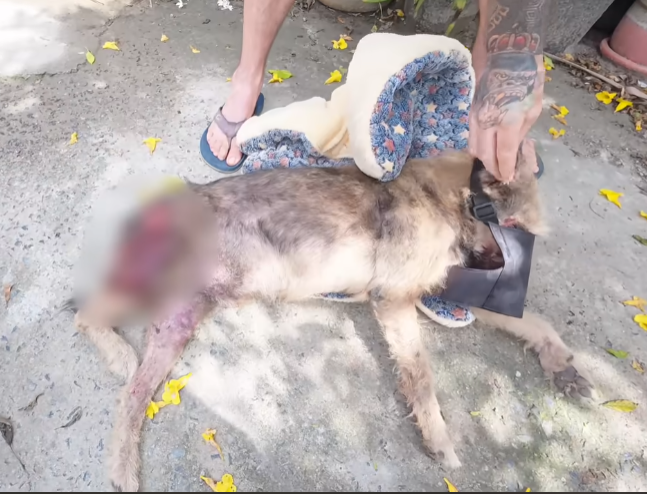
We took turns sitting near him, talking softly, even though we didn’t know if he could hear us. Stories. Encouragement. Promises we weren’t sure we could keep.
“Just stay,” we whispered. “Please.”
Morning came quietly.
Edge was still alive.
It wasn’t a victory—not yet—but it was hope. His vitals were slightly more stable. His body temperature had risen just enough to be safer. He hadn’t given up overnight, and that mattered more than anything.
The days that followed were a slow, fragile dance between progress and fear. Edge couldn’t eat on his own at first. Every drop of nutrition had to be carefully measured, slowly introduced. His wounds were cleaned daily, revealing the extent of his suffering. Some injuries were old, layered over newer ones, evidence of a life spent dodging danger without ever truly escaping it.
Despite everything, Edge never showed aggression. Even in pain, even when procedures hurt, he remained quiet. His strength was not loud. It was stubborn.
On the fourth day, something changed.
As a volunteer changed his bandages, Edge opened his eye fully and lifted his head just a little. It was an effort that clearly cost him energy, but he did it anyway. His gaze followed the movement in the room, curious, alert.
“He’s waking up,” someone said, barely daring to smile.
That tiny movement felt monumental. It meant his body was no longer just surviving—it was beginning to return.
By the end of the first week, Edge stood for the first time.
It wasn’t graceful. His legs shook violently, and he collapsed back down almost immediately. But the room erupted in quiet cheers anyway. Because a dog who stands after nearly dying is a dog who wants to live.
Recovery, however, is never a straight line.
Some days Edge improved. Other days he seemed to slip backward, exhaustion pulling him down again. Infections had to be fought aggressively. His immune system was weak, his body still fragile. Every setback reopened the question that haunted us from the start.
Did we get him in time?
Edge answered in his own way.
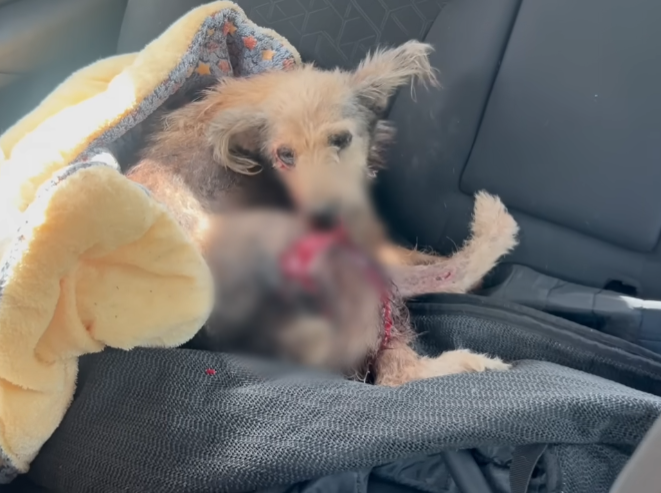
He began to wag his tail—just once at first, barely noticeable. Then more often. He learned to recognize familiar voices. When someone he knew entered the room, his eye brightened, his ears shifted forward. He leaned into gentle touches, craving comfort like something he had been denied for far too long.
The fear in him ran deep. Sudden noises made him flinch. Fast movements made his body tense. But alongside the fear grew something else: trust. Slow. Careful. Hard-earned.
Weeks passed. Edge gained weight. His fur began to grow back in patches where wounds had healed. His scars remained, telling stories no one would ever fully understand—but they no longer defined his future.
One afternoon, Edge walked outside for the first time since being found.
The sun touched his face. He stopped, lifted his head, and closed his eye, breathing deeply. Grass brushed against his paws. The world, once only pain and danger, felt different now. Safer. Kinder.
He took a few careful steps forward, then looked back, as if checking to make sure someone was still there.
We were.
Edge was eventually cleared to leave the clinic, but not to return to the streets. That chapter of his life was over. He went into foster care first, where he continued to heal, surrounded by patience and warmth. Each day, his personality emerged more clearly. Gentle. Thoughtful. Surprisingly playful.
Sometimes, when he slept, he twitched, dreaming of something unknown. But he no longer whimpered. He slept deeply, securely, knowing he would wake up to kindness.
So—did we get this street dog in time?
Yes.
But not because we were fast enough or skilled enough alone.
We got him in time because he chose to stay. Because even when his body was broken and his world cruel, Edge fought for his life with a quiet determination that refused to disappear.
He was never just a street dog.
He was a survivor.
And now, finally, he was safe. 🐾❤️