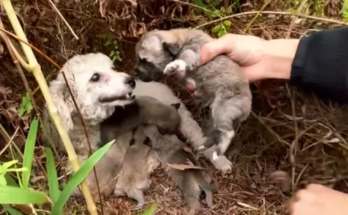
The crying was so faint at first that I thought I was imagining it.
It was late afternoon, the kind of hour when the sun hangs low but the shadows grow long and heavy. I was walking past an old row of storage sheds behind a closed factory, a place most people avoided. Rusted metal doors leaned crooked on their hinges, and weeds pushed through cracked concrete as if trying to reclaim the land. I would have kept walking—like everyone else always did—if that sound hadn’t reached me again.
A soft, broken cry.
Not a bark. Not a whine.
It sounded disturbingly like a baby.
I stopped.
The sound came again, clearer this time, echoing weakly from one of the locked sheds. My heart started pounding as I moved closer, calling out softly, “Hello? Is someone there?” Of course, no one answered. But the crying didn’t stop. It rose and fell, thin and desperate, as if whatever was making it had already used up all its strength.
I knelt and peered through a narrow gap beneath the door.
Inside was pure darkness.
The air smelled stale, heavy with rot and neglect. I could just make out two small reflections in the dark—eyes. They blinked slowly, then disappeared as another cry echoed through the metal walls. My stomach twisted. There was no doubt anymore.
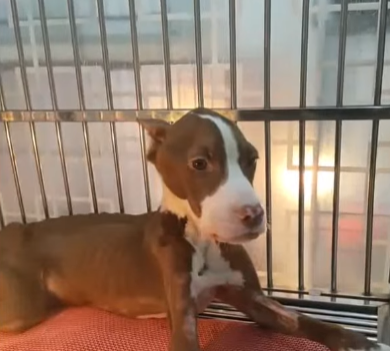
A puppy was locked inside.
I rattled the door. It didn’t move. A thick padlock held it shut, rusted but firm. Panic set in as I imagined how long she had been trapped there—hours? Days? The crying grew weaker, like she was begging not just for help, but for someone to notice she still existed.
“Hang on,” I whispered, even though I wasn’t sure she could hear me. “I’m here.”
I ran to find help, my mind racing. The factory had been abandoned for months. Whoever locked that door had not planned on coming back soon. After several frantic calls, I managed to get permission to break the lock. Every minute felt like a betrayal as I waited, listening to her cries fade into fragile whimpers.
When the bolt cutters finally snapped the lock open, the sound echoed like a gunshot.
I pulled the door wide.
The smell hit me first.
Then I saw her.
She was curled into the far corner, a tiny shape barely recognizable as a puppy. Her fur was matted and dirty, her ribs sharply outlined beneath her skin. She tried to stand when the light flooded in, but her legs buckled immediately. She fell, letting out a cry so raw and heart-wrenching it stopped me cold.
It truly sounded like a human baby crying in pain.
“Oh sweetheart…” My voice broke as I knelt down. “I’ve got you. You’re safe now.”
As I reached for her, she didn’t try to run. She didn’t even flinch. She simply lifted her head weakly and cried again, louder this time, as if releasing days of fear and hunger all at once. When my hands touched her, she trembled violently—not from aggression, but from exhaustion and relief.
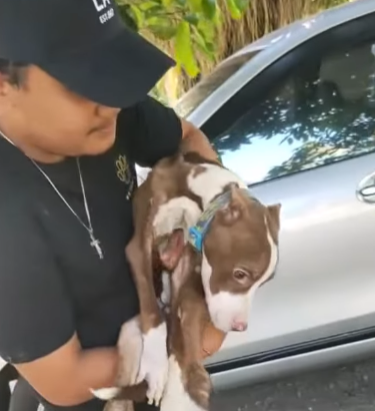
I wrapped her gently in my jacket and lifted her into my arms.
The moment I carried her out of that dark shed, her crying changed. It became softer, uneven, mixed with tiny gasps, like a baby finally being comforted after too long alone. She pressed her head against my chest, her small body shockingly light. I could feel her heart racing, fragile but still fighting.
Outside, the sunlight seemed to shock her. She squinted, then buried her face against me again, as if afraid the darkness might swallow her back up. I held her tighter, whispering promises I fully intended to keep.
“You’ll never be locked away again. Never.”
The drive to the vet felt endless.
She cried on and off the entire way, each sound cutting deeper into my heart. The veterinarian rushed us in immediately. As they examined her, the truth became painfully clear: severe starvation, dehydration, and weakness from being confined in the dark with no food or water. She was barely clinging to life.
“Another day like this,” the vet said softly, “and she wouldn’t have made it.”
They started fluids right away. I stood there watching, feeling anger, sadness, and guilt all at once—anger at whoever did this, sadness for what she endured, and guilt for all the times I’d walked past places like that without listening.
The first night was critical.
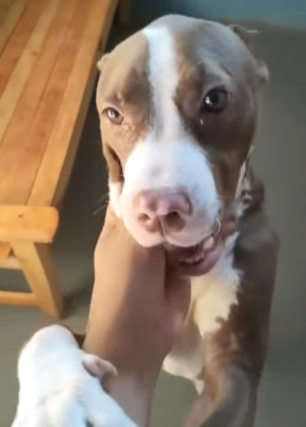
She slept under warm blankets, her tiny chest rising and falling steadily. Every now and then, she would cry in her sleep, a soft, broken sound that made my chest ache. I stayed nearby, reaching in to touch her gently whenever she stirred, reminding her she wasn’t alone anymore.
Recovery took time.
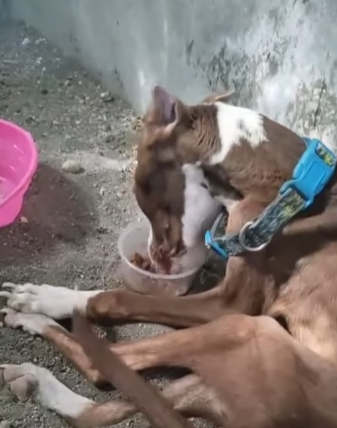
She had to learn that food would come regularly, that the dark no longer meant abandonment. At first, she guarded her bowl anxiously, eating as if it might disappear. Loud noises startled her. Closed doors made her whimper. But slowly, with patience and love, she began to change.
Her strength returned little by little.
Her fur grew softer. Her eyes, once dull and haunted, became bright and curious. One morning, weeks later, she wagged her tail when she saw me. It was small and hesitant, but it felt like a miracle.
The crying stopped too.
Now, when she sleeps, it’s quiet and peaceful. No more baby-like sobs echoing in the dark. Just the gentle rhythm of a puppy dreaming in safety. Sometimes she still presses close to me, as if afraid I might disappear. I don’t mind. I hold her a little tighter.
Because I know what it took to carry her out of that darkness.
And I will never forget the sound of her crying when the light finally found her.