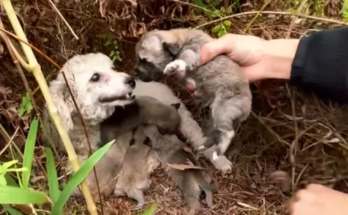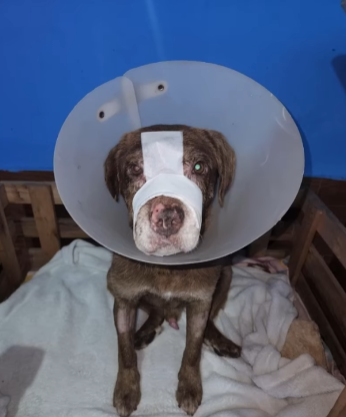
The morning traffic moved like it always did—horns blaring, engines growling, people rushing forward without looking back. On the edge of the sidewalk, where broken concrete met a puddle of muddy water, he lay curled into himself. His body was thin, ribs rising and falling like fragile sticks beneath torn skin. His fur, once perhaps a warm shade of brown, was now patchy and dull, clinging to him as if it might fall away at any moment. He barely lifted his head when footsteps passed by.
People noticed him.
They slowed down for half a second, their eyes flicking toward the motionless shape on the ground. Some shook their heads softly. Others whispered to the person beside them, “How pitiful…” Then they continued walking, their lives pulling them forward more strongly than his silent suffering pulled them back.
He had been there since the night before.
No one knew how long he had wandered the streets before collapsing. Maybe days. Maybe weeks. Hunger had hollowed him out, and thirst had dried his tongue until it stuck painfully to the roof of his mouth. Every breath felt heavy, like dragging air through water. The street was cold, even under the rising sun, and his body trembled despite the heat.
A young boy stopped once. He tugged at his mother’s sleeve and pointed. “Mom, is he sleeping?”
The woman glanced down quickly, her face tightening. “No, don’t touch. It’s dirty. Come on, we’ll be late.” She pulled the boy along, her footsteps quickening as if compassion itself might slow her down.
By noon, the sun beat down mercilessly. Flies gathered around the weak body, buzzing lazily, confident he would not chase them away. He tried to lift his head again, but his neck failed him. It dropped back to the ground with a soft, hopeless thud. A faint whimper escaped his throat—not loud enough to beg, not strong enough to call for help. Just enough to say, I am still here.
Cars passed. Motorbikes swerved around him. A man selling food nearby noticed him and sighed. “Poor thing,” he muttered, wiping his hands on his apron. He thought about pouring some water, but customers were lining up. He turned back to his stall.
Time stretched cruelly. Each minute felt heavier than the last. The world moved on, but for him, everything was slowing down. His eyes, once bright with curiosity, dulled as his strength faded. He did not know why no one stopped. He did not understand human schedules or excuses. All he knew was pain, hunger, and a deep, growing tiredness.
Then, late in the afternoon, someone stopped—not just for a glance, not just for a word.
She was walking home from work, exhausted like everyone else. At first, she almost passed him too. Almost. But something made her pause. Maybe it was the way his chest barely moved. Maybe it was the silence—no barking, no struggling, just surrender.
She knelt down.
The smell hit her immediately, but she didn’t step back. She reached out slowly, speaking softly, as if afraid he might disappear if startled. “Hey… you’re still alive, aren’t you?”
His eyes flickered open at the sound of her voice. Just for a second. Enough to see her face.
That was all it took.
“Oh no… oh no,” she whispered, her voice breaking. “You can’t stay here.”
People stared as she flagged down a taxi, her hands shaking while she explained. The driver hesitated when he saw the condition of the animal, but something in her urgency changed his mind. Together, they gently lifted the frail body and laid him on an old cloth in the back seat.
The ride felt endless.
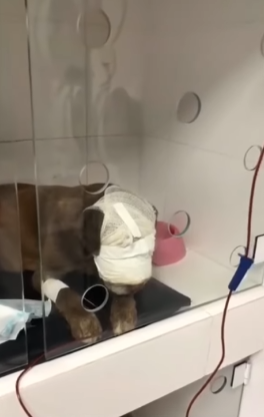
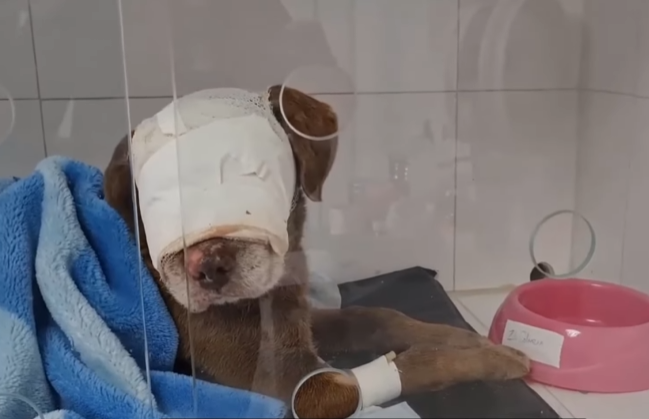
At the clinic, the staff rushed him inside. Words like “severe dehydration,” “infection,” and “critical condition” filled the air. Tubes, needles, and warm blankets surrounded him. Machines beeped softly, fighting against the silence that had nearly claimed him.
For hours, she waited.
She replayed the image of him lying on the street over and over in her mind. How many people had walked past? How close had he been to dying alone? Guilt mixed with relief, forming a tight knot in her chest.
The veterinarian finally came out, exhaustion clear on his face. “He’s very weak,” he said honestly. “But he’s a fighter. If he makes it through the night… there’s hope.”
That night, hope arrived quietly.
He opened his eyes again. This time, the world felt different. Warm. Safe. A hand rested near him, not pushing him away, not stepping over him—just staying. His breathing steadied. The pain dulled. For the first time in a long while, he slept without fear.
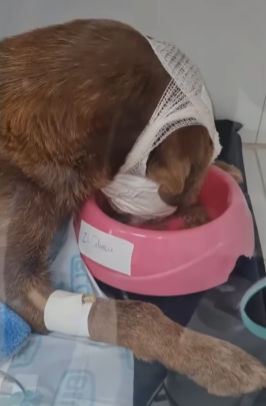
Recovery was slow.
Days passed. Then weeks. His body gained weight little by little. His fur began to grow back, softer and thicker. He learned that hands could bring food instead of harm, that voices could soothe instead of scare. Every small step forward felt like a miracle.
And one morning, when he stood up on his own and wagged his tail—just a little—the room filled with quiet joy.
He was no longer “pitiful.”
He was alive.
Sometimes, when she walked him down the same street where he had once collapsed, people smiled and commented on how healthy he looked. None of them recognized him. None of them knew how close he had come to disappearing right there on the pavement.
But she knew.
And he knew too.
Because while many had seen him and walked away, it only took one person to stop—to kneel, to care, to choose compassion over convenience.
And that choice changed everything.