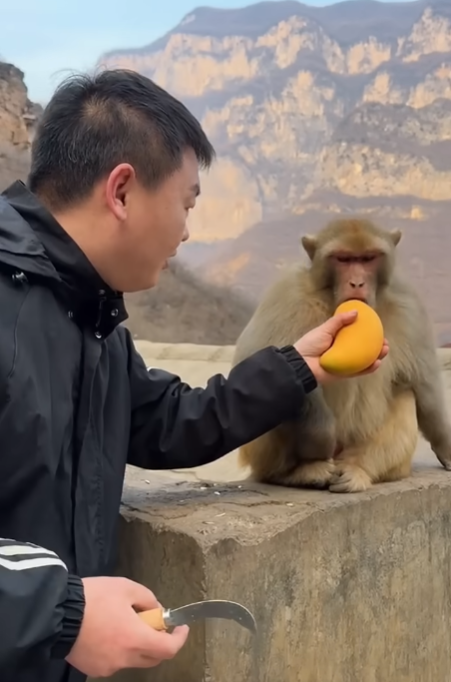
In the bustling village of Shilin, nestled between the emerald mountains and winding rivers of southern China, there lived a man named Lao Chen. He was an ordinary man by most accounts—middle-aged, wiry, and with a face lined from years of toil under the sun. But there was something peculiar about Lao Chen that set him apart from everyone else. His movements, his reactions, even the way he laughed, seemed… unnatural in a subtle way, as if a spirit from the wild had taken residence in his body.
Villagers had long speculated about his origins. Some whispered that he had a mischievous streak far beyond what was normal for humans. Lao Chen had an uncanny ability to climb trees faster than children, leap over streams in a single bound, and balance on narrow ridges like a tightrope walker. His reflexes were so sharp that it was said he could catch a falling chicken in midair or snatch a coin from someone’s hand before they even noticed. Children would follow him around, laughing and calling him a “monkey-man,” while elders shook their heads, muttering superstitions about reincarnation.
“Is it possible,” they would ask in hushed tones, “that this man was a monkey in his previous life?”
Lao Chen himself had never given much thought to these rumors. He laughed at them openly, enjoying the astonished looks on people’s faces when he performed feats that no ordinary human could. Yet sometimes, late at night, when he sat alone by the fire, he would feel a strange kinship with the forest around him. The rustling of leaves, the calls of the wild monkeys in the distant hills, even the patterns of the river currents—they seemed to speak to him in a language he could understand without words.
One spring morning, the village was abuzz with news: a golden-haired monkey had been spotted near the cliffs above the river. It was known among the locals as Xiao Jin, a clever and mischievous creature that had been the subject of countless stories. Some said Xiao Jin could open locked doors, steal food without leaving a trace, and vanish as mysteriously as he appeared. Lao Chen, upon hearing this, felt an odd stirring in his chest. His instincts prickled; it was as though he recognized something familiar in Xiao Jin’s gaze.
That afternoon, he ventured into the forest, following the sounds of chattering and rustling leaves. There, at the edge of a sun-dappled clearing, he saw the golden monkey perched on a low branch, watching him with bright, intelligent eyes. The monkey’s movements were fluid, precise, almost human-like. And when their eyes met, Lao Chen felt a shock of recognition—as though he had met a mirror of his own soul.
From that day forward, Lao Chen’s behavior grew even stranger. He began to mimic Xiao Jin’s movements unconsciously—scrambling up trees to gather wild fruits, swinging from vines, and leaping across streams with astonishing agility. Villagers watched in amazement as he moved through the forest like a creature born to the trees, whispering, “See? I told you—he must have been a monkey in his previous life.”
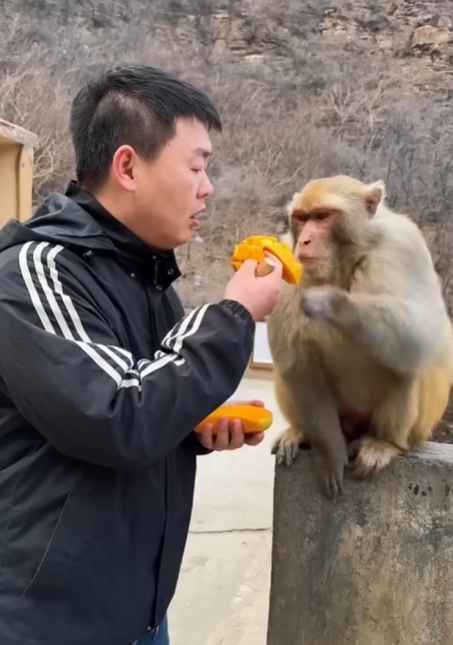
One evening, Lao Chen sat by the riverbank, tossing pebbles into the water and watching the ripples spread. Xiao Jin appeared beside him, unafraid. The monkey tilted his head, observing Lao Chen with curiosity. To anyone else, it would have seemed an ordinary encounter, but Lao Chen felt a deep connection, a silent communication that transcended species. It was then that a thought struck him: perhaps reincarnation was not merely a superstition, but a reality, a cycle of life that allowed spirits to travel in unexpected ways.
Over the following months, Lao Chen’s reputation grew. He became known not just as a skilled hunter or climber, but as a man in tune with the natural world in ways others could not comprehend. He could predict the behavior of animals, sense changes in the weather, and move through dense forests without leaving a trace. Children admired him, villagers respected him, and yet some remained wary, saying, “There’s something not quite human about him. He must have been a monkey in his previous life.”
Lao Chen did not deny it. In fact, in quiet moments, he embraced the idea. He began meditating under the trees, observing the monkeys, learning from their patterns, their playfulness, their instinctive wisdom. He noticed how they shared food without greed, how they communicated silently through subtle gestures, and how they approached danger with a combination of cunning and courage. He realized that in many ways, he had inherited these traits—not just physically, but in spirit.
Then came the fateful incident that sealed the villagers’ belief. One scorching summer day, a fire broke out in the forest, threatening the village’s outskirts. Smoke filled the air, and panic swept through the villagers. Lao Chen, without hesitation, raced into the flames, climbing trees and leaping across burning underbrush to rescue trapped animals and guide frightened villagers to safety. His agility, bravery, and quick thinking were nothing short of miraculous. By the time the fire was extinguished, he had saved countless lives. The villagers stood in awe, murmuring, “No human could do this… he must have been a monkey in his previous life.”
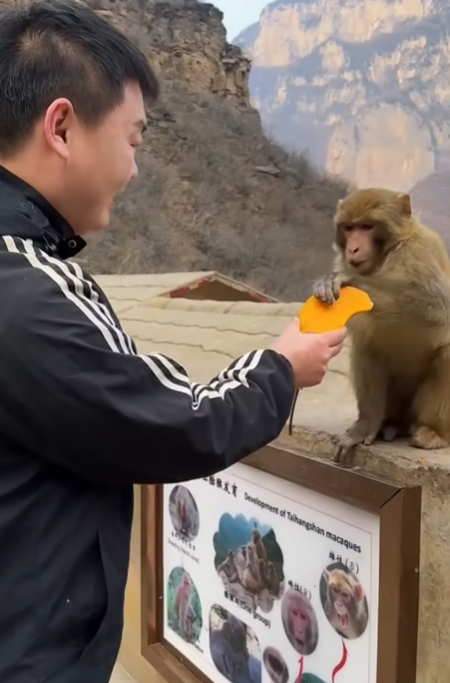
Lao Chen laughed, brushing soot from his clothes, but inside, he felt a deep sense of belonging. It was true—he was part of the natural world in a way that many humans were not. The fire, the animals, the trees—they were all threads of the same tapestry, and he was woven into it. Perhaps the villagers’ words were not just superstition, but recognition of a truth he had always felt.
Years passed, and Lao Chen continued to live among the villagers, always close to the forests where his instincts were strongest. Xiao Jin, the golden monkey, remained a loyal companion, often seen sitting quietly on Lao Chen’s shoulder or perched nearby, as if confirming the man’s connection to his past life. Children continued to imitate him, but always under careful supervision, and Lao Chen made sure to teach them safety. “Do not try everything I do,” he would say, “some moves are for those who are part of the forest spirit.”
In the end, Lao Chen’s life became a legend. People spoke of the man who moved like a monkey, who saw the world through eyes that seemed older and wiser than any ordinary human’s. Travelers came from faraway lands to catch a glimpse of him, hoping to witness the mysterious agility and uncanny instincts that set him apart. And in quiet moments, when Lao Chen sat under a tree, listening to the chatter of monkeys and the rustle of leaves, he would smile, thinking, Yes, perhaps I was a monkey in my previous life—but that is not a curse, it is a gift. A gift to live in harmony with the world, and to understand its spirit in a way few ever could.
And so the legend endured, whispered from one generation to the next: “Is it possible that this man was a monkey in his previous life?” To the villagers of Shilin, the answer was clear. In his leaps, his laughter, and his eyes that gleamed with wild intelligence, they saw the truth. Lao Chen was no ordinary man. He was a bridge between worlds, a reminder that life’s mysteries are far greater than we can imagine, and that sometimes, the spirits of the forest return to walk among us.