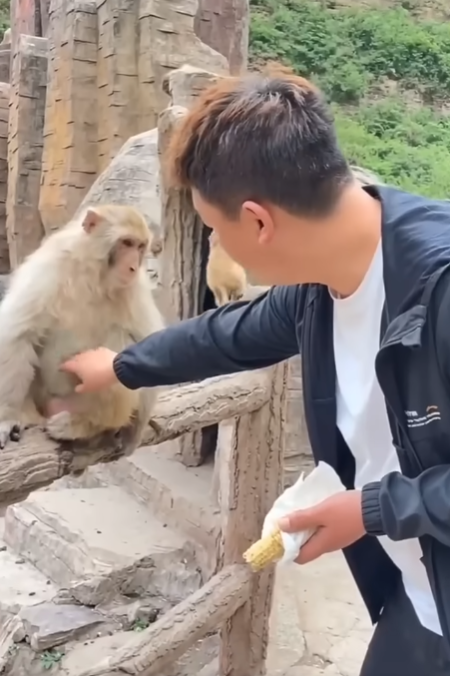
In a quiet village tucked between steep hills and bamboo forests, children often played near the riverbanks, their laughter echoing through the valleys. Among them, there was a legend that had persisted for generations: the tale of the Monkey King. Parents would tell their children, “Do not climb too high, do not play with fire, for the Monkey King watches.” No one had seen him for decades, but the story endured like a shadow that never left the mountains.
One day, a small, mischievous monkey appeared near the village. Unlike ordinary monkeys, this one had a crooked tail and eyes that shimmered with uncanny intelligence. He was fearless, climbing walls and leaping across rooftops with the ease of someone who had studied the wind. The villagers quickly noticed him, calling him Don, after the sound he made when he screeched. Children were fascinated, chasing him through the streets, while elders shook their heads, warning of the chaos a wild monkey could bring.
But Don was no ordinary monkey. He was clever, bold, and, strangely, reverent. There was something in the way he moved, the way he watched the villagers, that suggested he carried a secret. He seemed to understand more than mere survival instincts could explain. It wasn’t long before whispers began spreading: “Could this be the Monkey King himself?”
The story started one sunny morning when the village’s temple bell rang. Don, who had been climbing the tallest pine near the square, suddenly leaped down and landed at the temple’s entrance. Villagers gasped as he began performing acrobatic flips, standing on his hands, spinning, and moving with a rhythm that seemed both playful and ritualistic. It was mesmerizing—yet also slightly terrifying.
Grandpa Li, the village elder, stepped forward. “Children,” he said, “do not imitate these moves. That monkey… he is not ordinary. Even a simple fall could hurt you badly.”
Don, as if understanding every word, paused and looked directly at the children, his little crooked tail curling in what looked almost like a bow. It was a warning and a lesson all at once: respect skill, but do not try to imitate what you do not understand.
Over the next few days, Don’s antics became more extraordinary. He would leap from tree to tree, snatch fruit mid-air, and sometimes disappear altogether, only to reappear at the top of a hill or inside the temple courtyard. Some villagers swore they had seen him vanish into a flash of golden light, only to return moments later, perfectly unharmed. The legend grew: perhaps this was not just Don, but the Monkey King in a new form.

Grandpa Li, who had studied the ancient scrolls of the region, began to suspect something unusual. The Monkey King, according to lore, was no mere trickster. He was a spiritual figure, a protector of nature, a guardian who could traverse between the mortal world and the spirit realm. “Don is no ordinary monkey,” he muttered one evening. “He has become a spirit. He may even carry the essence of the Monkey King.”
The villagers were both awed and fearful. Some thought Don was a blessing, sent to protect the village from misfortune. Others whispered that such spirits were dangerous, capable of curses or tricks that could harm the unwary. Grandpa Li cautioned, “Respect him, yes, but do not provoke him. Do not try to mimic him. His moves are beyond human skill and safety.”
One afternoon, a group of children, curious and fearless, decided to climb the tall cliff near the river, imitating Don’s acrobatics. They had seen him leap from branch to branch and thought they could do the same. Grandpa Li noticed and ran toward them, shouting warnings.
“Stop! Do not imitate the Monkey King! You will fall!” he cried.
But the children, blinded by excitement, ignored him. Just as one boy attempted a daring jump, a golden wind seemed to sweep down from the trees. Don appeared suddenly, his crooked tail whipping through the air like a protective whip. The boy lost his balance and would have fallen, but Don darted forward, gently pushing him back to safety. The children stared in awe. The Monkey King, or spirit thereof, had intervened, teaching them a lesson without harm—but reminding them that some forces were not for imitation.
From that day on, Don became the village’s unofficial guardian. Farmers noticed that their crops grew healthier when he was near. Thieves and wild animals seemed hesitant to enter the village when he perched on rooftops. Children still played, but they now respected the monkey’s boundaries, understanding that his abilities were not for human imitation.
Grandpa Li often shared the legend of Don with the villagers at night. “Who is the Monkey King?” he would ask, eyes twinkling with the firelight. “He is not just a monkey. He is a spirit, a teacher, and a guardian. And Don… Don has inherited his essence. Look, learn, but never imitate recklessly. That is the greatest lesson of all.”
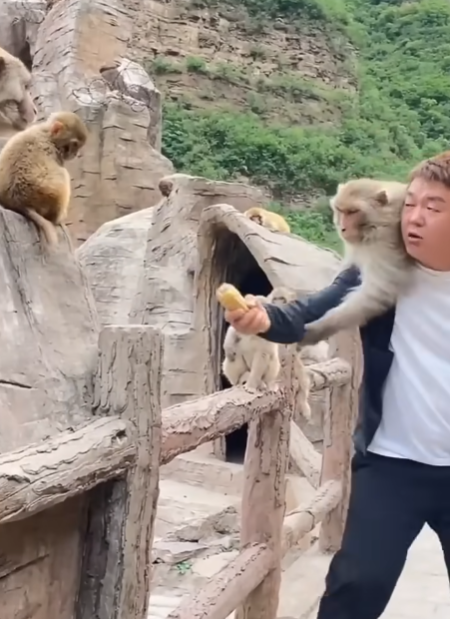
Don’s transformation into a spirit became more evident over time. Sometimes, when the moon was full, villagers would swear they saw him shimmer with golden light, his movements leaving trails like comets in the night sky. He could vanish at will, appear in multiple places, and even interact with the natural elements: wind, water, and trees seemed to respond to his presence. Children began to leave him offerings of fruit, flowers, and small trinkets, not out of fear, but out of respect for a spirit that protected them.
The story of the Monkey King, long thought to be only myth, had found a new form in Don. His little crooked tail, always curling and flicking, became a symbol of vigilance and wisdom. Adults and children alike learned that true skill was not for showing off, nor was it for imitation without understanding.
Years passed, and Don remained a constant presence in the village. He taught lessons silently, corrected missteps without malice, and protected the villagers in ways both subtle and miraculous. The legend of the Monkey King, once a distant tale, had become a living reality—though one that could never be fully replicated. His acrobatics were too dangerous for humans; his cleverness, too vast to imitate. Yet his spirit inspired courage, respect, and harmony between humans and the natural world.
Grandpa Li would often smile, watching Don perch on the highest roof, crooked tail twitching in the evening light. “Haha,” he would whisper to the children, “the Monkey has become a spirit. Admire him, learn from him, but do not imitate dangerous moves. True wisdom is in respect, not recklessness.”
And so, in that small village surrounded by bamboo forests and winding rivers, the Monkey King lived on—not as a legend in a book, but as a living, breathing, spiritual presence. He was mischievous yet wise, playful yet protective, a reminder that some powers are meant to be revered, not copied. Don, with his little crooked tail, had become more than a monkey—he had become a guardian, a teacher, and a symbol of the ancient magic that still lingered in the world.
The villagers never forgot the lesson: watch, learn, respect—and never, ever try to imitate the Monkey King.