The first time I noticed her, it was already too late.
I heard laughter—sharp, careless, and cruel—echoing down the narrow alley behind my apartment building. It wasn’t the kind of laughter that carried joy. It was the kind that followed something breaking, something being hurt. Then came the sound of plastic bottles clattering against concrete, a dull thud, and a frightened whimper that sliced straight through my chest.
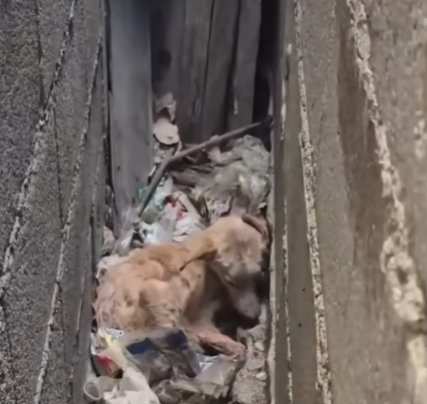
I turned the corner just in time to see a group of children scatter, their footsteps fading as quickly as their guilt. On the ground lay crushed food wrappers, banana peels, and an empty yogurt cup still rolling slowly to a stop. At first, I didn’t see her. She had already disappeared, retreating into the shadows between two tall buildings where the sunlight barely reached.
“Hey… hello?” I called softly.
Silence answered me, heavy and tense.
I stepped closer, my shoes crunching over the trash. The space between the buildings was narrow and damp, filled with the smell of mildew and old rainwater. And there, pressed against the wall as if trying to become invisible, was a small dog. Her fur was matted and dirty, speckled with bits of food and wet paper. One ear drooped lower than the other, and her body trembled so hard I could see it even in the dim light.
She didn’t growl. She didn’t bark. She just stared at me with wide, exhausted eyes that had clearly seen too much.
I knelt down slowly, afraid that even my breathing might scare her away. “It’s okay,” I whispered, not knowing if she understood the words but hoping she felt the meaning. “They’re gone now.”
She pressed herself deeper into the corner.
That was when I noticed the tear tracks—darkened lines running through the dirt on her face. Dogs don’t cry the way humans do, people say. But anyone who has ever looked into eyes like hers knows that pain finds a way to show itself.
I tried again. “Come here, girl…”
No response.
Then, without thinking, I said the name that slipped out of my mouth like a prayer. “Luna.”
It wasn’t a name I knew for sure. It just felt right.
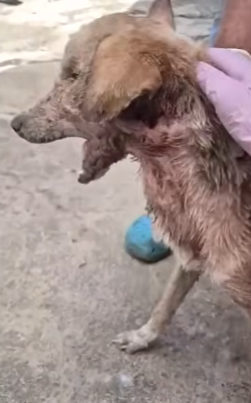
Her body froze.
Slowly—so slowly—it happened. Her ears twitched. Her head lifted just a little. And then she made a sound I will never forget: a soft, broken whine that turned into a trembling cry. She crawled forward a few inches, stopped, then crawled again, her tail tucked so tightly it looked as though it might disappear.
When I said her name again, she couldn’t hold it anymore. She cried openly, pressing her face into my hand as if she had been waiting—waiting for someone to call her, to see her, to remember that she mattered.
I didn’t realize I was crying too until my vision blurred.
I sat there with her for a long time. I didn’t rush. I didn’t try to pull her out of her hiding place. I just let her lean into me, let her breathe, let her feel safe in the smallest way possible. Every flinch of her body told a story—hands that had thrown, voices that had mocked, moments when she learned that children were not always gentle and that the world was not always kind.
Eventually, I stood and went back to my apartment. I returned with a bowl of water, some leftover chicken, and an old towel. When I set the food down, she hesitated, then ate with the desperate urgency of someone who didn’t know when the next meal would come. Between bites, she glanced up at me, as if afraid I might vanish.
“I’m not going anywhere,” I told her quietly.
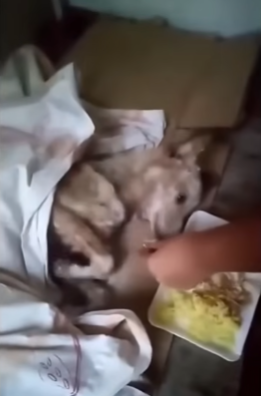
Over the next few days, I came back again and again. Each time, she was waiting in the same place. Each time, she trusted me a little more. She followed me out of the alley one morning, blinking at the sunlight like it was something new. Her walk was uneven, favoring one back leg, and when I touched it gently, she whimpered but didn’t pull away.
I took her to a vet who shook his head softly and said, “She’s been on the streets a long time.”
Bruises. An old fracture. Parasites. Hunger. Fear woven so deeply into her bones that it would take time—maybe a lifetime—to fully undo.
I took her home anyway.
The first night, she refused to sleep on the bed I made for her. Instead, she curled up against the wall, as if expecting it to protect her. When I called her name, she lifted her head and wagged her tail just once. A small thing—but to me, it felt like a miracle.
Weeks passed. Her fur grew cleaner, softer. Her eyes lost some of their sharpness. She learned the sound of my footsteps, the meaning of mealtime, the comfort of gentle hands. But loud laughter still made her flinch. Sudden movements sent her scrambling for cover. And sometimes, when children passed by outside, she would retreat to the far corner of the room, shaking.
I never forced her to face her fear. I just sat with her. I let her come to me when she was ready.
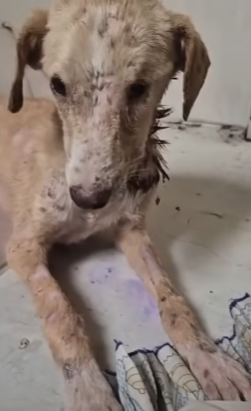
One afternoon, months later, we walked past the same alley where I had found her. She stopped, sniffed the ground, and looked up at me. I knelt down and called her name.
“Luna.”
She wagged her tail—not once, but wildly—and licked my face, her body loose and happy. The alley no longer owned her. The fear no longer ruled her.
Love had changed her.
And she had changed me too.
Because every time I look at her now—sleeping peacefully, belly up, trusting the world again—I think about how close she came to disappearing between two buildings, unseen and unheard. I think about how powerful something as simple as calling her name turned out to be.
Sometimes, saving a life doesn’t start with heroics.
Sometimes, it starts with noticing.
With stopping.
With saying, I see you.
With calling someone’s name—and meaning it.