The kennel smelled of disinfectant and despair.
Metal doors lined the narrow corridor, each one holding a story that had somehow gone wrong. Some dogs barked endlessly, their voices hoarse from days of trying to be heard. Others spun in tight circles, driven by anxiety. A few lay still, staring at nothing, already halfway gone.
At the very end of the row, in the coldest corner where the light barely reached, he was curled into himself.
He didn’t bark.
He didn’t move.
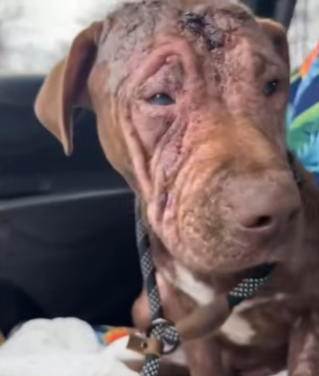
He was small to medium-sized, though it was hard to tell because he had folded his body into the tightest shape possible, nose pressed into his tail, paws tucked under his chest. His fur was dull and patchy, marked with old scars that spoke of a life that had never been gentle. The concrete beneath him was icy, but he didn’t shiver anymore.
He had learned that movement didn’t change anything.
A clipboard hung on the kennel door.
Status: Euthanasia Scheduled – Tomorrow Morning
The volunteer walking past slowed her steps. She had seen that word too many times before, yet it never stopped hurting. She crouched slightly to peer inside.
“Hey there…” she whispered.
The dog didn’t lift his head.
But his eyes moved.
Slowly, cautiously, they turned toward her. Dark eyes. Deep eyes. Eyes that didn’t hold anger or fear anymore—but something quieter. Something heavier.
A plea.
Not loud.
Not dramatic.
Just a silent, exhausted please.
The volunteer’s breath caught.
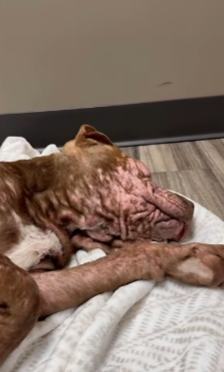
She had been told his story earlier that day. He’d been found wandering near an industrial area, skin and bones, limping badly. No microchip. No collar. No one came looking. When staff tried to examine him, he froze completely—didn’t growl, didn’t snap, just shut down as if he had learned that resistance only made things worse.
They called him “unadoptable.”
Too withdrawn.
Too damaged.
Too scared.
And the shelter was full.
The volunteer knew the rules. She knew the statistics. She knew that saving one meant another might not make it. She had learned how to build walls around her heart to survive this work.
But standing there, staring into those eyes, the walls cracked.
She opened the kennel door slowly.
The metal creaked. The dog flinched—not outwardly, but internally. His body tightened, breath shallow, waiting for whatever came next. He did not try to escape. He did not bare his teeth.
He simply accepted.
The volunteer knelt on the cold floor, staying a full arm’s length away. She didn’t reach out. She didn’t speak at first. She just sat.
Minutes passed.
Finally, she whispered, “You don’t deserve this.”
The dog’s ears twitched.
That was all.
But it was enough.
That night, she couldn’t sleep. Every time she closed her eyes, she saw his face in that dark corner. Saw the way he hadn’t begged with his body—only with his eyes. The way he had already accepted death as something inevitable.
By morning, she had made a decision.
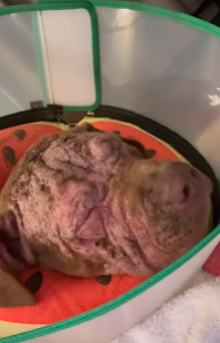
She arrived early, before the kennel staff began their rounds. She went straight to his cage. He was in the same position, unmoved, as if time itself had stopped for him.
“Hey,” she said softly. “I’m back.”
This time, his eyes lifted immediately.
She took a deep breath and unclipped the clipboard.
She didn’t know where she’d put him. She didn’t know how she’d afford the vet bills. She didn’t know if he would ever trust anyone.
She only knew one thing:
She could not let him die alone in a cold kennel believing no one cared.
When she clipped on the leash, the dog didn’t resist—but he didn’t stand either. His legs trembled violently as he tried to push himself up. Pain shot through his hind leg, and he whimpered quietly, collapsing back onto the floor.
“I’ve got you,” she said, voice breaking.
She lifted him carefully. He was shockingly light. Too light for a dog his size. As she carried him down the corridor, barking erupted around them—dogs sensing movement, sensing change.
He did not react.
He rested his head against her chest, eyes half-closed, as if conserving the last of his strength. Or perhaps, for the first time, allowing himself to feel safe enough to let go.
At the clinic, the vet examined him slowly, gently. X-rays revealed an old fracture that had never healed properly. Infections. Severe malnutrition. Trauma—both physical and emotional.
“He’s been hurting for a long time,” the vet said quietly. “But he’s not beyond help.”
They named him Jonah.
At first, Jonah didn’t move much. In the foster home, he chose a corner of the room and stayed there, pressed against the wall, watching everything. If someone walked past too quickly, he flinched. If a hand reached out suddenly, he shut his eyes tightly, bracing for pain.
But pain didn’t come.
Food did.
Warm blankets did.
Soft voices did.
Still, Jonah didn’t trust it. Not yet.
Trust, for a dog like Jonah, was dangerous. Trust had once led to abandonment. To hunger. To fear. To that cold kennel.
Days turned into weeks.
One evening, the volunteer—now his foster—sat on the floor reading quietly. She didn’t call Jonah. Didn’t look at him. Just existed peacefully in the same space.
Something changed.
Jonah shifted.
Just an inch at first. Then another. Slowly, almost imperceptibly, he inched closer until he was lying just behind her back, close enough to feel her warmth.
She didn’t move.
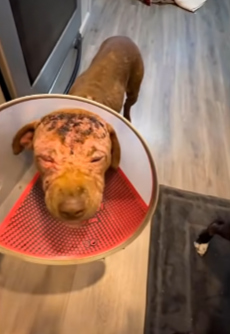
Tears slid silently down her face.
From that moment on, progress came in tiny victories. Jonah learned that hands could scratch behind ears. That footsteps didn’t always mean danger. That sleeping deeply was allowed.
The night he dreamed was the hardest.
He woke suddenly, crying—a raw, broken sound that tore through the quiet house. His body shook uncontrollably, legs paddling as if trying to run from something only he could see.
She wrapped him gently in her arms.
“It’s okay,” she whispered again and again. “You’re safe. I won’t let them hurt you.”
Jonah pressed his face into her chest and stayed there until the shaking stopped.
Months passed.
Jonah gained weight. His fur grew back thick and soft. The limp never fully disappeared, but he learned how to move without pain. More importantly, his eyes changed.
They still held sadness—but now they also held curiosity. Hope. A cautious kind of joy.
The day he wagged his tail for the first time, the volunteer laughed and cried at the same time.
When adoption inquiries came in, she was careful. Jonah needed someone patient. Someone kind. Someone who understood that love wouldn’t be instant.
Then one couple came.
They sat on the floor. They didn’t rush. They listened to Jonah’s story without flinching. They let Jonah approach when he was ready.
He did.
He sniffed their hands. He leaned—just slightly—against the woman’s leg.
Decision made.
On the day Jonah left for his forever home, the volunteer knelt beside him one last time. “You were never unlovable,” she whispered. “They were just wrong.”
Jonah looked up at her, eyes shining.
Once, he had been curled in the corner of a cold kennel, hours away from being erased from the world. No voice. No chance. Just a number on a clipboard.
But he had begged with his eyes.
And someone had finally listened.
Now, Jonah sleeps on a soft bed in a warm house, surrounded by people who chose him—not because he was perfect, but because he deserved to live.
And every night, when he curls up safely, his eyes close without fear.
Because this time, help didn’t walk away.