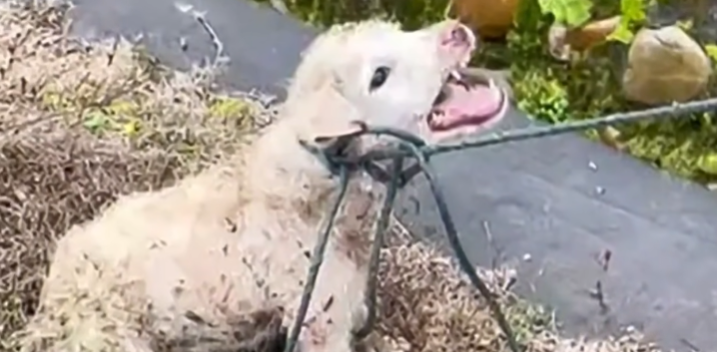
The dog’s cries echoed through the empty lot like something torn straight from desperation itself.
They weren’t loud barks or angry warnings. They were sharp, broken sounds—half yelps, half sobs—rising and falling as if he were running out of breath between each call. Anyone who heard them would have known immediately: this was not a dog asking for attention. This was a dog begging for help.
He stood near an abandoned warehouse at the edge of town, pacing in tight, frantic circles. His fur was filthy, clinging to a thin body that trembled even in the afternoon heat. Every few seconds, he ran a short distance, stopped, turned back, and cried again—louder this time—his eyes wild, his movements erratic.
He was calling someone.
Anyone.
People passing on the main road heard the noise but didn’t stop. Some shook their heads. Others assumed he was aggressive or sick. A few glanced nervously toward the warehouse and quickened their pace. Stray dogs were common here, and most people had learned not to get involved.
But the dog didn’t give up.
He ran toward every sound of footsteps, tail stiff, eyes pleading. When the person turned away, he rushed back to the same spot, whining, pawing at the ground, calling out again as if his voice alone could pull help from the air.
What no one could see yet was what lay behind the warehouse.
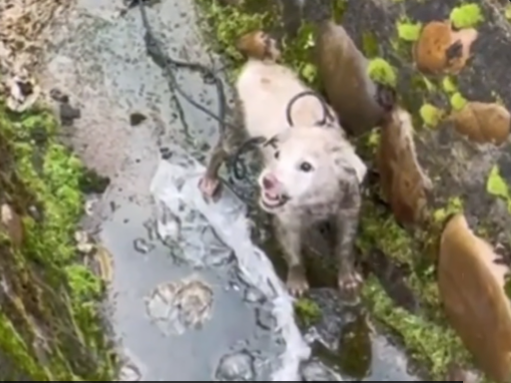
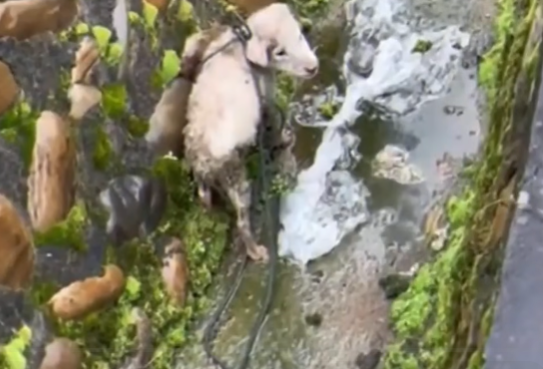
Hidden by rusted metal sheets and overgrown weeds was a narrow pit—no deeper than a man’s chest, but steep and slick from recent rain. At the bottom lay another dog. Smaller. Younger. Barely moving.
She was trapped.
The dog at the top—her brother, perhaps, or just her companion—had tried everything. He had clawed at the edge of the pit until his nails bled. He had jumped down once and managed to scramble back up, but she couldn’t follow. She was injured. Her back leg twisted at a painful angle, useless beneath her.
So he did the only thing left.
He called for help.
Late in the afternoon, a man walking his bicycle finally stopped. He had heard the cries for several minutes now, and something about them felt wrong—too urgent, too intentional. When the dog ran toward him, the man braced himself, expecting a bite or a bark.
Instead, the dog stopped a few steps away.
And then he did something strange.
He turned around.
He walked a few paces, stopped, looked back over his shoulder, and whined softly.
The man frowned. “What is it?” he muttered.
The dog repeated the motion—walk, stop, look back—his entire body tense, eyes fixed on the man as if begging him to follow. When the man didn’t move, the dog returned and circled him anxiously, then ran back again, crying louder.
That’s when the man understood.
“You want me to come with you,” he said slowly.
The dog barked once—a sharp, hopeful sound—and ran toward the warehouse, stopping every few steps to make sure the man was following. If the man slowed, the dog slowed. If he stopped, the dog stopped too, whining urgently until he moved again.
The behavior was unsettling. Almost human.
Behind the warehouse, the smell hit first—damp earth, rust, fear. The dog ran straight to the pit and stood at the edge, whining and pacing, peering down. The man leaned forward cautiously.
And froze.
At the bottom of the pit lay the second dog, her sides barely moving. Her eyes flickered open weakly at the sound above, and she let out a faint cry.
“Oh no…” the man whispered.
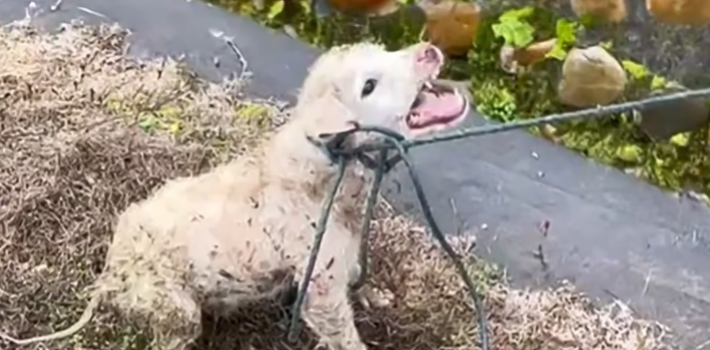
He pulled out his phone and called for help immediately, his voice shaking as he explained the situation. While they waited, he tried to calm the dog at the top—but this was when the dog’s behavior became truly strange.
Instead of staying near the edge, the dog backed away.
He paced in wide circles, whining, refusing to look directly at the pit anymore. When the man approached him, trying to reassure him, the dog flinched violently and retreated further, crouching low with his ears pinned back.
It was as if he suddenly didn’t trust the help he had worked so desperately to find.
Minutes later, a rescue team arrived. They moved quickly, bringing ropes and equipment. As soon as they stepped near the pit, the dog began to panic. He barked frantically, darting back and forth, placing himself between the rescuers and the hole, teeth bared—not in aggression, but in terror.
“He’s blocking us,” one rescuer said carefully. “But he’s not trying to attack.”
The dog’s body shook as he growled softly, eyes darting from the rescuers to the pit and back again. He wanted help—but now that it was here, something inside him was breaking.
The vet on the team watched closely. “He’s afraid,” she said quietly. “Not of us. Of what might happen.”
They moved slowly. No sudden gestures. No loud voices. One rescuer sat down on the ground a short distance away, turning sideways to appear less threatening. He spoke gently, not trying to touch the dog, not forcing eye contact.
“You did good,” he said softly. “You did everything right.”
The dog’s growls softened into whines.
Still trembling, he stepped aside—but only just enough.
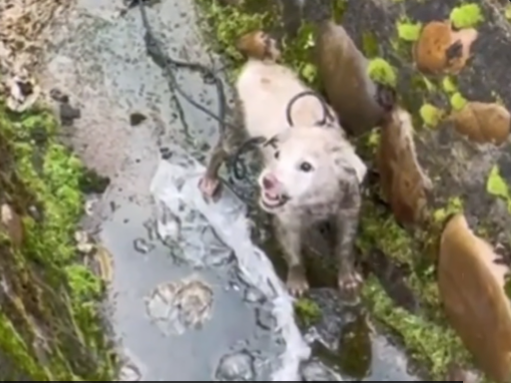
As the rope lowered into the pit and the injured dog was carefully lifted out, the dog at the top watched every movement with intense focus. He cried continuously, a high-pitched, desperate sound, until she was safely on the ground.
When she was finally free, the dog rushed to her side, sniffing frantically, licking her face, pressing his body against hers as if to reassure himself she was real. She lifted her head weakly and nudged him in return.
Only then did he collapse.
His legs buckled beneath him, and he lay down hard on the ground, chest heaving. The adrenaline that had kept him going for who knew how long drained away all at once. Up close, the rescuers could see how thin he was, how his paws were raw and bleeding, how his eyes were rimmed red from exhaustion.
“He’s been doing this for days,” the vet said, her voice tight. “Calling for help. Guarding her. Not leaving.”
At the clinic, both dogs were treated. The injured dog—now named Luna—had a fractured leg and severe dehydration. The dog who had called for help—named Echo—had torn pads, malnutrition, and extreme stress.
But physically, he would recover.
Emotionally was another matter.
Even in the safety of the clinic, Echo acted strangely. He refused to eat unless Luna ate first. He startled at footsteps. When staff tried to take Luna for X-rays, Echo panicked so badly he had to be gently restrained, crying and clawing at the door.
“He thinks if he lets her out of sight, she’ll disappear,” the vet explained. “He’s learned that losing someone happens fast.”
It took time. Patience. Trust.
Staff began letting Echo walk Luna to her appointments. They fed them side by side. They spoke to Echo before touching Luna, letting him see every step. Slowly—very slowly—his panic eased.
One night, Echo slept.
Not sitting upright. Not watching the door. He lay down fully, his head resting against Luna’s side, eyes closed, breathing steady.
Weeks later, when the time came for adoption, the decision was simple.
“They stay together,” the rescuer said firmly. “There’s no question.”
A family came forward—people who listened carefully to the story, who understood that love sometimes came with fear attached. When Echo left the shelter for the first time in a car, he shook violently. But Luna was there, and he pressed close to her, drawing strength from the one he had refused to abandon.
Echo had called for help when no one else would.
And when it finally came, he acted strangely—not because he didn’t want it, but because he had learned the hard way that help doesn’t always stay.
Now, in a quiet home with soft voices and gentle hands, Echo still watches closely. He still checks on Luna. He still startles sometimes.
But when he sleeps, his cries are gone.
Because the dog who once begged the world to listen finally learned that this time—this time—help wasn’t going to walk away.