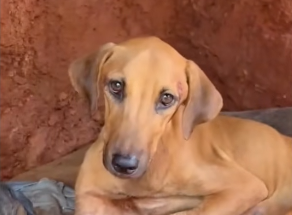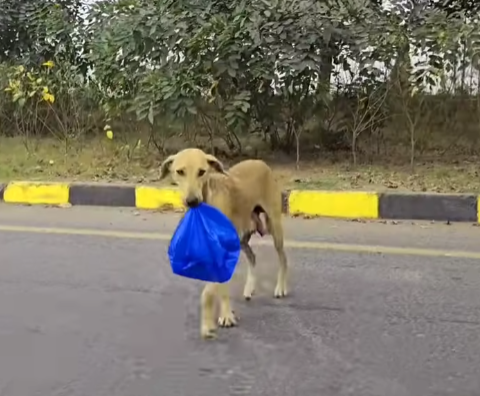
Every morning at exactly six o’clock, a thin brown dog appeared at the corner of Maple Street.
He walked slowly, his ribs visible beneath his dusty fur, one ear bent permanently forward as if listening for something that never came. What caught everyone’s attention, though, was not his frail body or tired eyes—it was the bag.
Clenched gently between his teeth was a small, worn cloth bag, tied with a faded blue string. He carried it carefully, never dropping it, never letting it drag on the ground. Rain or sunshine, cold or heat, the dog came the same way, at the same time, holding the same bag.
At first, people were curious.
“Look, the dog is back,” the bakery owner would say, wiping flour from his hands.
“Someone must be feeding him,” a woman assumed. “Maybe there’s food in that bag.”
Children laughed and pointed. “He’s going shopping!” they joked.
But the dog never stopped. He never begged. He never barked. He didn’t wag his tail or approach anyone. He simply walked, eyes forward, bag in his mouth, as if following an invisible path only he could see.
Weeks passed.
Then months.
And still, no one knew what was inside the bag.
Some tried to follow him. The dog always walked the same route—past the bakery, across the narrow bridge, beside the old bus stop, and down a dirt road that led toward the abandoned railway tracks. Anyone who followed him too closely noticed the same thing: the dog would glance back, eyes alert, not aggressive but protective. If they kept their distance, he continued. If they came closer, he stopped.
People learned to let him be.
Until one cold winter morning, the dog didn’t appear.
The bakery owner noticed first. He waited, glancing at the clock. Six o’clock passed. Then six-thirty. The street felt strangely empty.
“Maybe he found another route,” someone suggested.
But the next day, and the day after that, the dog was still gone.
A quiet unease settled over Maple Street.
Then, on the fourth day, he returned.
But something was wrong.
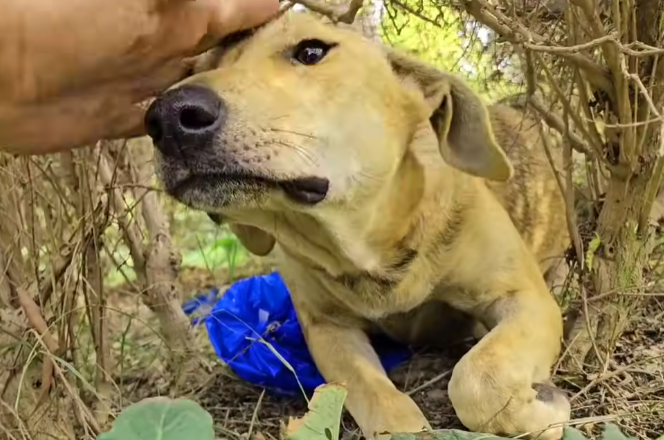
His walk was slower, uneven. One of his legs dragged slightly, and his breathing was shallow. The bag was still there, clenched in his teeth, but it looked heavier now, sagging lower. His eyes—once tired but determined—were dull with pain.
He reached the bakery steps and collapsed.
Gasps filled the air.
“Quick! The dog!” someone shouted.
The bakery owner ran out, kneeling beside him. The dog whimpered softly but refused to release the bag, even as his body trembled.
“He’s hurt badly,” a woman said. “We need to help him.”
They tried to touch the bag. The dog growled weakly, not in anger, but in desperation. His jaw tightened, muscles straining, refusing to let go.
“Fine,” the owner said softly. “We won’t take it. Just help him.”
Someone brought water. Another fetched a blanket. But the dog’s condition worsened. His breathing grew erratic, his body cold despite the blanket.
A young girl, maybe ten years old, knelt beside him. She had watched the dog for months, always wondering about the bag. Gently, she spoke, her voice trembling.
“It’s okay,” she whispered. “We just want to help you.”
The dog’s eyes met hers.
For the first time, he loosened his grip.
The bag fell onto the ground.
Everyone froze.
The girl slowly untied the faded blue string.
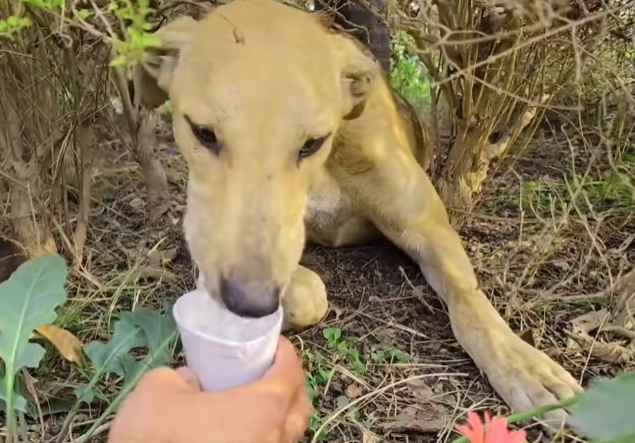
Inside the bag was not food.
Not money.
Not trash.
Inside were folded pieces of cloth… and beneath them, a tiny knitted hat, a pair of baby socks, and a photograph sealed in plastic.
The photo showed a young woman sitting on the steps of the old railway station. Beside her sat the same brown dog, younger, healthier, his head resting on her knee. In her arms was a newborn baby wrapped in a blanket.
There was writing on the back of the photo.
“If anything happens to me, please take this to the station. Please don’t let him forget us.”
The street went silent.
Someone gasped. Another wiped tears from their eyes.
“His owner…” the bakery owner whispered. “She must have been homeless.”
A memory surfaced among the older residents. A woman who used to sit near the railway tracks years ago. Quiet. Sick. Always with a dog and a baby. One winter, she disappeared.
No one had asked what happened.
The truth lay inside that bag.
The dog stirred weakly, lifting his head as if checking whether the bag was safe. The girl gently retied it and placed it beside him.
“You carried it for her,” she whispered, tears streaming down her face. “Every day.”
A vet was called immediately. They lifted the dog carefully, bag secured against his chest. Even unconscious, his paw curled toward it.
At the clinic, the diagnosis was grim. Severe infection. Old untreated injuries. Exhaustion. Hunger. He had been surviving on scraps, walking miles every day for years.
“But why the same route?” the vet asked quietly.
The bakery owner answered, voice thick with emotion. “The station. He was trying to go back. Every day.”
The dog survived the night.
Barely.
When he woke, he panicked—until he felt the familiar bag pressed against him. Only then did he relax.
The town changed after that.
People brought blankets. Toys. Food. Donations. They learned the dog’s name from a tag hidden inside the bag.
Benny.
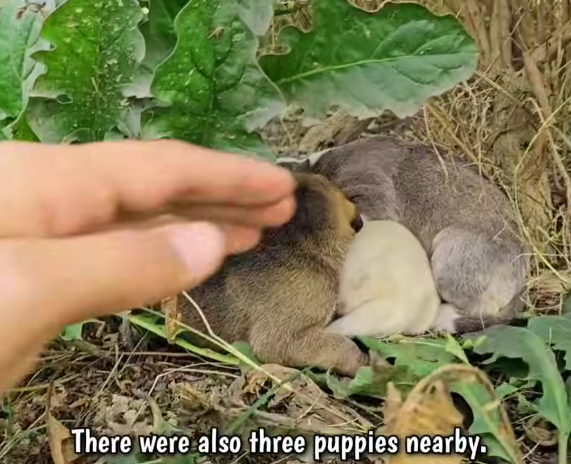
Benny stayed at the clinic for weeks. Each day, the girl visited him. She read to him, showed him the photograph, held his paw. Benny would wag his tail weakly whenever she came.
One afternoon, when he was strong enough, she asked her parents a question that changed everything.
“Can we take him to the station?”
They did.
Wrapped in a warm coat, Benny was carried to the old railway tracks. As soon as he saw the place, his ears lifted. His tail wagged faster than it had in years.
They sat with him on the steps, placing the bag beside him.
Benny sniffed the air, then gently nudged the bag, finally letting out a soft sigh—as if a long journey had reached its end.
That was the last time he tried to walk the route alone.
Benny was adopted by the girl’s family. The bag stayed with him, resting beside his bed. He no longer needed to carry it daily.
But everyone understood now.
He wasn’t carrying a bag.
He was carrying a promise.
A promise to remember.
A promise to love.
A promise that even when the world forgets, loyalty never does 💔