Every morning, just as the sun began to stretch its pale light across the quiet town, a dog appeared on the same narrow road.
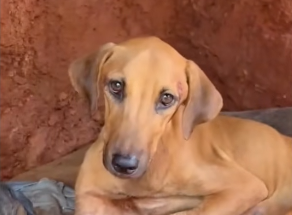
He was medium-sized, his fur once golden-brown but now dulled by dust and time. His steps were slow yet steady, as if guided by an invisible clock no one else could see. What made people stop and stare was not his tired eyes or the scars that crossed his legs—it was the bag.
A small canvas bag hung from his mouth, gripped gently but firmly between his teeth. The fabric was worn thin, patched in places, its strap knotted carefully to make it easier to carry. Day after day, the dog walked the same route with that bag, never stopping, never begging, never dropping it.
At first, the town found him amusing.
“The dog’s running errands,” the shopkeeper joked, leaning against his doorway.
“Maybe his owner sends him out for groceries,” another laughed.
Children pointed and followed him for a short distance before getting bored. Adults glanced up briefly and then returned to their lives. In a town full of routines, the dog simply became another one.
But as weeks passed, curiosity slowly replaced humor.
People noticed that the dog never ate from the trash bins he passed. He ignored food scraps tossed in his direction. Even when someone placed a bowl of water on the ground, he would drink quickly—but only after carefully setting the bag beside him and placing one paw protectively on top.
No one could touch it.
If anyone tried to approach too closely, the dog would stiffen. He didn’t bark or bite. He simply stared—eyes dark, serious, warning without threat. It was enough.
So people stopped trying.
They began to wonder instead.
What was in the bag?
Some said food. Others thought it was money, stolen or saved. A few whispered darker theories—something valuable, something dangerous. But no one truly knew.
The dog’s route never changed.
He walked past the school, the market, the riverbank, and finally toward the edge of town, where old houses leaned tiredly against time. At the far end stood a small cemetery, nearly forgotten, grass overgrown, names faded from stone.
That was where the dog always stopped.
He would sit there for a long while, the bag resting beside him, his head lowered. Sometimes he lay down. Sometimes he stared at the ground as if listening.
Then, without fail, he picked up the bag again and walked back the way he came.
Every single day.
Until one morning, he didn’t.
The absence was unsettling. People noticed the silence first—the lack of soft paws on pavement, the missing shape at the corner of the street. By noon, the shopkeeper frowned toward the road.
“He’s never late,” he muttered.
By evening, concern had replaced curiosity.
The next day, a storm rolled in. Rain lashed the streets, wind howled through empty alleys. Still, no dog.
On the third day, a child ran into the market shouting, “The dog! He’s by the river!”
A small crowd gathered quickly.
They found him lying beneath a broken bench near the riverbank. His breathing was shallow, his body trembling. One leg was twisted unnaturally, clearly injured. Mud clung to his fur, and rain soaked him to the bone.

But even then—especially then—he refused to release the bag.
His jaw was clenched so tightly that his muscles quivered with the effort.
“Poor thing,” someone whispered. “He must be in terrible pain.”
A woman reached out, intending to help lift him, but the dog growled weakly, pulling the bag closer to his chest.
“He’s protecting it,” a man said softly. “Whatever’s in there matters more to him than himself.”
They called the local vet, who arrived quickly with a blanket and stretcher. It took time, patience, and gentle words to calm the dog enough to lift him. Even as they carried him, the bag stayed pressed against his body, secured beneath the blanket.
At the clinic, the vet examined him carefully.
“He’s been walking on this injury for a long time,” she said quietly. “And he’s malnourished. Exhausted. I don’t know how he’s lasted this long.”
“Can he survive?” someone asked.
The vet hesitated. “We’ll try.”
As they treated him, the bag finally slipped free.
It landed softly on the floor.
The room fell silent.
No one moved at first. The bag seemed heavier now—not with weight, but with meaning.
Slowly, the vet picked it up and opened it.
Inside were neatly folded clothes. Not dog clothes—human ones. A thin scarf. A worn sweater. Beneath them lay a small notebook wrapped in plastic, its pages yellowed but protected. At the bottom, there was a photograph.
The photo showed a young man sitting on the steps of the cemetery gate. The same dog sat beside him, younger and full of life, eyes bright, tail mid-wag. The man’s arm rested around the dog’s neck, his smile tired but genuine.
Written on the back were a few simple words:
“If you find this, please tell him I tried to come back.”
No one spoke.
The vet slowly opened the notebook.
It was a diary.

The man had written about losing his job, about sleeping near the cemetery because it was quiet and safe. He wrote about illness, about being afraid, about the dog who stayed with him when everyone else walked away.
“I don’t have family anymore,” one entry read. “But I have him. And he has me.”
The final entry was short.
“I’m too weak to walk today. If I don’t wake up, I hope he remembers where I am.”
Tears filled the room.
The truth settled heavily over everyone: the dog had not been wandering. He had been keeping a promise.
Every day, he carried the bag from the place where his human once lived to the place where he now rested. Back and forth. Again and again. As if refusing to let either be forgotten.
When the dog woke later that night, he panicked—until the vet placed the bag beside him.
Only then did he relax.
Recovery was slow, but the town changed while he healed.
People donated food, money, blankets. The cemetery was cleaned. A small marker was placed where the man had been buried, his name carefully engraved.
And when the dog was finally strong enough to walk again, they brought him there.
He limped slightly, but his eyes were alert. As they reached the gate, his tail wagged for the first time anyone could remember seeing.
He set the bag down gently at the marker and lay beside it, resting his head on the cool stone.
After a long moment, he sighed.
A deep, peaceful sigh.
The dog was adopted by the vet, but he still visited the cemetery often. The bag stayed with him, resting near his bed at night, no longer carried daily.
Because his journey was over.
He wasn’t carrying food.
He wasn’t carrying valuables.
He was carrying memory, loyalty, and love.
And no one who saw him ever forgot that some promises are so strong, not even death can break them.