The old scrapyard sat at the edge of the city, forgotten by time and avoided by most people. Rusted cars rested in crooked lines, their windows shattered, doors hanging open like broken wings. Grass and weeds pushed through oil-stained soil, reclaiming what humans had abandoned. It was a quiet place, except for the wind whistling through hollow metal and the distant echo of traffic far away.
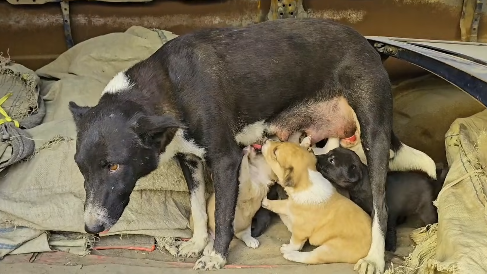
Inside one of those forgotten vehicles, an old white van with peeling paint and a cracked windshield, a mother dog lay curled around her puppies.
She hadn’t chosen this place because it was safe. She had chosen it because it was hidden.
The van smelled of dust, rust, and old fabric. Torn seats exposed yellow foam, and shards of glass glittered on the floor like tiny knives. The mother dog had carefully pushed the sharpest pieces aside with her nose, clearing a small space beneath the back seat. It was dark there, cramped and uncomfortable—but it was all she had.
Her body was thin, her fur rough and dulled by hunger. Every rib showed when she breathed. Yet her eyes were fierce and alert, constantly scanning the shadows beyond the van’s open door. Outside, stray cats prowled, rats squeaked between tires, and other dogs sometimes passed through the yard. Any of them could be a threat.
She would not allow it.
Five puppies pressed against her belly, blind and helpless, their tiny bodies warm and trembling. They squeaked softly, searching for milk that her body struggled to produce. Each sound made her heart tighten. She licked them again and again, whispering comfort in the only way she knew.
She hadn’t eaten properly in days.
Every time she left the van to search for food, fear clawed at her chest. What if someone found them while she was gone? What if another animal climbed inside? The scrapyard was no place for newborns. So she learned to be quick. She scavenged whatever she could—scraps, spoiled leftovers, anything to keep her alive just a little longer.
Then she ran back.
She always ran back.
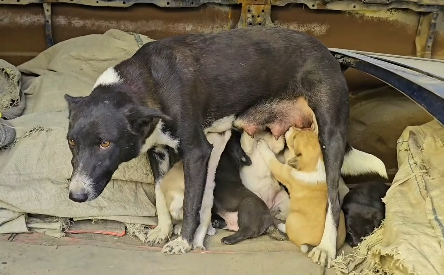
Her paws were scraped and sore from the broken glass scattered everywhere. Old engines and twisted metal surrounded the van like a cruel maze. From the outside, it looked like just another piece of junk, forgotten and useless. No one would guess a family was fighting for survival inside.
One afternoon, footsteps echoed through the yard.
The mother dog froze.
Her ears flattened, and she stood over her puppies, legs shaking but firm. A man walked between the rows of cars, inspecting parts, kicking tires. His shadow passed over the van door. She let out a low growl, barely audible, but filled with warning. Her body tensed, ready to fight—even though she was weak, even though fear burned through her veins.
If he came closer, she would not move.
The puppies squirmed beneath her, unaware of the danger. She lowered her head and licked them quickly, her eyes never leaving the opening. The man paused, glanced toward the van, then shrugged and walked away.
Only when his footsteps faded did her body finally relax.
She sank back down, exhausted, her breath shaky. She had won this time.
Days passed like this—constant fear, constant guarding. Rain leaked through holes in the van roof, soaking the floor and chilling her bones. At night, the cold crept in, wrapping around her and the puppies. She curled tighter, offering her own warmth, even as hunger gnawed at her insides.
Still, she never left them for long.
Then one morning, unfamiliar voices broke the silence.
A woman’s voice, gentle but surprised. “Wait… did you hear that?”
The mother dog’s head snapped up. Her heart pounded as she heard soft puppy cries echo faintly from beneath the seat. Footsteps approached. Light spilled into the van as someone peered inside.
She stood immediately, growling louder now, placing herself between the strangers and her babies.
“Easy, mama,” the woman whispered. “We’re not here to hurt you.”
But the mother dog didn’t understand words—only intentions. And all she knew was that her puppies were in danger. She barked sharply, her voice hoarse but determined.
The rescuers backed away slowly, respecting her fear. They crouched down at a distance, speaking softly, tossing small pieces of food toward her. The smell made her stomach ache. She hadn’t eaten since the day before. Still, she didn’t move.
Not until one puppy whimpered loudly.
The sound broke her resolve. She grabbed the food quickly, gulped it down, and rushed back to her babies, never turning her back on the humans. The rescuers exchanged glances. They had seen this before—pure maternal devotion, stronger than hunger, stronger than fear.
It took time.
They brought water. More food. They waited patiently, letting the mother dog watch, learn, and decide. Slowly, her growling softened. Her body still trembled, but she no longer barked.
When the rescuers finally reached inside the van, they moved carefully. One by one, they lifted the puppies, wrapping them in warm cloths. The mother dog panicked at first, crying and circling, but when she saw them placed gently into a crate, safe and warm, something shifted.
She followed.
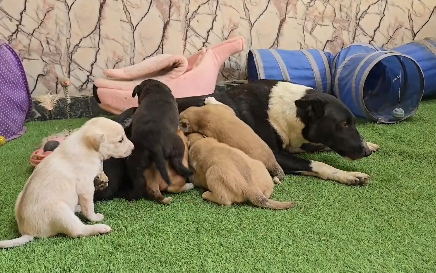
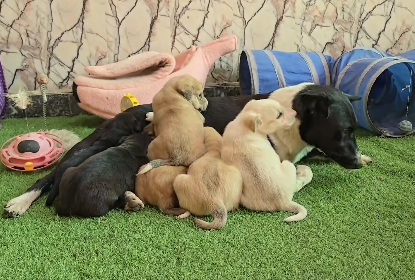
At the rescue center, the family was given what they had never known—clean bedding, full bowls, and peace. The puppies slept deeply, their tiny bodies finally relaxed. The mother dog ate slowly, almost cautiously, as if afraid the food might vanish.
But it didn’t.
Days later, her eyes softened. Her ribs began to disappear beneath healthier weight. She still watched closely whenever someone approached her puppies, but her growl faded into quiet vigilance.
She had done her job.
In an old van surrounded by broken vehicles, she had protected her babies with everything she had. Love had made her brave. Hunger had not defeated her. Fear had not driven her away.
And because someone finally saw her—not as junk in a scrapyard, but as a mother fighting for her family—her puppies would grow up knowing safety instead of fear.
💔🐶😢