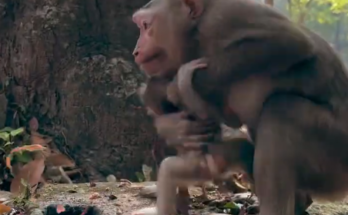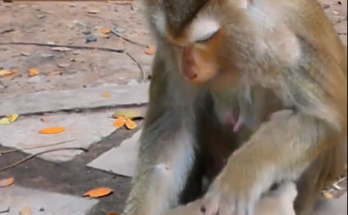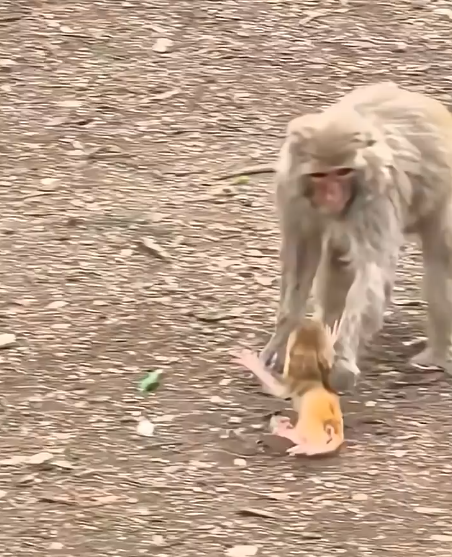
Monkeys are often admired for their intelligence, agility, and social bonds. In wildlife documentaries, we see them play, groom, and protect one another. Their intricate social structures are a marvel — a mirror, in some ways, to our own human communities. Yet, like humans, monkeys are not always perfect in their relationships. There are moments when survival, fear, or instinct drives them to make choices that seem harsh, even heartbreaking. Monkeys are animals that abandon their loved ones, and it is a truth that evokes both sadness and reflection.
At first glance, it feels cruel. The image of a baby monkey clinging to its mother, desperate for comfort, only to be left behind, tugs at our emotions. But nature is rarely sentimental. In the wild, every decision is shaped by survival. Mothers sometimes abandon offspring if they are ill, weak, or too small to survive. It is not malice; it is instinct, a hard lesson in the natural order of life. For humans, this seems tragic because we view loyalty, love, and attachment as moral absolutes. For monkeys, these concepts are entwined with survival.
Social dynamics among monkeys are complex. Groups are organized hierarchically, with dominant males and females often controlling access to food, mates, and territory. In such systems, loyalty is conditional. A mother may care deeply for her young, but when resources are scarce, she may leave the weakest behind to protect herself or the group. Younger monkeys may face abandonment if they fail to adhere to group norms or challenge authority. At first glance, it appears callous. But when we study these behaviors scientifically, we see a pattern designed to maintain the survival of the strongest and the health of the group.
There are stories from the wild that highlight this phenomenon. A baby macaque may be rejected by its mother after an illness, left alone while the mother rejoins the troop. Young monkeys that are orphaned often struggle to integrate into new groups, sometimes facing aggression or exclusion. These moments are raw, unsettling glimpses into the natural world. They remind us that emotional attachment is secondary to survival instincts.
Interestingly, abandonment is not always absolute. Monkeys have been observed forming bonds with other members of the group, even after being rejected by their mothers. An orphaned baby might be adopted by a grandmother, aunt, or unrelated female. These acts of compassion are remarkable and suggest that social bonds are flexible and resilient. Yet, they do not erase the fact that initial abandonment occurs. Nature can be both merciless and tender, often in the same breath.
Abandonment is also tied to fear and stress. In moments of danger, a mother monkey may flee, leaving her young behind if she perceives no hope of carrying it to safety. Predators, sudden storms, or human interference can trigger this behavior. It is instinctual rather than calculated. Survival often requires quick decisions, and sadly, that can mean leaving loved ones behind.
Human observers often anthropomorphize these behaviors, projecting feelings of betrayal, resentment, or cruelty onto animals. Yet, when we step back, we see that monkeys operate under different imperatives. Their social and emotional frameworks are not identical to ours. What looks like abandonment may, in fact, be a survival strategy honed over thousands of generations. Nature does not reward sentimentality; it rewards endurance.
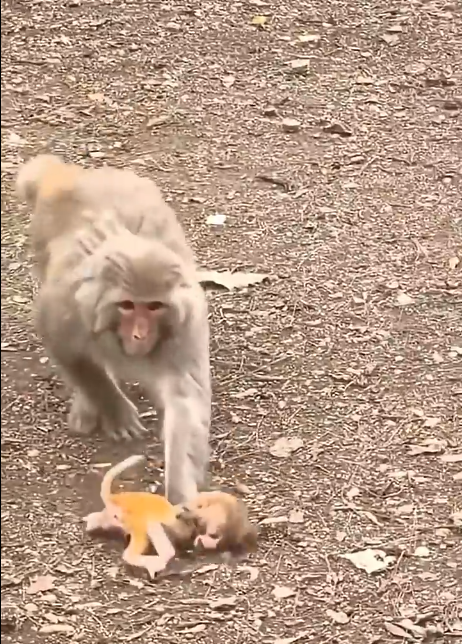
Despite the apparent harshness, these experiences teach valuable lessons. Observing abandonment among monkeys reminds us of the fragility of life. It reminds us that love and attachment, while powerful, exist alongside the primal demands of survival. In many ways, it challenges us to reconsider how we view family, loyalty, and resilience. Even in human society, relationships can be strained or broken by circumstances beyond control. Seeing this mirrored in the animal world underscores a universal truth: life is unpredictable, and attachments are sometimes tested in ways we cannot prevent.
Stories of abandoned monkeys can also inspire empathy and action. Wildlife rehabilitation centers around the world often rescue orphaned monkeys, providing care, nourishment, and socialization until they can survive independently. These interventions highlight the tension between instinctual behavior and the human desire to protect and nurture. They remind us that while abandonment is natural, it is not inevitable when humans choose to intervene responsibly.
Moreover, abandonment does not define a monkey’s entire life. Many animals grow to adapt and survive despite early rejection. They learn to navigate social hierarchies, find new companions, and develop resilience. Observing this adaptability can be inspiring. It is a reminder that adversity, though painful, often fosters growth and resourcefulness.
There is also a poetic aspect to this harsh reality. Life in the wild is raw and unfiltered. Monkeys abandon their loved ones not out of malice but because life is often uncompromising. In witnessing this, we confront the stark truth that relationships, survival, and loyalty are interwoven with challenge. We are reminded that love, protection, and attachment are not guaranteed, and that resilience is essential for survival.
In some ways, the abandonment of young monkeys is a mirror to our own fears and experiences. Humans too face rejection, loss, and the feeling of being left behind. Observing these behaviors in animals offers perspective. It reminds us that survival is universal, that the struggle to endure is shared across species. The pain of abandonment is real, but it is part of the larger story of life — a story of struggle, adaptation, and eventual resilience.
It is also important to note that abandonment among monkeys is not permanent in every sense. Bonds can be restored, new connections can form, and survival strategies evolve. Even when a mother leaves her young, the group or the individual may offer support. Nature is not devoid of care or compassion; it is simply structured differently from human ideals. These observations help us appreciate the balance between instinct and social support, between survival and nurture.
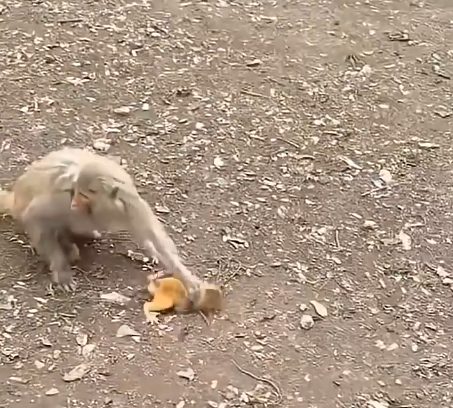
Finally, witnessing abandonment in monkeys can evoke a complex mix of emotions: sadness, empathy, fascination, and respect. Sadness for the immediate suffering, empathy for the vulnerable, fascination with the intricacies of social behavior, and respect for the animal’s resilience and adaptability. Each abandoned young monkey becomes a living testament to the tension between instinct and attachment, survival and emotion.
In conclusion, monkeys are animals that abandon their loved ones, and it is a reality that is both painful and enlightening. It reflects the harsh demands of survival, the complexity of social hierarchies, and the flexibility of bonds in the animal world. While it may seem cruel to human eyes, it is an essential part of life in the wild. Yet, even amidst abandonment, there is resilience, there is hope, and there are lessons about adaptability, empathy, and the delicate balance of existence.
Observing these behaviors reminds us of life’s fragility, the strength of survival instincts, and the profound beauty of resilience. It teaches that abandonment, though painful, is not the end. Nature has a way of challenging the vulnerable, yet it also offers opportunities for connection, recovery, and growth. In the raw reality of monkeys abandoning their loved ones, we see a reflection of life itself — imperfect, challenging, yet filled with moments of unexpected grace and perseverance.
Even as we mourn the losses, witness the struggles, and feel the sting of separation, we also witness survival, learning, and eventual triumph. Life moves forward, lessons are learned, and bonds, though sometimes broken, can be rebuilt in new and unexpected ways.
Monkeys teach us that love and survival coexist in tension, that abandonment can be a tool of life rather than cruelty, and that even the most vulnerable have the capacity to endure. They remind us that life is not always fair, but it is always resilient.