As a professional dog groomer, I’ve seen a lot in my career. I’ve encountered dogs with matted fur, cracked paw pads, ear infections, and overgrown nails that curled dangerously. I’ve seen neglect, I’ve seen accidents, I’ve seen illnesses—but nothing prepared me for what walked into my grooming salon that day.
It started like any other appointment. I received a call from a local rescue organization: they had rescued a dog from a neglected home and needed a groomer to help clean him up and assess his condition. They warned me the dog was in “poor shape,” but even that description did not prepare me for the reality.
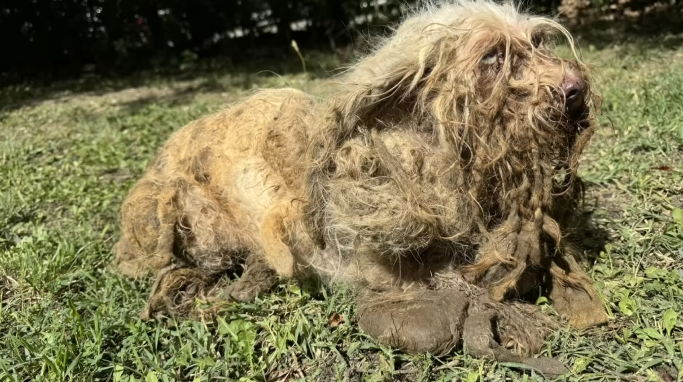
When the dog arrived, I was struck by his size first—he was a medium-sized shepherd mix, but what immediately caught my attention was the state of his coat. Thick, dirty mats clung to his skin like chains, some as large as my fist. His fur was caked with mud, feces, and dried food. I could see parts of his skin through the matted clumps, raw and irritated from constant rubbing and neglect. The smell hit me before he even stepped inside—a pungent mix of rot, urine, and unwashed dog smell so strong that it made my eyes water.
The dog stood silently as his handler led him into the grooming area. At first, he didn’t move much. His eyes were wary but curious. I noticed immediately that he seemed underweight. His ribs were visible beneath his fur, and his legs looked weak, as if carrying his body was a struggle. He was trembling slightly, but it wasn’t cold—this was a deep exhaustion, the kind that comes from prolonged neglect and hunger.
I knelt down slowly to assess him. His coat was beyond regular grooming—it required careful, patient de-matting and detangling. But as I gently touched his fur, he flinched. I noticed for the first time the sores along his back and legs. Some were fresh, red and raw, while others had scabbed over, infected, and painful. His ears were crusted with buildup, his eyes watery and irritated, and his nails had grown so long they curled and dug into the pads of his paws.
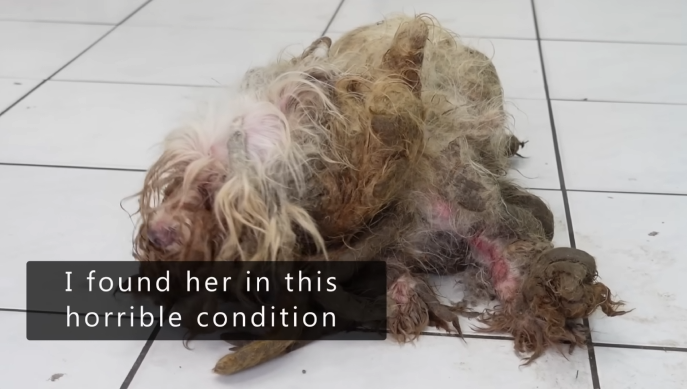
This wasn’t just poor grooming. This was a living nightmare of neglect.
I started with the most urgent task: cleaning his ears and assessing his skin. The odor from his ears was so strong it made me step back. He winced as I carefully swabbed the crusted buildup. Underneath, I found signs of infection. His eyes were inflamed, and his tear ducts had dried into sticky, yellowed trails across his cheeks.
Next, I tackled his nails. Each paw was a delicate balance between careful clipping and fear of causing him pain. His nails had grown so long they twisted unnaturally, and trimming them was slow and meticulous work. He flinched occasionally, but never growled or snapped. I could feel his trust building slowly.
Then came the mats.
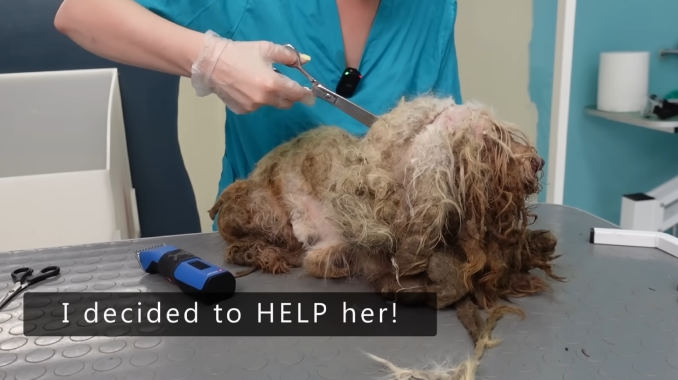
I’ve worked with matted dogs before, but nothing like this. His fur was so entangled that removing the mats would require hours of patience, comb by comb, sometimes cutting through the most stubborn sections. Underneath, I discovered layers of skin irritation, hidden abscesses, and small wounds that had festered unnoticed for weeks, maybe months. Some areas were so raw that a slight tug on the mat made him flinch sharply. I spoke to him gently, soothing him, telling him it would be okay. Slowly, he relaxed enough to let me continue.
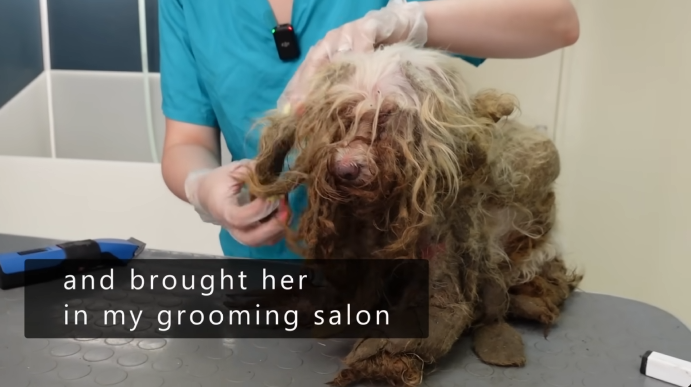
Throughout the grooming, I noticed his behavior. Despite the pain, despite the filth, despite the fear he must have endured, he never snapped at me. He was cautious, yes, but patient. He would sit, shift slightly to ease pressure on sore spots, and allow me to clean him, clip him, and remove the mats. The sadness in his eyes was overwhelming. You could see how long he had waited for kindness, how long he had endured without hope.
After hours of work, the transformation—though incomplete—was remarkable. His eyes were clearer after a gentle cleaning, his fur, though still thin in patches, was free of the worst mats. His nails were clipped, and his ears were treated for infection. I could finally see his true coat—a soft, short layer that had been hidden under months of neglect.
But more than the physical condition, what struck me most was his spirit. Despite everything, he was still willing to trust. Despite the pain he endured, he wagged his tail tentatively when I spoke softly. Despite the filth and sores, he nudged my hand with his nose, asking for comfort.
After the grooming, I sat down with the rescue handler and discussed the dog’s condition. He would need extensive medical care: antibiotics for infections, treatment for skin sores, possibly minor surgery to correct wounds that had festered too long. He would need proper nutrition to regain strength. And he would need patience—months, maybe years, to fully heal from the trauma of neglect.
I thought about how easily this dog could have been lost. Many dogs in this condition never survive long enough to be rescued. Many are surrendered to shelters or left to fend for themselves on the streets, unnoticed and forgotten. Yet here he was, alive and still willing to trust, still willing to seek comfort in human hands.
That night, I could not stop thinking about him. I replayed the images in my mind: the matted fur, the sores, the emaciated frame, the trembling legs, and the eyes—those deep, intelligent eyes that held both fear and hope. I realized that as a groomer, my role was not just to clean or trim a dog. It was to see them fully, to recognize their suffering, and to begin the slow process of restoration.
Every dog that walks into my salon is a story, but this one was a warning and a lesson all at once. Neglect leaves marks that are more than skin deep. It leaves scars on the body and on the spirit. Yet it also leaves a chance for redemption, a chance for healing if someone cares enough to notice and act.
In the weeks that followed, I continued to work with him alongside the rescue team. We bathed him gently every few days, applied ointments to his sores, and monitored his healing progress. Slowly, his coat started to shine. Slowly, his eyes regained some brightness. Slowly, he started to walk with more confidence, though his body still bore the signs of abuse and neglect.
The first time he wagged his tail fully, without hesitation, I cried. Not because I was relieved, but because I realized the depth of resilience in this creature. He had endured what I can only describe as unimaginable neglect, yet he was learning to trust again.
As a dog groomer, I’ve seen bad conditions before. I’ve seen dirty dogs, neglected dogs, even abused dogs. But nothing compared to him. Nothing matched the sheer extent of physical deterioration combined with the fragile but persistent hope in his eyes. He reminded me why I do this work—not for the grooming itself, but for the lives behind the fur.
He became my most memorable client, not because of the work it took to groom him, but because of the lesson he gave me: no matter how broken someone appears, there is still a capacity to trust, still a capacity to heal, and still a capacity to feel love again.
Eventually, the rescue found him a permanent home. I visited once after he had settled, and I could barely recognize him. His fur was soft and clean, his eyes sparkled with life, and his tail wagged constantly. He had gained weight, strength, and confidence. And yet, there was a quiet dignity in him—a resilience forged from the worst condition I have ever seen in my life.
That day, I realized that grooming is more than brushing fur or trimming nails. It’s about seeing a soul in pain and giving them a chance to heal. It’s about recognizing suffering and responding with compassion. And sometimes, it’s about witnessing a transformation so profound that it stays with you forever.
He was no longer the dog whose weak, festering body could barely carry him. He was a survivor. He was proof that even in the worst circumstances, hope and care can restore life and spirit. And as a groomer, I will never forget him.