It started as a quiet afternoon. The sun hung low in the sky, casting long shadows over the street. The neighborhood was calm, the kind of calm that makes small disturbances stand out in stark relief. That was when I first noticed him.
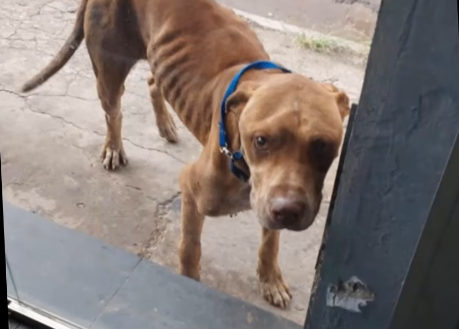
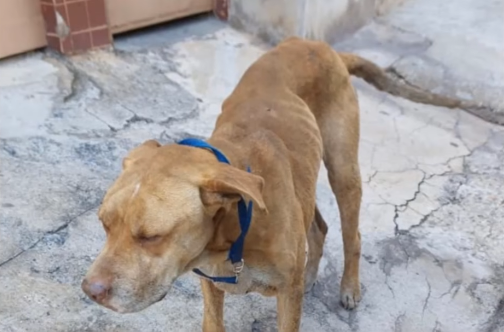
At the end of my driveway, a dog sat motionless. His fur was matted and dull, streaked with dirt and dried blood. His ribs jutted sharply beneath his skin, and sores covered his legs and back. The stench of infection lingered around him, a pungent, sour smell that clung to the air.
For hours, he simply sat there. Not moving forward, not running away, not even barking. His head dropped low, and his eyes—faintly clouded but still intelligent—watched the house with a mixture of hope and exhaustion.
I hesitated at first. His body looked like it couldn’t support him much longer. Every breath he took seemed laborious, every twitch of a paw a battle against weakness. Still, he stayed.
I went inside and grabbed a bowl of water and a small towel. As I returned, he lifted his head slightly, nostrils flaring at the scent of moisture. I crouched down a few feet away and set the water on the ground.
He didn’t rush to drink. He didn’t dare move quickly. Every inch of his motion was measured, cautious, as though he feared this was a dream that might vanish if he made the wrong move. I could see it in his eyes—he had been through too much to trust easily.
When he finally lowered his head and lapped at the water, I noticed how frail he was. His legs trembled under him, his tail didn’t wag, and his breathing was uneven. Infection had taken root in his wounds, festering under the layers of dried mud and scabs. His body was a map of suffering, each mark a story of neglect or accident.
I called the local animal rescue while gently trying to comfort him. He flinched at my voice at first, ears flattening against his head, but then something changed. He seemed to understand I wasn’t a threat. He leaned slightly against my legs, letting me touch him for the first time.
The rescue volunteers told me they could arrive in a few hours. I stayed with him, brushing his matted fur gently with the towel, trying not to cause him pain. He didn’t resist. He didn’t move away. He just sat, eyes half-closed, trusting enough to let me ease some of his suffering.
During those hours, I realized something remarkable. Despite the pain, despite the sores and weakness, despite the fact that his body had endured unimaginable hardship, he had not given up. He had not turned away when the world had turned its back on him. He had waited.
When the volunteers arrived, it took careful coordination to move him. His hind legs barely supported his weight, and he had to be lifted with blankets to avoid aggravating his wounds. Still, through it all, he did not cry. He did not snap. He simply let the humans around him handle what his broken body could no longer do.
At the clinic, the veterinarian examined him thoroughly. He had severe infections on his legs and back, malnutrition, and exhaustion so profound that even standing caused pain. But most importantly, he was alive—and his spirit was intact.
“Some dogs don’t make it after this long,” the vet said quietly. “But he waited. He held on.”
That phrase stayed with me. He had waited. He had endured hours outside my house, days perhaps, maybe weeks, clinging to hope that someone—anyone—might come. That hope alone had carried him through pain that would have broken many others.
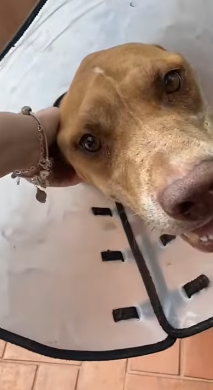
The first night in recovery was difficult. He trembled in his small kennel, soaked in antiseptic and bandages, but still alive. He lifted his head when I visited, recognizing me, and leaned slightly toward my hand. There were no grand gestures—no joyful jumps—but the quiet trust in his eyes spoke volumes.
Over the next several weeks, I followed his progress closely. Each day, he gained a little strength. The festering wounds healed slowly, guided by careful veterinary care. He learned to trust hands again, slowly allowing gentle pats and scratches behind the ears. His eyes brightened, and the faint tail twitches grew more frequent.
Every evening, I would sit by his side, talking softly to him. I told him stories of the world outside, of people who cared, of the life that awaited him once he recovered. I told him he was safe now, that he no longer needed to endure pain alone.
And in return, he would lift his head, sometimes nuzzle my hand, and sometimes just look at me with an expression I could only describe as gratitude. Not the kind that can be spoken, but the kind that is written into the eyes, the ears, the entire being.
Months passed. The day finally came when he could walk short distances with support. The bandages were removed, and his coat began to show glimmers of the shine it once had. I named him Chance—because that is exactly what he had given himself. A chance to survive, a chance to trust again, a chance to experience kindness.
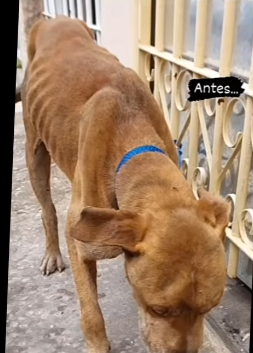
When I brought him into my yard for the first time, unrestrained by bandages or blankets, he paused. He sniffed the ground carefully. His legs were still weak, but his spirit was unbroken. For a moment, he simply stood there, looking toward the street. Then, as if realizing he could finally move forward, he began to walk slowly, taking careful steps on unsteady paws.
I watched silently, tears streaming. This was the dog who had stood for hours outside my house, unable to bear the weight of his own suffering. This was the dog who could have given up, who could have surrendered to hunger, infection, and neglect. And yet here he was—alive, moving, trusting again.
It was during one of these walks that he finally wagged his tail fully for the first time. Not a hesitant twitch, not a careful flick, but a genuine, joyful wag. His eyes shone brighter than I had ever seen them. He barked softly, almost experimentally, testing the sound of his own voice. And in that moment, I realized that he wasn’t just surviving. He was living again.
Chance became a fixture in the neighborhood. People who had once ignored him or looked away now stopped to pet him, to admire his resilience. He learned to play again, to respond to joy, to interact with other dogs without fear. He became a testament to the power of hope, patience, and human kindness.
But he never forgot.
Even months later, he would pause at the end of the driveway, glance toward the street, and settle in his spot, as if remembering those hours he had waited, body trembling with exhaustion, hoping someone would see him. And every time he did, I would sit beside him, scratch behind his ears, and remind him that he no longer had to endure alone.
Some wounds heal slowly, some spirits remain cautious after trauma. But Chance’s story was proof that even when the body is weak, the spirit can endure. Even when festering pain seems unbearable, hope can carry a soul forward. And sometimes, all it takes is one moment of recognition—one person who chooses to care—for a life to be saved.
The dog who once stood helpless in front of my house, his body unable to bear the weight of suffering any longer, now walks confidently, tail high, eyes bright, and heart open. His story is a reminder of the resilience that lives in all creatures, and of the responsibility we hold to notice, to act, and to care.
Sometimes survival is not just about strength. Sometimes it is about waiting for a single chance. And Chance, in every sense of the word, took it—and never let go.