Deep in the lush green canopies of a sprawling forest, life among the monkeys thrived with its own rhythm. Sunlight filtered through the thick foliage, casting warm golden patches on the forest floor. Birds chirped in a medley of tunes, insects hummed tirelessly, and the distant roar of a waterfall added a serene backdrop to the daily life of the forest dwellers. Among the trees lived a troop of monkeys, each member intricately connected to the other, sharing food, grooming, play, and protection. Life was a careful balance of survival, social bonds, and instinct. Yet, one small moment threatened to unravel this balance—a newborn monkey had been abandoned by its mother.
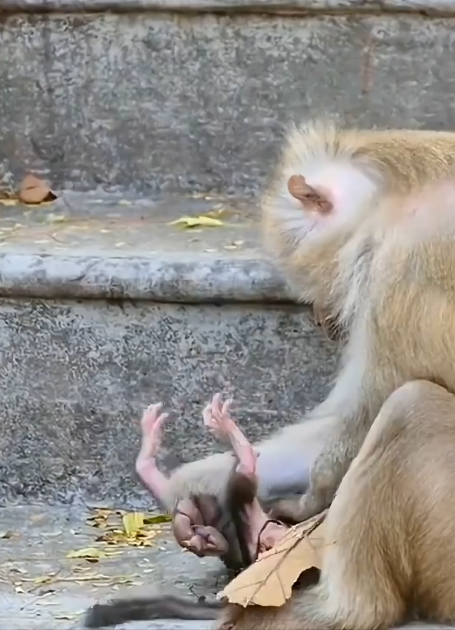
The tiny infant, barely hours old, had been left in a shallow hollow beneath a large tree. Its fur, still damp from birth, clung to its fragile frame. It lay trembling, eyes wide and innocent, calling out for the warmth and comfort that only a mother could provide. The cries were soft, pitiful, and desperate, echoing faintly among the thick underbrush. Yet, the mother who should have been there was nowhere to be seen.
Abandonment in the wild can happen for many reasons. Sometimes, a mother may be inexperienced or frightened. Other times, environmental pressures—scarcity of food, predation, or illness—may force a mother to make difficult decisions. In this case, the reasons were unclear. The troop had moved on, leaving the newborn behind, and the tiny creature faced the perilous reality of survival alone.
Hours passed, and the infant’s cries grew weaker as hunger and cold began to take their toll. It rolled helplessly in the soft leaves, its small limbs unable to find the strength to cling or grasp. Predators prowled silently nearby, and even the smallest noises of the forest could spell danger. Yet, amidst this vulnerability, a glimmer of hope appeared.
A villager named Arun, who often wandered along the forest edge collecting herbs and checking traps, heard the faint cries. At first, he thought it might be a lost bird or small mammal. But as he approached the hollow, his heart sank at the sight before him. There lay the tiny monkey, trembling, abandoned, and in urgent need of help.
Without hesitation, Arun scooped up the fragile creature. He felt the rapid, uneven beat of its tiny heart and the weightless frailty of its body. Carefully, he wrapped the newborn in a soft cloth and carried it back to his home, murmuring soothing words as he went. The forest, alive with danger and mystery, seemed momentarily distant. Here, in his hands, was a life that needed care, protection, and warmth.
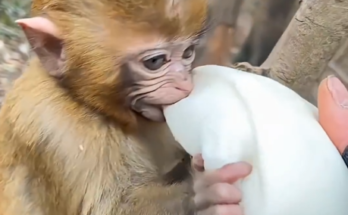
At home, Arun and his family immediately sprang into action. They built a small, secure nest for the newborn, lined with soft cloth and leaves. The infant was weak and hungry, unable to suckle on its own. Arun mixed a special formula to feed the baby, mimicking the nutrients found in monkey milk. Every hour, he fed the infant, whispered reassuring words, and stroked its damp fur, providing the human equivalent of a mother’s gentle touch.
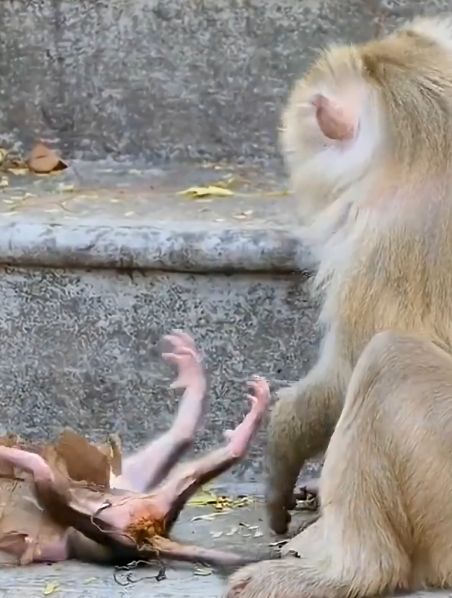
Days turned into weeks. The infant, whom the family named Mimi, began to show signs of growth. Her fur thickened slightly, her eyes brightened, and her tiny hands started to grasp with more confidence. Yet, despite these improvements, Mimi remained cautious and fragile. Having been abandoned by her mother had left an imprint, a lingering fear that even warmth and care could not immediately erase.
Arun recognized that Mimi needed more than just food and shelter; she needed companionship and guidance. They decided to gradually introduce her to other rescued monkeys in the village’s small sanctuary. Here, young monkeys who had been orphaned or rescued from danger lived under careful observation. The troop, though composed of different ages and personalities, provided Mimi with a sense of social learning, an opportunity to understand hierarchy, play, and interaction.
The first encounters were timid. Mimi approached the older juveniles with wide eyes, unsure of their intentions. A few huffed and waved their hands, signaling caution. But gradually, with gentle encouragement from Arun and the patience of the other monkeys, she learned to interact. She mimicked their grooming, learned to balance on branches, and began to understand the subtle cues of communication within a troop. Each small success built confidence, helping her heal not only physically but emotionally from the abandonment she had endured.
Mimi’s story, however, was not just one of human intervention. Her natural instincts began to emerge. She learned to climb with precision, leap from branch to branch, and explore safely within her enclosure. Arun carefully observed her, noting how quickly she adapted to new challenges. Even after being abandoned, Mimi retained the curiosity and intelligence that all monkeys possess. The combination of instinct and careful nurturing allowed her to thrive despite the trauma she had endured.
Social bonds were the next challenge. Monkeys are highly social creatures, relying on grooming, play, and hierarchy to maintain cohesion. Mimi had missed the crucial early bonding with her mother, and therefore needed to learn how to relate to her peers. At first, she would retreat from playful advances, flinch at grooming attempts, and vocalize in small, hesitant cries. But with consistent exposure and gentle guidance from older juveniles, she began to reciprocate. She offered grooming gestures, joined in playful chases, and even learned to assert herself subtly when others tested her patience.
One particularly moving moment occurred when an older female in the sanctuary, a surrogate mother named Lita, approached Mimi with a tentative gesture. She offered her back as a place to rest, demonstrating trust and acceptance. Mimi hesitated for a heartbeat, then climbed onto Lita’s back, curling tightly. For the first time, she experienced the feeling of protection and warmth from a mother figure other than Arun. Lita gently groomed Mimi, reinforcing the social skills the baby monkey had missed in her early days. This bond became crucial in helping Mimi regain confidence and social awareness.
Meanwhile, the human caregivers played a critical role in reinforcing positive experiences. Arun introduced safe toys, climbing structures, and food-based challenges that mimicked the natural learning environment of the forest. These activities allowed Mimi to strengthen her muscles, improve coordination, and develop problem-solving skills. Each success, whether it was reaching a dangling fruit or balancing on a narrow branch, built resilience and reinforced the lesson that she could thrive even without her biological mother.
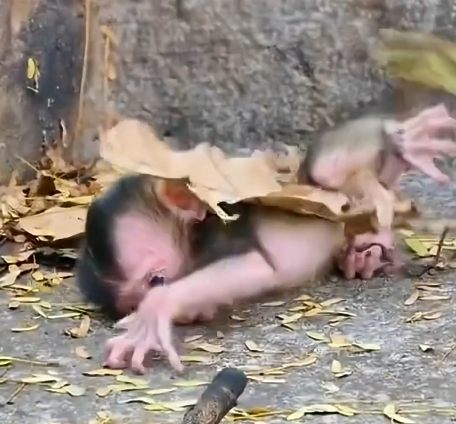
Months passed, and Mimi grew from a fragile newborn into a spirited juvenile. Her fur became sleek and glossy, her eyes sparkled with intelligence, and her small hands and feet became strong and dexterous. She could climb, leap, and explore confidently, often leading other younger monkeys in playful chases. The memory of abandonment lingered in her cautious glances and brief hesitations, but it no longer defined her world. Instead, Mimi had learned that life could be nurturing, even after trauma, and that bonds—whether formed with humans or surrogate monkeys—could provide the safety and guidance she had lost at birth.
Mimi’s story quickly became known beyond the village. Visitors came to the sanctuary to witness the miraculous recovery of the abandoned newborn. Scientists documented her behavior, noting her quick learning, social adaptation, and resilience. They marveled at the ability of a monkey, separated from her mother, to form bonds and thrive in a surrogate environment. For the villagers, Mimi became a symbol of hope, resilience, and the profound impact of compassion.
Yet, perhaps the most important lesson was emotional. Mimi’s journey illustrated that survival in the wild is not solely about strength or instinct—it is also about connection. Even in the absence of her mother, Mimi learned to trust, form attachments, and navigate complex social structures. She learned that care could come in many forms: from humans, from surrogate monkeys, and from the friendships she cultivated as she grew.
One rainy afternoon, when the sanctuary was quiet, Mimi clung to Arun’s shoulder, chirping softly as he stroked her fur. Her small body shivered slightly, but the gesture was not of fear—it was of trust and comfort. Nearby, Lita and other young monkeys played, leaping through the trees and sharing fruits. Mimi watched, then joined them, demonstrating courage and confidence born from nurturing, patience, and careful observation.
Over time, Mimi’s presence had ripple effects. Other rescued monkeys, particularly those who had suffered abandonment or trauma, began to respond more openly, inspired by her resilience. The human caregivers observed that the lessons of patience, compassion, and structured care not only helped Mimi but enhanced the welfare and development of all the young monkeys in the sanctuary.
Mimi’s story remained a living reminder that life, even after abandonment, could be full of hope. Monkeys, like humans, form deep bonds and learn from both affection and example. Mimi had been abandoned, yes, but she had also been rescued, nurtured, and guided. Through her journey, she demonstrated that resilience is born from support, trust, and love—whether from human hands or from the community of her own species.
As the sun set behind the mountains, casting long golden shadows over the sanctuary, Mimi climbed to the top of a tall branch, looking out over the forest she might one day return to. She stretched her small limbs, leapt gracefully to a lower branch, and chirped softly—a song of life, survival, and the triumph of care over abandonment.
Though she had begun life alone, trembling in a shallow hollow, Mimi now thrived surrounded by those who had nurtured her, guided her, and given her the chance to grow. Her journey had begun with desperation, yet it transformed into one of courage, learning, and belonging—a testament to the extraordinary resilience of life in the forest, and the profound difference that love, patience, and human intervention can make.
In the forest and the village beyond, Mimi would always be remembered as the newborn monkey who had been abandoned—but who, against all odds, had been rescued, nurtured, and allowed to flourish. Her story continued, a living example of hope, resilience, and the enduring bond between humans and the creatures they choose to protect.