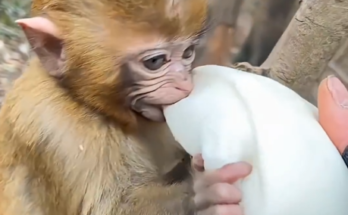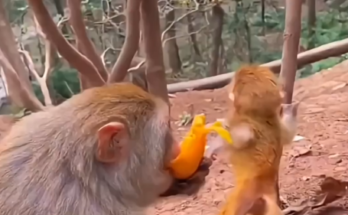
In the dense, sun-dappled forests of the mountains, a troop of monkeys lived among the trees, moving through the canopy with agile grace. The forest was alive with chatter, rustling leaves, and the occasional distant roar of a river. Life for a monkey troop was a careful balance of play, learning, survival, and social order, and within this troop, one small baby monkey was learning a lesson he would never forget—though it came not from play or danger, but from the strictness of his mother.
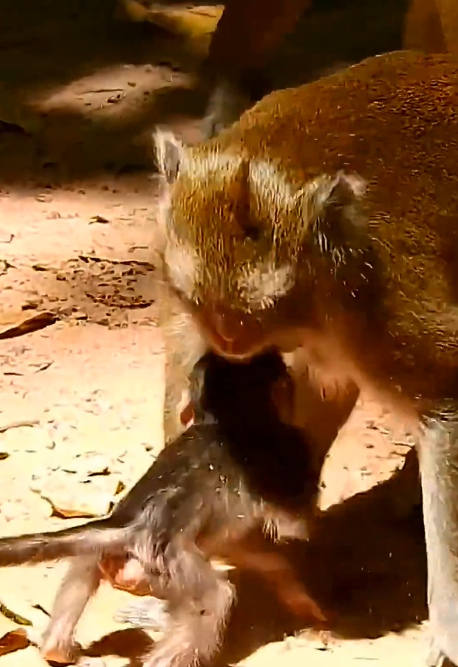
The mother monkey, an experienced and dominant female named Kala, had always taken her responsibilities seriously. She was disciplined, vigilant, and determined to ensure her baby learned the rules of the troop quickly. She corrected mistakes without hesitation, insisted on proper behavior, and rarely showed the playful warmth that other mothers displayed. For Kala, life was about survival and preparation; indulgence was a luxury she could not afford.
Her baby, a small brown monkey named Kiko, had been born into this strict environment. He was naturally curious and sensitive, easily startled by loud noises or sudden movements. Unlike some babies who might climb eagerly, explore boldly, or play freely with others, Kiko hesitated. His heart raced at the slightest sign of disapproval, and each sharp word or corrective gesture from his mother filled him with fear.
At first, Kiko tried to stay close to his mother, as instinct demanded. He clung to her fur, following her through the branches and mimicking her movements. But each mistake—slipping on a branch, dropping a piece of fruit, or wandering too far from the group—brought stern chattering, a sharp swipe of her hand, or a swift nudge to remind him of the rules. Over time, these corrections made him wary. Kiko began to associate proximity to his mother with anxiety. The closer he was, the more likely he was to be scolded.
One sunny morning, Kiko’s fear reached its peak. The troop was playing near a fruiting tree, the branches heavy with ripe bananas and figs. Other juveniles leapt effortlessly from branch to branch, squealing with excitement. Kiko wanted to join them, but he hesitated. He glanced at his mother, who was perched higher up, watching him with sharp eyes.
“Careful, Kiko! Don’t fall!” she called. Her tone was firm, bordering on harsh.
The baby froze. His hands shook as he gripped the branch. A slip could mean a reprimand—or worse. He inched backward, lowering himself to a safer branch, and tried to hide behind a thicker limb. His heart pounded in fear, and his small body trembled.
Kala noticed his retreat and let out a frustrated chattering. “Kiko! Stop hiding! Come here! You must learn!”
But Kiko could not move. He wanted to obey, but the anxiety swirling in his chest made him feel paralyzed. His mother’s strictness, intended to guide him, had become a barrier. He was afraid to be with her, afraid to make a mistake, afraid of her disapproval.
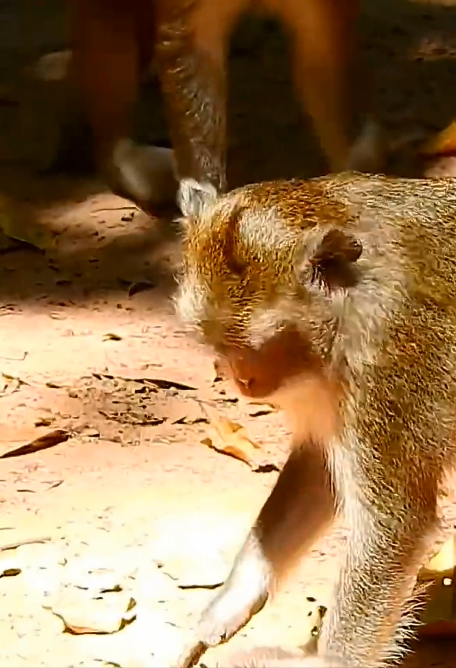
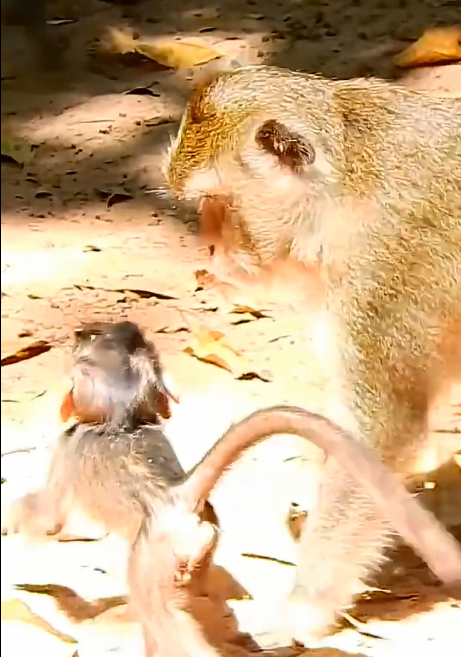
The situation continued for days, with subtle tension building between mother and child. Kiko increasingly sought refuge away from Kala, hiding in the lower branches or staying close to the forest floor while the mother foraged or supervised from above. Other monkeys noticed his unusual behavior. Juveniles occasionally called to him, urging him to join in play, but he hesitated. Even when the troop was at ease, Kiko remained cautious, his gaze constantly flicking to his mother.
It was during one such quiet afternoon that the consequences of this fear became clear. A small snake slithered silently along the ground, approaching the cluster of juveniles. Kiko, perched nervously on a low branch, froze in panic. He wanted to warn the others, but his fear held him back. Kala, noticing the snake from above, leapt swiftly, her sharp cries echoing through the forest. The other monkeys scattered, avoiding the snake just in time.
Kiko’s relief was immediate but bittersweet. He had been too afraid to act. His mother’s strictness had taught him caution—but it had also taught him hesitation. He realized, with a pang of guilt, that fear could prevent him from protecting himself and others when it mattered most.
Over the next several days, Kiko remained withdrawn. He climbed cautiously, avoided loud calls, and rarely engaged with the other juveniles. He ate quietly, groomed himself obsessively, and sought the safety of the shadows. The forest, normally alive with wonder and discovery, felt intimidating and overwhelming. He longed for his mother’s warmth but could not bring himself to approach her.
Kala noticed this change and grew concerned. She had intended to teach him discipline, resilience, and awareness of danger, but she had not anticipated that her methods would instill fear rather than confidence. For the first time, she hesitated before scolding him, observing his behavior with a mixture of worry and reflection.
One evening, as the sun dipped below the horizon, casting golden light through the canopy, Kiko sat alone on a low branch, trembling as a gentle breeze rustled the leaves. Kala approached quietly, not with sharp words or corrective gestures, but with soft chattering and slow, deliberate movements. She perched nearby and offered a slow blink—a signal of calm and reassurance in monkey communication.
Kiko’s ears twitched. He recognized the gesture but remained still, unsure. The forest seemed to hold its breath as mother and child sat together, a silent dialogue passing between them. Kala let him set the pace. She did not demand closeness, she did not rush him. She simply remained, present and steady, giving him the space to choose.
After several long minutes, Kiko inched closer, cautiously touching her arm with his tiny hand. Kala responded with a gentle nuzzle, letting him know he was safe. That small moment marked the beginning of a subtle transformation. Kiko began to understand that his mother’s strictness did not negate her love. He began to learn that discipline could coexist with care, that guidance could be firm yet compassionate.
The following days brought gradual changes. Kiko ventured a bit farther, climbing higher into the branches with Kala nearby. When he made mistakes, she corrected him, but the tone was softer, the gestures less threatening. Kiko began to engage in play again, testing his limits with the guidance of a mother who now balanced discipline with reassurance.
He still felt fear at times, but it became a tool rather than a barrier. Fear reminded him to be cautious, to respect the forest, and to pay attention—but it no longer immobilized him. Slowly, confidence returned. He learned to leap across wider gaps, to reach for fruits without hesitation, and to follow his mother’s lead in foraging and social interactions.
The troop adapted as well. Juveniles who once played freely alongside Kiko now offered gentle encouragement, reinforcing his cautious bravery. Adult monkeys observed the interaction between mother and child, noting how discipline could coexist with nurturing, and how fear, when guided, could become resilience.
Over weeks and months, the bond between Kiko and Kala grew stronger. The baby no longer hid from his mother. Instead, he approached her intentionally, seeking guidance, comfort, and protection. He learned to anticipate her corrections, understanding that they were part of learning and survival rather than punishment. Kala, in turn, learned to temper her strictness with patience and empathy, recognizing that each child requires a unique balance of discipline and encouragement.
One afternoon, as the troop foraged near a riverbank, Kiko encountered a situation that tested his newfound confidence. A large bird swooped close, startling the younger monkeys. Kiko froze momentarily, but he remembered his mother’s guidance. He climbed higher, using the cover of branches for protection, and called softly to the other juveniles, guiding them to safety. Kala observed proudly from above, nodding with approval. Her strictness had not been removed—it had been transformed into a foundation for wisdom and courage.
The experience taught Kiko an invaluable lesson: fear and respect are not enemies of love; they are companions. A strict mother can instill caution, survival instincts, and awareness, but with patience, understanding, and reassurance, that same strictness can coexist with trust, affection, and security.
By the time the seasons changed, Kiko was no longer the timid, fearful baby he had once been. He had grown into a capable, alert juvenile, capable of navigating the forest with confidence while maintaining respect for his mother and the social hierarchy of the troop. He climbed higher, leapt farther, and engaged in play without hesitation. Yet he never lost the lessons instilled by the careful, firm guidance of Kala—the mother who had been strict but, in doing so, had taught him to survive, to respect, and ultimately, to trust.
In the forest, life is a balance of joy and caution, freedom and responsibility. For Kiko, the journey from fear to trust was shaped by the discipline of a mother whose love was expressed through strict guidance. And while fear had once kept him away, it ultimately became the pathway to courage, wisdom, and the deep bond that could only exist between a mother and her child in the wild.
Through it all, the troop watched, learned, and adapted. The story of Kiko and Kala became a living lesson in the forest: strictness is not the enemy of love, and fear, when met with patience and understanding, can become the bridge to trust, resilience, and lasting connection.