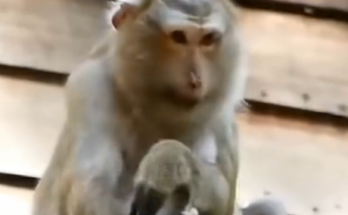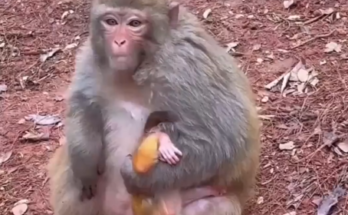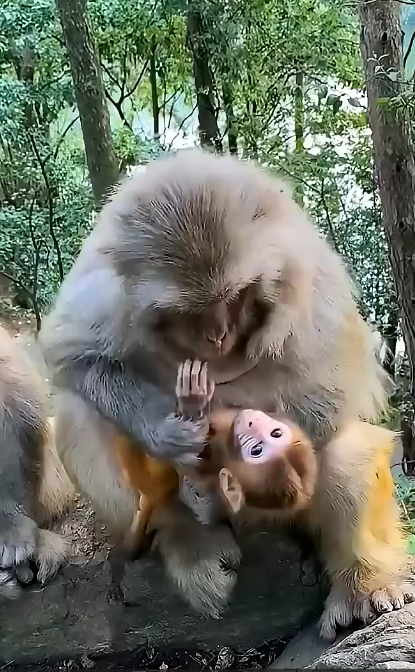
In the deep green forest where the trees grew tall and the ground was never truly silent, a young monkey sat alone on a low branch, hugging its knees tightly. The air was thick with afternoon heat, but the young monkey felt cold inside. Below, the troop moved as usual—grooming, eating, calling to one another—but the young monkey did not move with them.
Today was different.
Today, the young monkey was angry, hurt, and confused. And for the first time in its short life, one thought repeated again and again in its mind:
I’m leaving my angry mother.
The mother monkey was known in the troop for her strictness. She was strong, experienced, and fiercely protective, but her temper was sharp. She scolded often, pushed her child to learn quickly, and showed little patience for mistakes. Other mothers were gentler, allowing their babies to cling longer, to play more freely. But not this one.
“Hold tighter.”
“Climb faster.”
“Stop crying.”
These were lessons of survival, the mother believed. The forest was dangerous, and weakness could kill. She had lost siblings when she was young. She had learned the hard way. And she wanted her child to survive at any cost.
But the young monkey did not understand that.
All it felt was fear.
That morning, everything had gone wrong. The young monkey had slipped while climbing and cried out in panic. Instead of comfort, the mother reacted with anger. She shouted, grabbed the young monkey roughly, and pushed it back onto the branch.
“No more clinging!” her voice seemed to say. “Learn!”
The young monkey froze. Its heart raced. The scolding hurt more than the fall.
When the mother turned away to feed, the young monkey stayed behind, trembling. Other monkeys glanced over but said nothing. This was family business. This was how life worked.
But inside the young monkey, something broke.
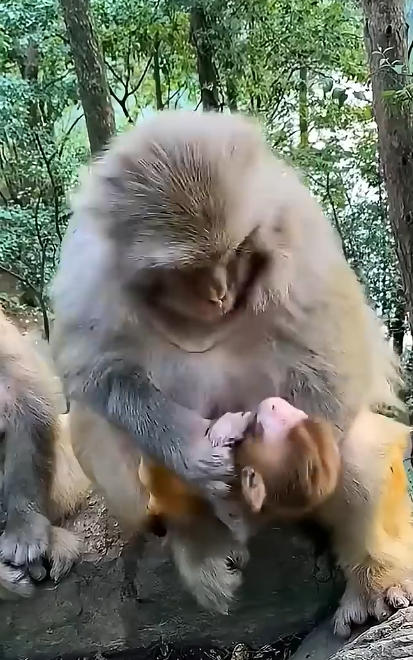
Why was love so loud?
Why did learning feel like punishment?
Why did safety feel so far away?
That was when the thought came: I will leave.
As the troop slowly moved deeper into the forest, the young monkey did not follow. It waited. The sounds of the group faded—branches shaking, calls echoing farther and farther away. Silence replaced them.
The forest felt enormous now.
The young monkey climbed down carefully, every step unsure. The ground smelled different—damp earth, fallen leaves, unknown danger. Fear wrapped around its chest, but anger pushed it forward. Anything felt better than staying with an angry mother.
“I can do this alone,” the young monkey told itself.
At first, freedom felt exciting.
The young monkey explored lower trees, jumped short distances, and found small fruits on its own. No one yelled. No one pushed. No one watched closely. The quiet felt like relief.
But freedom in the forest is never simple.
As the sun moved lower, shadows grew longer. Strange sounds crept out—rustling, distant calls, wings beating overhead. Hunger returned, sharper now. The fruit here was unfamiliar. Some tasted bitter. Others were hard to reach.
The young monkey tried to climb higher but hesitated. Without its mother nearby, every branch felt less trustworthy.
Night was coming.
The forest changed when darkness approached. The air cooled. Insects sang louder. Eyes watched from places unseen. The young monkey’s bravery faded quickly, replaced by a heavy loneliness.
For the first time since leaving, the young monkey cried.
Soft at first. Then harder.
There was no warm chest to cling to. No familiar heartbeat. No grooming hands to calm shaking fear. Anger toward the mother slowly mixed with something else—longing.
Meanwhile, far away, the troop had noticed.
The mother monkey turned suddenly, scanning the trees. Her child was not there. She called sharply. No answer. Again. Louder. Panic crept into her voice.
The troop stopped.
The mother’s anger vanished, replaced by raw fear. Memories flooded her mind—falls, predators, storms. She realized what her child must have felt. She realized how alone anger can make someone feel.
Without hesitation, she ran back, calling again and again.
Back in the shadows, the young monkey heard something.
A familiar voice.
At first, it didn’t respond. Pride and hurt held it still. She’s angry, it thought. She doesn’t care.
But the calls grew frantic. Broken. Different.
The young monkey climbed higher, peeking through leaves. There—moving quickly, searching wildly—was its mother. Her movements were not angry now. They were desperate.
The young monkey hesitated, heart pounding.
Then it answered.
A small, shaky call.
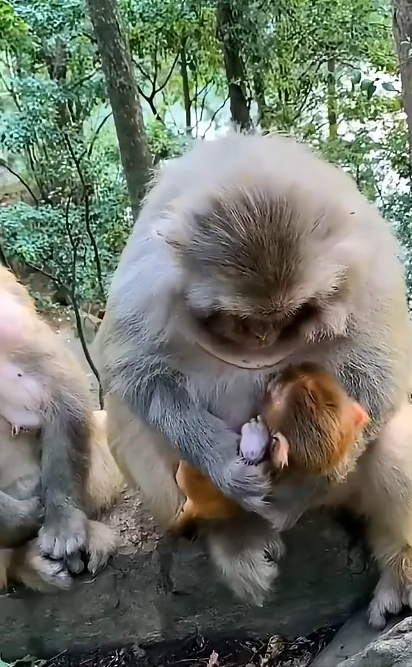
The mother froze. Then she ran toward the sound, ignoring everything else. When she saw her child, she leaped forward and pulled it close, wrapping arms tightly around the small trembling body.
This time, she did not scold.
She groomed gently. She held firmly. She stayed silent, letting warmth speak instead of anger. The young monkey cried into her fur, exhaustion pouring out at last.
In that moment, both learned something.
The young monkey learned that leaving does not always mean strength. That independence without safety can become danger very quickly.
And the mother learned that anger, even when meant to protect, can push love away.
They returned to the troop together, slower than before, closer than before. The mother allowed her child to cling longer that night. The young monkey held tighter—not out of fear, but understanding.
Life in the forest continued.
The mother was still strict at times. The child still stumbled and cried sometimes. But something had changed. Anger softened. Trust grew.
Because life of monkeys, like life of all beings, is not about perfection.
It is about learning—
how to love without fear,
how to teach without hurting,
and how even when someone leaves in anger,
the bond of family can still bring them home.