The call came in early in the morning, just after sunrise. A neighbor reported seeing a dog wandering near an old construction site on the edge of town—thin, dirty, and clearly abandoned. What made the situation more urgent was the way the dog behaved. He wasn’t running away from people, but he also wasn’t coming closer. Instead, he kept pacing back and forth, whining softly, always returning to the same spot near a pile of broken concrete.
When the woman arrived, she immediately sensed that this was not a simple rescue.
The dog stood still when he saw her. His ribs showed through his dusty coat, and his eyes carried a mix of fear and exhaustion. He took a step toward her, then stopped, turning his head to look behind him. She followed his gaze—and that was when she saw it.
Tucked deep in the shadows was another dog.
Smaller, weaker, and barely moving, the second dog lay curled against the rubble. His breathing was shallow, his body too tired to react. It was clear that he had been there for a long time. And just as clear was the bond between them.
The standing dog glanced back at the woman, then returned to his friend, lowering his head and nudging him gently, as if to say, “I’m here.”
In that moment, she understood: this dog wasn’t refusing help. He was guarding someone he loved.
The woman crouched down, speaking softly. She offered food and water, placing the bowls a safe distance away. The standing dog approached cautiously, eating quickly—but after only a few bites, he stopped. He picked up a mouthful of food, turned, and dropped it beside the weaker dog.
Again and again, he did this.
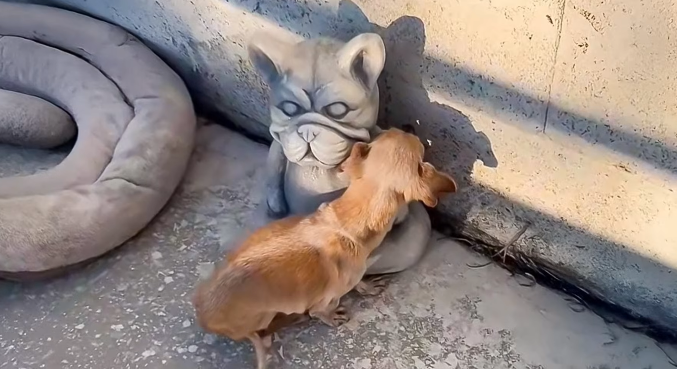
It was heartbreaking and astonishing at the same time. Despite his own hunger, he was putting his friend first. He refused to leave his side, refused to move more than a few steps away. Every time the woman tried to coax him toward her, he hesitated, looking back with panic in his eyes.
She realized something important then: if she wanted to save one, she would have to save both.
Calling for backup, she stayed with them, shielding them from the heat and speaking gently. She learned that the stronger dog was terrified—but not for himself. Each time she got closer to the weaker one, the standing dog positioned himself between them, not aggressively, but protectively.
Hours passed before help arrived. When the rescue team carefully approached the weaker dog with a stretcher, the stronger one panicked. He circled them, crying, trying to climb onto the stretcher himself. He refused to be separated, placing his body against his friend as if his presence alone could keep him alive.
So they let him stay.
They transported both dogs together, side by side, the stronger one pressing his head against the other’s neck during the entire ride. Every bump in the road made him tense, but he never moved away. It was as if he believed that letting go—even for a second—would mean losing his friend forever.
At the veterinary clinic, the diagnosis was grim. The weaker dog was severely dehydrated, malnourished, and suffering from an untreated infection. The vet warned that the next 48 hours would be critical.
As the staff prepared to take the weaker dog for treatment, they gently tried to move the stronger one away. He resisted—not with teeth or growls, but with desperation. He planted his paws firmly on the floor and cried, his whole body shaking.
The woman stepped in. She asked the vet a simple question: “Can he stay where he can see him?”
The answer changed everything.
They placed the stronger dog just outside the treatment area, separated only by a glass panel. The moment he saw his friend again, his panic eased. He lay down, eyes locked on the motionless body being worked on, refusing food, refusing rest, refusing to look away.
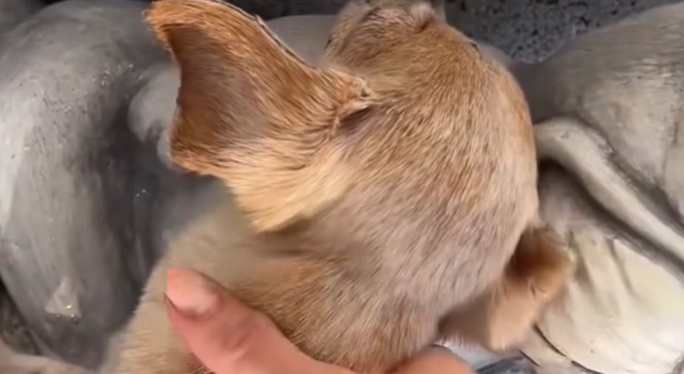
All night, he waited.
Something incredible happened during those long hours. Every time the weaker dog’s heart rate dipped, the stronger one stirred. Every time the vet returned to check on him, the stronger dog lifted his head, tail twitching faintly, as if offering silent encouragement.
By morning, the weaker dog was still alive.
Over the next few days, slow improvements began to show. Fluids helped. Medication worked. The weaker dog’s breathing steadied. And through it all, the stronger dog remained close—always watching, always waiting.
When the weaker dog finally opened his eyes, the reaction was instant.
The stronger dog jumped up, tail wagging furiously, whining in joy. He pressed himself against the glass, paws tapping excitedly. The staff stood silently, many of them fighting back tears. They had seen loyalty before—but rarely like this.
Once the weaker dog was stable enough, they were reunited in the same room. The moment they touched noses, the stronger dog collapsed beside him, as if his body had finally allowed itself to rest. He slept deeply for the first time since being rescued, his head resting protectively over his friend’s legs.
Recovery was slow, but it was shared.
As the weaker dog regained strength, the stronger one encouraged him to eat, nudging bowls closer, licking his face gently. When the weaker dog struggled to stand, his friend stayed beside him, matching his pace step by step.
The woman visited every day. She watched their bond grow even stronger as healing replaced fear. It became clear that these two had survived something terrible together—abandonment, hunger, loneliness—and that their connection had been the reason either of them was still alive.
When the time came to discuss adoption, there was no debate.

“They go together,” the woman said firmly.
She knew that separating them would be another trauma, another loss they did not deserve. So she opened her home to both dogs, committing not just to rescue—but to family.
Life in a home was a new world for them. At first, they stayed close, always touching. If one moved, the other followed. If one slept, the other curled nearby. Slowly, as safety became familiar, their personalities began to shine.
The stronger dog revealed a playful, gentle spirit. He loved toys, walks, and curling up beside his rescuer on the couch. But he always checked on his friend first, making sure he was nearby.
The weaker dog, once so fragile, grew braver each day. His strength returned, his eyes brightened, and his tail wagged more often. With his friend beside him, he learned to trust again.
Months later, it was hard to imagine that these two happy dogs had once been abandoned, clinging to life in the shadows. They ran freely in the yard, slept peacefully on soft beds, and greeted each morning with excitement instead of fear.
But the bond remained unchanged.
Even now, they still eat side by side. They still sleep touching. And if one ever walks out of a room, the other follows without hesitation.
The woman often thinks back to the moment she first arrived at the construction site—the moment she realized that rescuing one dog would never be enough.
Because sometimes, rescue isn’t just about saving a life.
Sometimes, it’s about honoring a love so strong that even abandonment couldn’t break it.