Every morning for ten long years, before the metal shutters rattled open and the smell of fresh bread drifted into the street, the old dog would already be awake. His name was Lucky—though no one had called him that in years—and he lay curled on a flattened piece of cardboard just inside the doorway of a small neighborhood store. One ear always twitched at the sound of footsteps, keys, or unfamiliar voices. Guarding was not something he did because he was trained. It was simply who he was.
Lucky arrived at the store as a young dog, all long legs and hopeful eyes. He had followed the owner home one rainy evening, tail wagging despite the mud clinging to his fur. The owner, a busy man with little patience for strays, tried to shoo him away at first. But Lucky kept coming back—waiting quietly outside the shop, never begging, never barking, just watching. After a week, the owner sighed, tossed him a leftover bun, and said, “Fine. You can stay. But you work.”
From that day on, Lucky became part of the store. Customers grew used to seeing him stretched across the entrance, his body a living barrier that somehow looked gentle and firm at the same time. Strangers hesitated when they saw him, not because he looked dangerous, but because his eyes were alert, measuring, protective. At night, when the street emptied and shadows grew long, Lucky stayed awake. He chased away rats, barked at suspicious figures, and once even scared off a thief who tried to pry open the back door. The owner laughed about that for weeks, telling everyone how “his dog” had saved him money.
But love was a word no one used for Lucky.
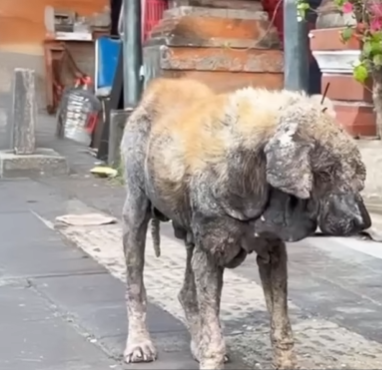
He ate what was left over—stale rice, scraps of meat, sometimes just soup poured over old bread. In summer, he panted through the heat on the concrete floor. In the rainy season, his fur never fully dried. Still, he never complained. Dogs like Lucky don’t complain. They endure. They believe.
Years passed. Lucky’s muzzle slowly turned gray. His once-springy steps became slower, more careful. He no longer leaped up when customers entered; instead, he lifted his head, tail thumping softly against the floor. People joked about how old he was getting. “Still here?” they’d say, surprised. Lucky would wag, proud, as if to say, Of course. Where else would I be?
Then one winter, Lucky got sick.
At first, it was just a cough. A dry, rattling sound that shook his thin body at night. The owner frowned, annoyed by the noise. “He’s getting useless,” he muttered. Lucky heard the tone but didn’t understand the words. He only knew that his chest hurt, that standing for long hours was harder now, and that sometimes his legs trembled beneath him.
He still guarded the store.
Even when his eyes became cloudy and his hearing dulled, Lucky stayed at his post. One evening, he didn’t have the strength to bark when a drunk man kicked the door. He only growled weakly. The owner noticed and scolded him the next morning. “What’s wrong with you? Sleep all night?” Lucky lowered his head in shame, though he had tried his best.
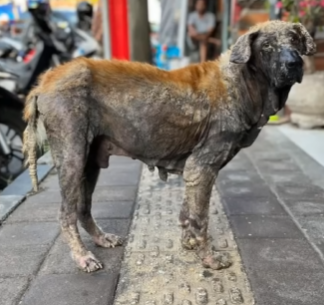
As the weeks went on, Lucky’s condition worsened. He stopped eating much. His ribs showed clearly under his fur. Customers started to comment, some with concern, others with indifference. A young woman once knelt to pet him and whispered, “You’re a good boy.” Lucky’s tail wagged harder than it had in days. That small kindness warmed him more than any blanket ever could.
But kindness does not always change outcomes.
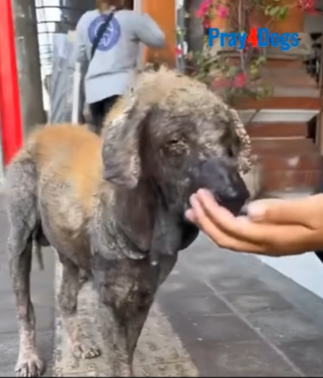
One morning, the owner arrived later than usual. He looked at Lucky lying near the door, breathing shallowly, and sighed—not with worry, but with irritation. “You’re a problem now,” he said. Lucky tried to stand, failed, and whimpered softly. That sound, so weak and helpless, seemed to harden something in the man instead of softening it.
That afternoon, the owner tied a rope around Lucky’s neck.
Lucky thought they were going for a walk.
His tail wagged as they left the familiar street, as the store disappeared behind them. He struggled to keep up, paws dragging, but he trusted completely. Trust is a dog’s greatest strength—and sometimes, its tragedy.
They stopped near an empty lot on the edge of town. Dust and trash covered the ground. The owner tied the rope to a broken fence post, avoided Lucky’s eyes, and turned away. No goodbye. No thank you for ten years of loyalty. Just silence.
Lucky waited.
At first, he thought the man had gone to get something. He lay down, conserving his strength, watching the road. Hours passed. The sun moved across the sky. His throat grew dry. When night fell and the cold crept in, Lucky whimpered softly, confused. He had never been away from the store before. He didn’t understand what he had done wrong.
Days went by.
Lucky grew weaker. The rope cut into his neck when he tried to stand. Rain soaked his fur. Hunger gnawed at him, but worse than hunger was the feeling of being forgotten. Every sound made his heart jump—every footstep, every engine. He hoped. Every time.
Then one evening, a boy passing by stopped.
The boy noticed the dog’s sunken eyes, his labored breathing, the rope biting into his skin. He ran home and told his mother. Together, they came back with water and bread. Lucky drank slowly, gratefully, his tail giving a small, tired wag. The mother’s eyes filled with tears when she saw the state he was in.
They untied him.
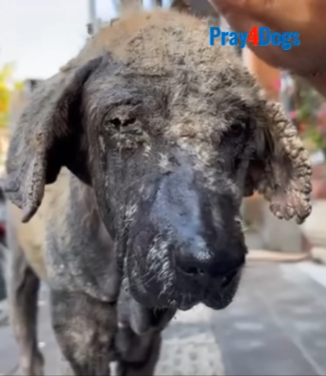
Lucky was taken to a small shelter run by volunteers with more compassion than money. A veterinarian examined him and shook his head sadly. “He’s very old,” she said. “And very sick. But he’s still fighting.”
Lucky spent his last days on a soft blanket. He was warm. He was spoken to gently. Hands stroked his head, telling him he was good, that he was safe now. For the first time in a long time, he slept deeply, without fear.
On his final morning, the sun streamed through the shelter window. Lucky opened his eyes, saw a volunteer smiling at him, and wagged his tail once. Just once. It was enough.
He passed away quietly, with someone holding his paw.
The store reopened as usual that day. Customers came and went. The doorway felt strangely empty, though few could say why. The owner never mentioned Lucky again.
But those who knew his story remembered.
They remembered a dog who gave ten years of his life without asking for anything in return. A dog who guarded, endured, and trusted until the very end. And they asked themselves a painful question—one that lingers long after Lucky’s story is told:
If loyalty like that can be abandoned so easily, what does that say about us?
Lucky may have been forgotten by the man he served, but he was not forgotten by the world. In the quiet way stories travel from heart to heart, his life became a reminder: that old age is not uselessness, that sickness is not a failure, and that those who give us their loyalty deserve dignity—until their very last breath.