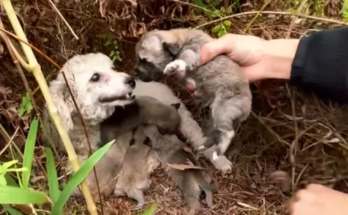
I almost didn’t see her at first.
It was early morning, the kind where the sky is still undecided about becoming blue, and the air smells like dust and leftover rain. I was walking past the market on my usual shortcut, thinking about nothing in particular, when a soft movement near the trash cans caught my eye. At first, I assumed it was a plastic bag stirred by the wind or a stray cat looking for scraps. I would have kept walking—people do that all the time—if not for the sound.
A small, broken sound.
Not loud enough to demand attention, not dramatic enough to force sympathy. Just a weak whimper, like someone who had already learned that crying too hard didn’t change anything.
I stopped.
Behind the trash can, half-hidden by cardboard and old newspaper, was a small figure curled into herself. She was thin—too thin—and covered in dirt. Her fur, once probably soft and light-colored, was matted and stained. One ear bent awkwardly, as if it had healed wrong after an old injury. Her eyes, though, were what held me there. They were wide, dark, and tired in a way that no living being should ever be.
She looked at me like I might disappear if she blinked.
I knelt slowly, careful not to scare her. “Hey,” I whispered, my voice sounding too loud in the quiet street. She flinched, pressing herself closer to the trash can, her body trembling. That was when I noticed her leg—one of her back legs was swollen, and she was holding it off the ground.
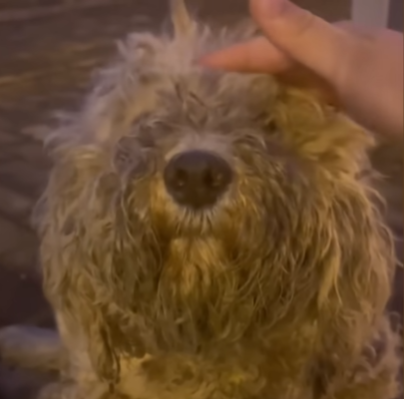
She had been living here.
Eating whatever she could find. Sleeping beside trash. Hurt. Alone.
Something in my chest tightened, sharp and sudden. I told myself I couldn’t take her home. I didn’t plan for this. I didn’t have extra money. I didn’t even know if she would let me touch her. But while my mind was listing excuses, my body had already decided. I took off my jacket and gently placed it on the ground, sliding it toward her.
“It’s okay,” I said again. “I’m not going to hurt you.”
She didn’t move at first. Then, inch by inch, she sniffed the fabric. Her nose twitched. Slowly, carefully, she stepped onto it, wincing as her injured leg touched the ground. I could see how much pain she was in, yet she never cried out. It was as if she had learned long ago that pain didn’t earn comfort.
That broke me more than anything else.
When I reached out, she froze. I waited. After a long moment, I touched her gently on the head. She didn’t pull away. She didn’t lean in either. She just accepted it, like someone who didn’t believe kindness was real.
I wrapped her in my jacket and lifted her into my arms. She was so light it scared me. For a second, I thought she might fight or try to escape, but instead, she relaxed against my chest. Her head tucked under my chin, and she let out a sigh—deep, shaky, full of exhaustion.

That sound felt like a promise.
The walk home felt longer than usual. People stared. Some smiled softly. Others looked away. She stayed quiet the whole time, her breathing warm against me, as if afraid that any movement might undo this sudden safety.
When I opened my door, she stiffened again. New smells. New sounds. A new world. I set her down gently on a blanket and backed away, giving her space. She stayed still for a moment, then slowly stood and looked around. Every corner seemed to confuse her. Every shadow made her pause.
I filled a bowl with water and another with food—real food, not scraps. When I placed them near her, she hesitated. She sniffed. Looked at me. Looked back at the bowl. Then she began to eat, fast and desperate, like someone afraid the meal might be taken away.
I had to turn my head.
After she finished, she curled up on the blanket and fell asleep almost immediately. No guarding. No fear. Just pure, heavy sleep. I sat on the floor beside her, listening to her breathe, noticing the rise and fall of her small body. For the first time since I’d found her, she looked peaceful.
Later that day, I took her to the vet. The diagnosis wasn’t good, but it wasn’t hopeless either. Infection in her leg. Malnutrition. Dehydration. Signs of long-term neglect. The vet asked if she was mine.
“Yes,” I said without thinking.

The word felt right.
The first few days were hard. She didn’t trust sudden movements. Loud noises made her shake. Sometimes, when I reached out too quickly, she would flinch like she expected to be hit. That hurt in a quiet way that stayed with me long after.
But slowly, she changed.
She started wagging her tail when she saw me. At first, it was just the tip. Then, one day, her whole body joined in. She learned that hands could bring comfort, not pain. That food came every day. That the floor was clean. That sleeping didn’t require one eye open.
She followed me everywhere. Bathroom. Kitchen. Doorway. If I sat down, she was there, pressing gently against my leg, as if to remind herself I was real.
One night, during a storm, she climbed into my bed without hesitation. She shook when thunder cracked outside, burying her face into my side. I wrapped my arm around her, and she sighed—the same sound she had made that first morning by the trash can.
Only this time, it wasn’t exhaustion.
It was relief.
Weeks passed. Her fur grew softer. Her eyes brighter. Her leg healed. She discovered toys and mirrors and the joy of running just because she could. She started doing this silly little spin before meals, like she couldn’t contain her happiness.
Sometimes, I would catch her staring at me. Not begging. Not scared. Just watching, like she was trying to understand how this life became hers.
I often think about that morning. About how close I came to walking past. About how easily she could have remained invisible, just another forgotten life beside a trash can.
She sleeps at my feet now as I write this. Her belly rises and falls slowly. She twitches in her dreams, probably chasing something wonderful. Every once in a while, she lets out a quiet, happy noise.
I didn’t just take her home.
She took a broken moment in my day and turned it into something that changed both of us forever.
And every time I look at her, I’m reminded of one simple truth: sometimes, saving a life isn’t about planning or perfection—it’s about stopping when you hear a small, broken sound and choosing not to walk away.