The forest was unusually quiet that morning. Sunlight filtered through tall trees, painting soft patterns on the ground, and the air smelled of damp leaves and earth. I had come to this place many times before, usually to observe wildlife from a respectful distance. Monkeys were common here—playful, curious, sometimes mischievous—but that day, something happened that changed my understanding of trust forever.
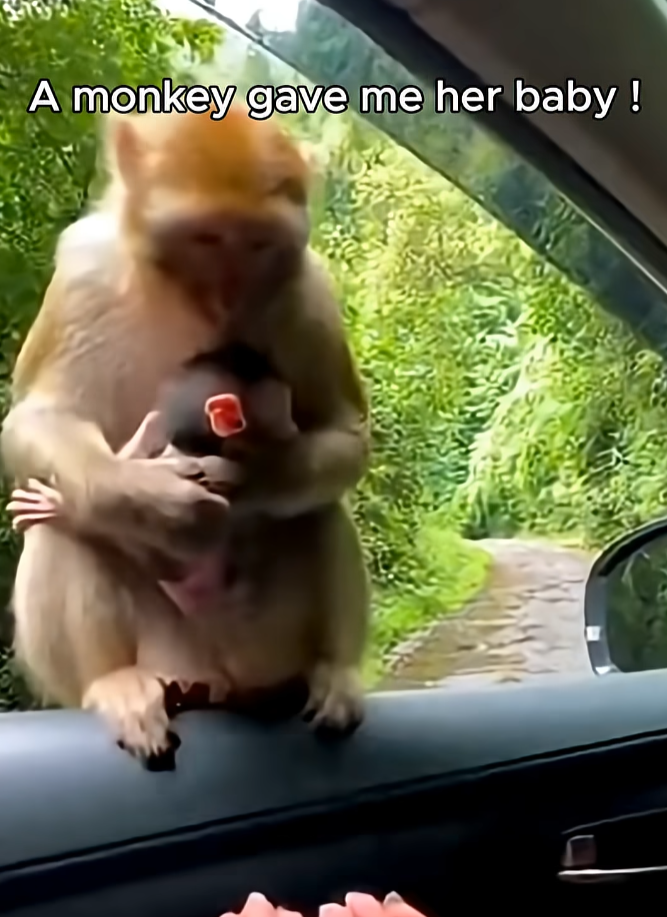
I noticed her sitting alone on a low branch, a female monkey with tired eyes and fur that looked slightly unkempt. She held her baby tightly against her chest. The baby was tiny, its fingers curled into her fur, its eyes half-open as if still learning what the world was. At first, I stayed still, not wanting to scare them. I had learned that patience was the most important rule when observing animals. If you rush, they disappear. If you wait, sometimes they reveal more than you expect.
The mother monkey looked at me again and again. Her gaze wasn’t aggressive. It wasn’t fearful either. It was searching—almost questioning. I remember thinking how human her eyes looked in that moment. They carried exhaustion, worry, and something else I couldn’t immediately name.
Slowly, she climbed down from the branch. My heart started to beat faster. Monkeys are unpredictable, and I didn’t know what she might do. I stayed calm, crouching slightly, keeping my movements slow. The forest seemed to hold its breath.
Then, unbelievably, she came closer.
She stopped just a few steps away from me. The baby stirred and made a tiny sound. The mother tightened her grip for a moment, then relaxed. She looked at me, then at the baby, then back at me again. That was when I felt it—a silent communication, not made of words but of instinct and emotion.
She was asking for help.
I had seen injured animals before. Sometimes they approached humans when they had no other choice. But this felt different. The baby looked weak. Its movements were slow, and it clung to its mother as if even holding on required effort. The mother monkey gently adjusted her hold, as if trying to make the baby more comfortable, but her body language showed stress and uncertainty.
And then she did something I will never forget.
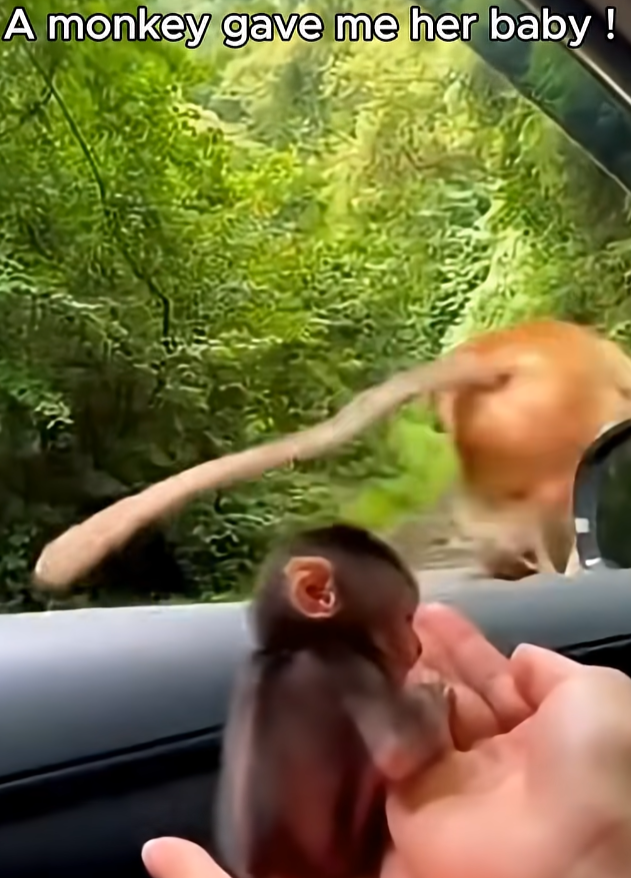
With careful, trembling movements, she reached forward and placed her baby into my hands.
Time seemed to stop.
I barely breathed, afraid that even the smallest motion would break the fragile trust she was giving me. The baby was warm, impossibly light, and it wrapped its tiny fingers around my thumb instinctively. I could feel its heartbeat, fast and uneven.
The mother monkey didn’t run away. She stayed right there, watching every move I made. Her eyes never left her baby. This wasn’t abandonment. This was faith.
I gently sat down on the ground to steady myself. I checked the baby as best as I could without causing stress. It seemed dehydrated and exhausted, possibly separated from proper feeding for too long. I knew I couldn’t fix everything there in the forest, but I could do something.
I reached for the small bottle of water and fruit mash I carried for emergencies—never for feeding wildlife casually, but for situations exactly like this. I dipped my finger carefully and touched a tiny drop to the baby’s lips. Slowly, the baby responded, licking weakly at first, then with more strength. The mother monkey leaned closer, watching intently.
Every second felt sacred.
After a few minutes, the baby’s grip strengthened. Its eyes opened wider, and it made a soft sound that felt like relief. I could see the tension in the mother’s body ease just a little. She moved closer until her knee brushed my arm, unafraid now.
When I slowly offered the baby back, she hesitated for a moment, then took her child gently, pulling it back against her chest. She cradled the baby and rocked slightly, a universal motion of comfort that crossed species and boundaries.
But she didn’t leave right away.
She sat there with me, her baby breathing more steadily now. In that quiet moment, I understood something deeply important: trust is not owned by humans alone. Animals feel fear, hope, and desperation just as we do. When pushed to the edge, a mother will do anything for her child—even trust a stranger from another species.
Eventually, she stood and climbed back onto the branch, pausing once more to look at me. It wasn’t just a glance. It was acknowledgment.
Then she disappeared into the forest.
I stayed there for a long time after, replaying the moment again and again in my mind. People often say that animals don’t think the way we do, that they act only on instinct. But that day taught me that instinct itself can be incredibly wise. That mother monkey knew when she could no longer do it alone. She knew when to ask for help. And somehow, she knew who to ask.
Since that day, whenever I walk through the forest, I move with more humility. I understand now that being human doesn’t place us above nature—it places us within it, with responsibilities as real as any instinct. The memory of that tiny baby monkey in my hands reminds me that compassion doesn’t require language. It only requires presence, patience, and the courage to care.
A monkey gave me her baby once.
And in doing so, she gave me a lesson I will carry for the rest of my life.