I almost didn’t stop.
It was early morning, the kind of hour when the world feels unfinished. The sky was pale, birds just beginning to test their voices, and the road ahead of me stretched quiet and empty. I was tired, already running late, my mind wrapped around plans for the day. Then I saw him—just a shape at first, crumpled near the edge of the road like discarded trash.
Something made my foot hit the brake.
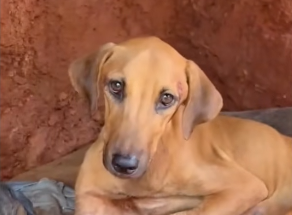
When I got closer, my chest tightened. He was lying on his side, half in the dirt, half on the cracked pavement. A dog. Medium-sized. Brown and white fur matted with dust and old blood. His back legs were twisted unnaturally behind him, unmoving. Flies hovered around a wound I couldn’t fully see yet. He didn’t try to run when I approached.
He just lifted his head.
His eyes met mine.
They weren’t wild. They weren’t angry. They weren’t even afraid.
They were trusting.
That was the part that broke me.
He wagged his tail—or tried to. Just a faint movement, a twitch at the base, as if his body remembered how even if it couldn’t quite obey. His front paws scraped weakly against the ground, an instinctive attempt to move closer. When he couldn’t, he stopped trying and simply watched me, breathing shallow but steady.
As if to say, You came. I knew someone would.
I knelt beside him, heart pounding. “Hey, buddy,” I whispered, my voice shaking despite my effort to sound calm. “I’m here.”
His ears flicked at the sound.
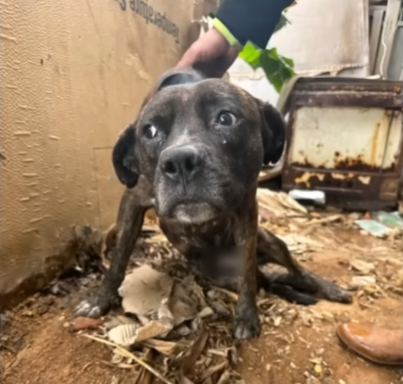
Up close, the damage was worse. His hind legs were completely limp. One was swollen, the fur worn away from dragging. There were deep scrapes along his hips and belly, raw and infected. He smelled of pain and exposure—of days, maybe weeks, spent surviving like this. I could see where he had tried to pull himself forward, the ground etched with faint trails.
He had been paralyzed. And alone.
I don’t know how long he’d been there. Hours? Days? Long enough for the sun to burn him during the day and the cold to settle into his bones at night. Long enough to be passed by cars, by people, by lives that kept moving while his had stopped.
And still—still—he trusted me.
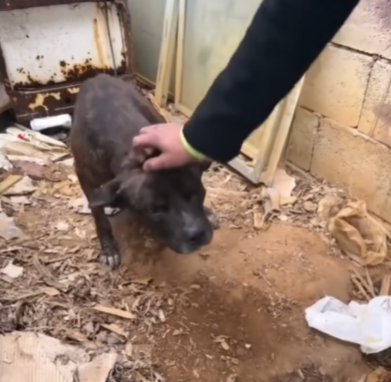
When I reached out slowly, giving him time to pull away if he wanted, he leaned into my hand. Not flinching. Not cowering. He pressed his head against my palm with what little strength he had left and let out a soft sound—half sigh, half whimper.
I cried.
Right there on the side of the road, I cried into the dust and the morning light, because I couldn’t understand how something so broken could still believe in kindness.
I wrapped my jacket around him carefully, terrified of hurting him more. He didn’t resist. When I lifted him, his body was frighteningly light, like he’d already begun to fade. But he relaxed against me, trusting my arms to hold what the world had dropped.
The drive to the vet felt endless.
He lay on the passenger seat, bundled and quiet. Every so often, he looked up at me, eyes following my face as if memorizing it. As if afraid that if he looked away, I might disappear like everyone else had.
“I won’t leave you,” I kept saying. “I promise.”
I didn’t know yet if I could keep that promise. But I said it anyway.
At the clinic, the staff moved fast. X-rays. IV fluids. Gentle hands. Serious faces. I stood in the corner, numb, watching strangers fight for a life that had already endured too much.
The diagnosis came quietly.
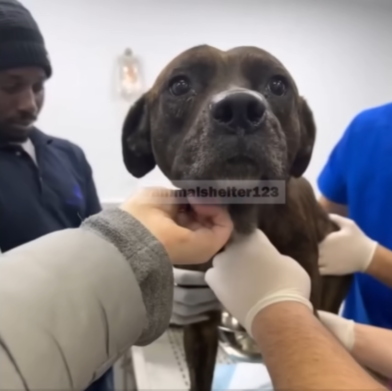
Severe spinal trauma. Likely hit by a car. No treatment. No help. Just left. The paralysis was permanent. He’d dragged himself until his front legs gave out. Infection had set in. Dehydration. Starvation.
“But he’s alert,” the vet said, almost surprised. “And… he’s incredibly calm.”
I nodded, throat tight. “He trusts people.”
The vet sighed. “That’s the hardest part.”
They asked me the question I dreaded. The one wrapped in compassion but heavy with reality. Was I prepared for what came next? For the cost? For the care? For the fact that even with everything done right, he might never walk again?
I looked through the glass at him lying on the exam table. His head was lifted. His eyes searched the room. When he saw me, his tail moved again, just barely.
“Yes,” I said. “I’m prepared.”
The days that followed were hard.
He needed cleaning twice a day, wounds flushed and treated. He needed help relieving his bladder. He needed medication, special food, constant monitoring. Sleep came in short pieces. Fear crept in during quiet moments. Doubt whispered questions I didn’t want to answer.
But he never complained.
Not once did he snap or growl or show fear. When something hurt, he squeezed his eyes shut and leaned into whoever was helping him. When he was tired, he rested his head on my knee. When he was hungry, he waited patiently, tail twitching.
I named him Hope.
Not because he had hope—but because he gave it.
As the weeks passed, his body stabilized. His wounds began to close. The infection retreated. His fur grew back in soft patches. He learned to balance himself upright with support, his front legs strong and determined. When we introduced a wheelchair, he hesitated at first, confused by the strange frame.
Then he took a step.
And another.
The first time he moved on his own again—even with wheels instead of legs—he looked at me like he’d just discovered magic. His mouth opened in a crooked, joyful grin, tongue lolling out as his tail wagged freely now, no longer limited by weakness.
I laughed through tears.
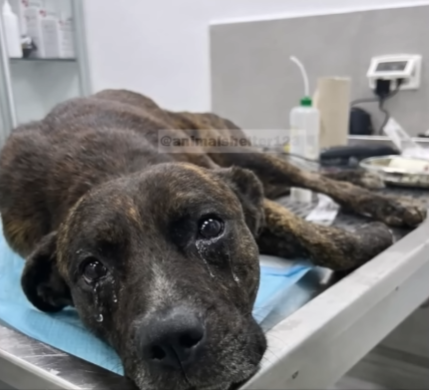
Life with Hope became a rhythm. Morning care. Afternoon sun. Evening cuddles. He learned the sound of my footsteps. I learned the meaning of his small sounds—the hum he made when content, the sharp puff when annoyed, the quiet huff that meant thank you.
Strangers often asked me the same thing.
“How do you do it?”
“Isn’t it sad?”
“Wouldn’t it be easier to let him go?”
I’d look at Hope then—rolling happily across the grass, greeting everyone with pure delight, eyes shining—and I’d shake my head.
He wasn’t broken.
He was alive.
What people didn’t see was how much he gave back. How he sensed sadness and pressed close. How he celebrated ordinary moments like they were miracles. How every day with him felt intentional, grounded, real.
He had lost his legs.
But he had not lost his spirit.
Sometimes, late at night, when the house is quiet and Hope sleeps beside me, I think about the moment I found him. Paralyzed. Alone. Waiting. I think about how close the world came to losing him—not because he gave up, but because others did.
And I think about that first look he gave me.
That trust.
It still humbles me.
Hope doesn’t know what he survived. He doesn’t replay the pain or wonder why it happened. He lives where dogs always live—in the now. In the warmth of a hand. In the joy of movement. In the comfort of belonging.
But I know.
I know that he trusted humans even when humans failed him.
And every single day, I try to be worthy of that trust.