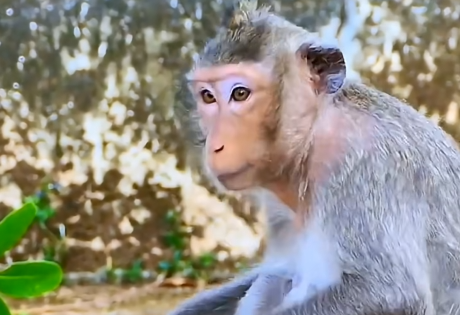
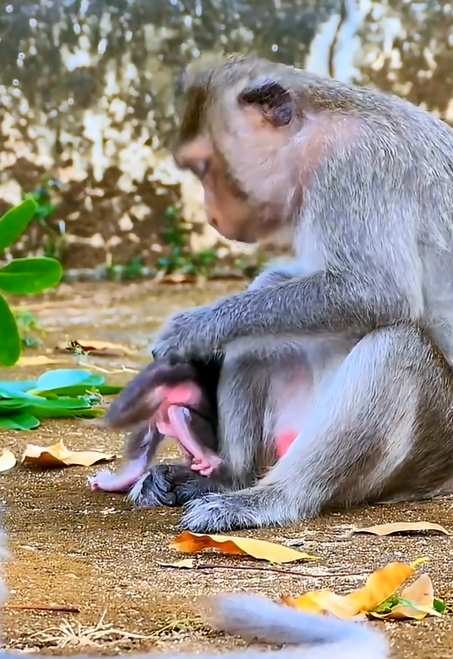
In the dense, green canopy of a tropical forest, life pulsed with energy and unpredictability. Every rustle of leaves, every distant call, and every movement of branches held meaning for the inhabitants of this vibrant ecosystem. Among the creatures who called this forest home, monkeys were some of the most agile, curious, and socially complex. Their lives were shaped by bonds of family, friendship, and hierarchy, and nowhere was this more evident than in the tender relationship between a mother and her baby.
At the center of a small troop of long-tailed macaques was a mother named Maya, a figure of strength and care, with fur as soft as dusk and eyes that radiated both intelligence and gentleness. She had given birth to a small baby, whom she named Niko. From the moment he had been born, Niko clung to her, finding safety and warmth against her chest. His tiny hands held onto her fur as if the world beyond her arms was too dangerous to face alone.
Maya’s days were filled with foraging, grooming, and keeping a watchful eye on her young one. She had spent months teaching Niko the ways of the forest: how to climb with balance, how to recognize edible fruits, and how to avoid predators that lurked unseen. Niko had begun to explore, letting go of her fur for moments at a time, testing his newfound agility under her vigilant gaze. But as every young monkey learns, independence often comes before full understanding of danger.
One sunny morning, the troop moved through a patch of forest rich with fruiting trees. The branches were heavy with mangoes, figs, and other ripe fruits, attracting monkeys from surrounding areas. Maya carefully selected a tree with low-hanging branches, perfect for her baby to practice climbing under her supervision. She set Niko down gently on a sturdy branch and instructed him with soft, attentive gestures to stay close.
Niko, wide-eyed with excitement, observed as Maya began to pick fruits. His tiny hands reached toward the branches, testing his balance. He wanted to imitate her, to be part of the foraging process. Maya allowed him short, supervised forays, ready to intervene if he became too adventurous.
But as the morning wore on, Maya had to move slightly farther to reach a particularly enticing cluster of figs. She assumed Niko would wait patiently. After all, he had learned the basics of following her instructions. Yet, the moment her attention was directed elsewhere, a surge of anxiety gripped the baby monkey. Niko realized, in a flash of primal understanding, that his mother had left his immediate side.
Panic set in. His little heart raced as he looked down and saw the forest floor, distant and intimidating. The branches above seemed unstable, swaying slightly in the morning breeze. Niko’s instincts screamed at him to move, to follow, to never be separated from Maya. He let out a high-pitched squeak, a sound that immediately drew the attention of other nearby monkeys. The call was both a signal of distress and a plea for assistance.
Without hesitation, Niko scrambled after his mother. His tiny limbs worked furiously to navigate the network of branches, sometimes gripping too tightly, sometimes misjudging a leap. The panic in his movements contrasted sharply with Maya’s calm, methodical foraging. When she turned and saw Niko dashing toward her, she immediately paused, her eyes scanning the branches for any hazards he might encounter.
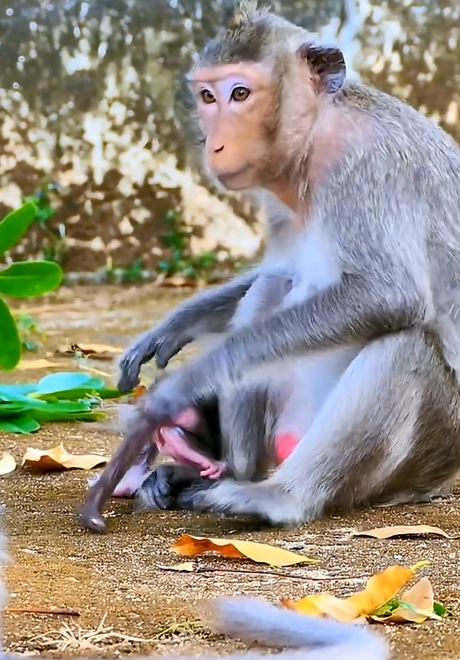
“Wait, Niko!” she called softly, though her voice carried the weight of urgency and concern.
But Niko was already in motion, driven by raw emotion rather than reason. He leaped from one branch to another with surprising agility for his size, though miscalculations sent him sliding or grabbing onto rough bark to stop himself from falling. The forest seemed to echo with his frantic squeaks, a chorus of fear and determination.
Other members of the troop noticed the commotion. An older juvenile male watched with curiosity, while a few adult females shifted to keep an eye on the baby’s precarious journey. In monkey society, vigilance and collective awareness play a vital role in the survival of the young. Even as Niko panicked, the troop’s social instincts kicked in. Maya’s motherly presence was the anchor, but the troop’s collective attention created a safety net of sorts.
Despite the chaos, Niko continued, propelled by the need to reach Maya. The forest, however, is not without its dangers. Branches can be slippery, thorns hidden among leaves, and the slightest misstep can lead to injury. At one point, Niko misjudged the distance between two branches and slipped, hanging upside down by one hand. Panic surged again, but he managed to grasp a nearby branch with his other hand. The moment of terror was brief but seared into his memory.
Maya, observing the near mishap, immediately climbed toward him. Her movements were fluid, practiced, and precise. She reached Niko just as he stabilized himself, wrapping her arms around him with warmth and reassurance. The baby’s rapid breathing slowed as he felt her embrace, the panic fading into relief.
“You must be careful, Niko,” Maya murmured, her voice both soothing and firm. Her eyes scanned the surrounding branches, ensuring that no further danger loomed. “I will never let anything happen to you, but you must learn to stay calm and follow instructions.”
The baby monkey nestled into her fur, his tiny body trembling not from fear but from the adrenaline of the chase. He realized, in that moment, how fragile life could be and how important it was to trust his mother’s guidance.
After the encounter, Maya led Niko to a safer part of the tree, where branches were thick and sturdy. Here, he could practice climbing without the immediate threat of falling. She handed him a small piece of fruit, a reward for his bravery and a subtle reminder that mistakes could be corrected with patience and care.
Over the next few days, the incident continued to influence Niko’s behavior. He was more attentive to his mother, more cautious in his movements, yet still curious and eager to explore. Maya’s guidance became even more deliberate, teaching him how to assess risks, how to judge distances, and how to remain calm in moments of uncertainty.
The forest itself seemed to participate in the lesson. The wind rustled through leaves, the sun highlighted different paths, and the sounds of distant birds provided a backdrop for practice and learning. Each day, Niko’s confidence grew, tempered by the memory of his panic and the reassurance of his mother’s presence.
Other young monkeys in the troop observed Niko’s experience closely. They learned not just by doing but by watching—the social learning that is a hallmark of primate intelligence. Niko’s panic and subsequent recovery became a subtle yet powerful teaching moment for the entire troop, reinforcing the importance of staying close to caregivers and understanding the perils of separation.
As the days passed, Niko began to master the delicate art of independence. He could leap between branches with greater assurance, forage for small fruits under supervision, and even engage in playful wrestling with other juveniles without endangering himself. Maya’s careful guidance, combined with his own growing skill, allowed him to navigate the forest with increasing confidence.
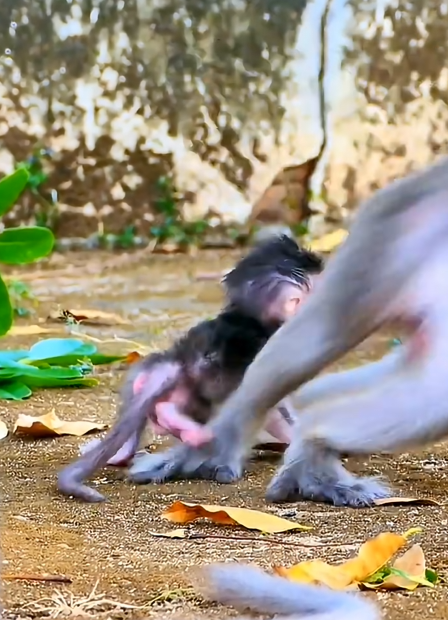
However, the memory of that day—the day he panicked when his mother left—remained vivid. It served as a constant reminder of the fine line between curiosity and recklessness. Niko learned to balance his adventurous spirit with caution, understanding that freedom in the forest came with responsibility and awareness.
The bond between mother and baby deepened as well. Maya’s actions demonstrated not just protection but love, patience, and teaching. Niko learned to read her expressions, understand her signals, and anticipate her guidance. This silent communication, built on experience and trust, became a cornerstone of his development.
Life in the forest continued with its rhythm of foraging, climbing, resting, and social interactions. Niko’s panic had been a turning point, a moment of fear that transformed into understanding. The young monkey grew stronger, wiser, and more attuned to the social and environmental dynamics of his troop.
By the time the sun set each evening, painting the canopy in shades of gold and crimson, Niko would curl up against Maya, exhausted but safe. The forest’s sounds—the rustling leaves, distant calls of other animals, and the gentle whispers of the wind—provided a lullaby. He slept not only with physical security but with the knowledge that he was guided, protected, and loved.
In the world of monkeys, every experience is a lesson, every mistake an opportunity to learn, and every act of panic a chance to understand boundaries. Niko’s frantic chase after his mother was more than a moment of fear; it was a fundamental step in his journey toward independence and resilience.
Maya, ever watchful, continued to nurture him, balancing discipline with comfort. Niko grew not just in size but in understanding, learning to navigate the forest’s challenges while remaining mindful of the wisdom imparted by his mother.
Through it all, one truth became clear: life in the forest is both beautiful and perilous, and the bond between mother and baby is a lifeline that shapes the young monkey’s ability to survive, thrive, and eventually pass on the lessons learned.
As weeks turned into months, Niko’s panic transformed into prudence. He still explored, still tested his limits, but with a newfound respect for the guidance of those who loved him. And as Maya watched her baby navigate the forest with increasing skill, she felt the quiet pride of a mother whose lessons had taken root.
In the life of monkeys, each day is a blend of adventure, learning, and care. And for Niko, the day he panicked when his mother left became a story of growth—a reminder that even in moments of fear, love and guidance can provide the courage to continue, to learn, and to flourish in the complex, beautiful world of the forest.