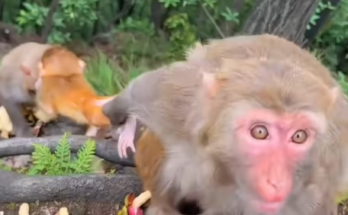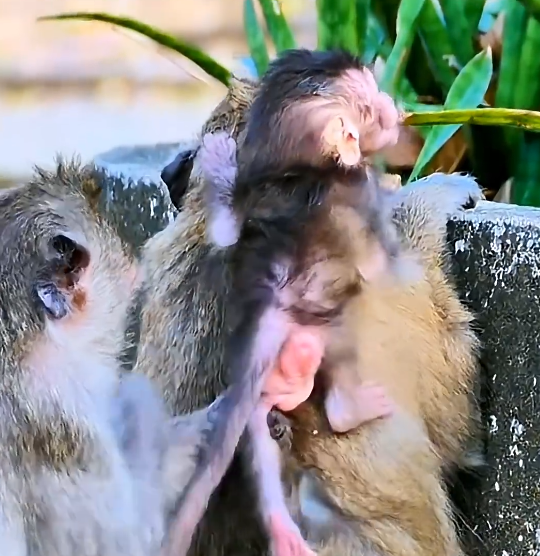
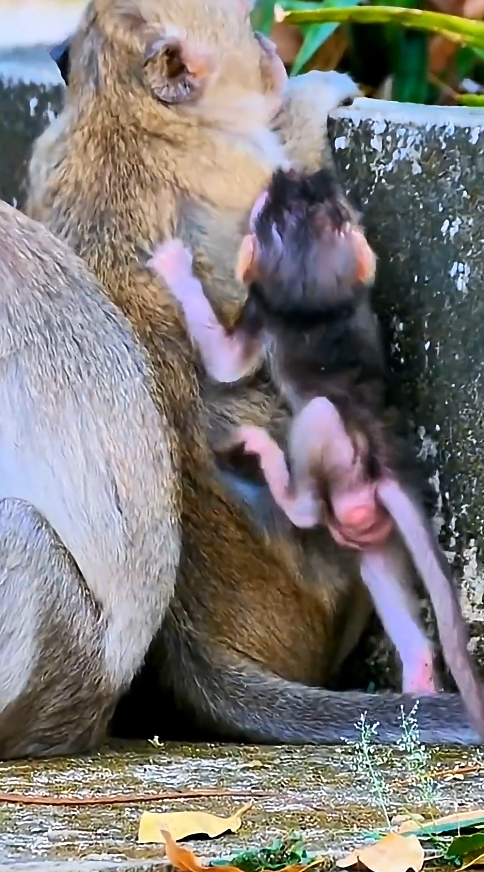
In the dense canopies of the jungle, where sunlight filters through swaying leaves and the air hums with life, a quiet drama unfolds every day: the life of monkeys and the unbreakable bond between a mother and her baby. Mother monkeys are always vigilant, always alert, and their eyes carry a mixture of love, fear, and determination. They live in a world where danger lurks in every shadow, where the unexpected is a constant, and where the safety of their young depends entirely on their watchfulness.
From the moment a baby monkey is born, the mother’s life changes completely. She is no longer free to forage carelessly or play among the branches. Every movement is calculated, every glance is purposeful. The tiny infant clings to her fur, completely dependent on her strength and instincts. Its small hands grip tightly, and its eyes look around with curiosity and trust, expecting the world to be as safe as the mother’s arms make it feel.
In many monkey species, the first days of a baby’s life are critical. The mother’s vigilance is at its peak. She is constantly scanning for predators—birds of prey circling above, snakes slithering unseen through undergrowth, and larger mammals that might threaten her baby. Even in the absence of immediate danger, she remains alert. Her body tension is a protective response, her ears swivel toward sounds, and her eyes move constantly, never resting completely.
Mother monkeys also face threats from within their own groups. Hierarchies and social tensions can turn dangerous, especially in species where males are dominant and aggressive. Infanticide, while rare, occurs in certain monkey populations, often when a new male takes control of a troop. A vigilant mother must constantly be aware of the males around her, ready to move, hide, or defend her young at a moment’s notice. Every interaction is a test of awareness and courage.
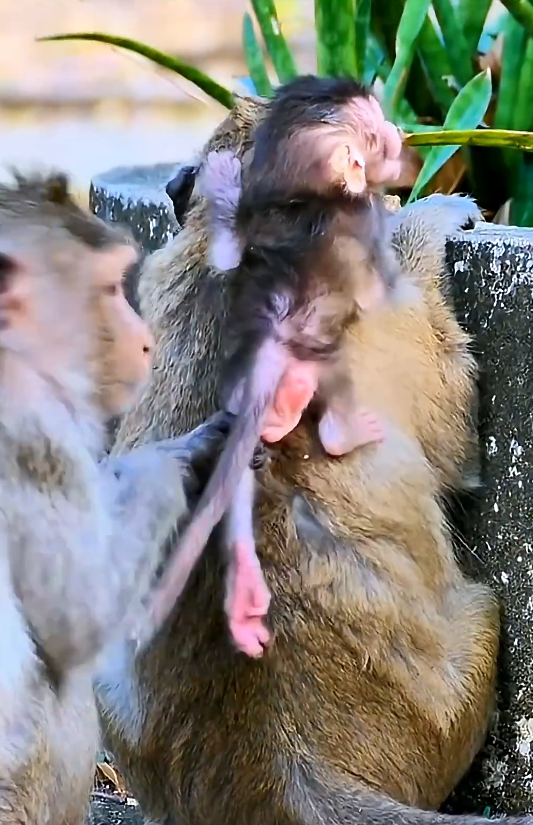
Feeding time is another challenge. While the baby clings to her chest or back, the mother must find food without putting her infant at risk. She balances high branches and leaping from tree to tree, ensuring that every motion is smooth and safe. Even a single misstep could mean a fall, injury, or separation. Her vigilance is not only about avoiding predators but also about navigating the environment safely. Every fruit plucked, every branch grasped, is a decision made with both nourishment and safety in mind.
Communication plays a crucial role in this relationship. Mother monkeys use soft vocalizations to calm their babies and warn them of unseen threats. A subtle trill or murmur reassures the infant that all is well. Loud alarm calls can signal danger to the rest of the troop. The bond is reinforced through touch—gentle grooming, embracing, or simply allowing the baby to cling as she moves. Through these small acts, the mother teaches her baby about the world, demonstrating both caution and confidence.
The vigilance of a mother monkey is not just instinct; it is also emotional. She experiences fear and anxiety when her baby is in danger, joy when it learns to climb or leap, and pride when it successfully navigates obstacles. Researchers observing monkeys in the wild have noted that mothers often display signs of stress when separated briefly from their infants. Heart rates increase, movements become faster, and vocalizations intensify. These reactions are part of the maternal instinct—an emotional drive to protect, teach, and nurture.
In the early weeks and months, the mother rarely allows her infant to venture far. Even as the baby grows stronger, her eyes never stray far from it. Play is allowed, but always within reach, always within sight. Climbing higher, exploring new branches, or interacting with other juveniles is encouraged gradually, always under the watchful gaze of the mother. She learns to read the signs of her baby’s confidence and caution, responding with guidance or intervention when needed.
Monkeys are social animals, and the dynamics of the troop also influence maternal behavior. Other females, often relatives, may assist in watching the young, offering moments of shared vigilance. But even with helpers, the primary responsibility falls on the mother. She cannot delegate entirely, for her bond with the infant is unique and irreplaceable. Her vigilance is personal, protective, and profoundly intense.
As the baby grows, the nature of the vigilance changes. She no longer has to carry the infant constantly, but she still monitors interactions, potential dangers, and the baby’s behavior. Learning to navigate the complex social and physical environment of the jungle requires supervision. Every new leap, every encounter with other monkeys, every step away from her side is watched carefully. The fear of losing the baby never fully disappears; it evolves into a constant awareness of the world’s unpredictability.
There are moments when the vigilance becomes extraordinary. A sudden predator attack, a misstep on a branch, or a social conflict can trigger immediate action. Mothers will scream, swing through trees at incredible speed, or place their bodies between threats and their infants. Their actions are swift, precise, and fueled by a mix of fear and determination. In these moments, the depth of maternal instinct becomes undeniable.
Scientists studying monkeys have also noted that maternal vigilance has long-term benefits for the baby. Infants raised under attentive mothers tend to grow into confident, socially competent adults. They learn essential survival skills, understand social hierarchies, and develop resilience. The mother’s constant watchfulness is not only about immediate safety but about preparing the next generation for life in a challenging environment.
In captivity, maternal vigilance is often observed in sanctuaries and wildlife reserves. Even when predators are absent, mother monkeys maintain the instinctive watchfulness. The emotional connection remains strong. They are quick to soothe, alert to any perceived threat, and deeply responsive to their infant’s needs. This behavior demonstrates that vigilance is not merely a response to danger; it is an essential aspect of the mother-infant relationship.
The life of a monkey mother is demanding, exhausting, and emotionally intense. Yet it is also rewarding. Each small milestone achieved by the baby—a successful jump, a first independent climb, a safe interaction with other monkeys—is a triumph that validates the mother’s tireless effort. She experiences the world through the eyes of her child, balancing love, fear, and hope in every decision.
Ultimately, maternal vigilance among monkeys is a testament to the power of instinct, love, and resilience. It illustrates how life in the wild is governed not only by survival but by the deep bonds that connect individuals. Mothers carry the weight of responsibility, the fear of loss, and the joy of growth, all while navigating a world full of dangers and uncertainties. Their vigilance is constant, a living demonstration of devotion that humans can observe, admire, and learn from.
The life of monkeys, particularly the relationship between mother and infant, offers a glimpse into the raw intensity of maternal love. It is a life defined by vigilance, care, and fear of loss, yet also filled with moments of joy, learning, and trust. The mother’s watchful eyes, patient guidance, and protective actions ensure that the next generation can grow, explore, and survive in a world that is both beautiful and dangerous.
Mother monkeys remind us that love is not passive. It is active, alert, and relentless. It is a force that guides, protects, and teaches. Their vigilance is not just survival—it is devotion. And in their careful, watchful eyes, we can see the depth of fear, courage, and love that defines the life of every mother who walks, climbs, and leaps with her child.