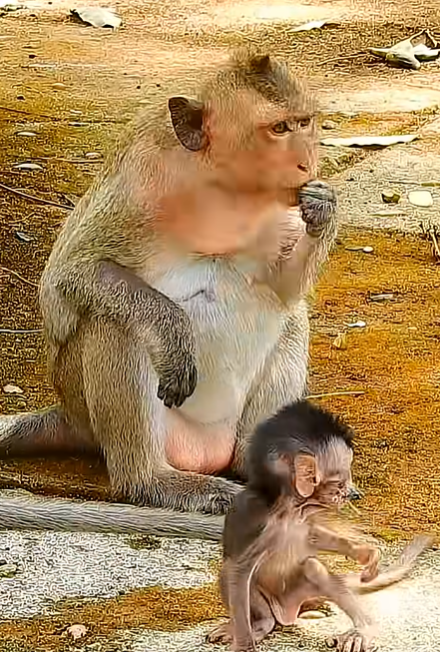
In the dense forests and bustling riverbanks where monkeys thrive, life is a constant balance of play, survival, and social interaction. Among the most fascinating aspects of their lives is the bond between a mother monkey and her offspring. These bonds are strong, instinctual, and critical for the survival of the young. One of the most remarkable—and challenging—realities for mother monkeys is managing the boundless energy and hyperactivity of their young.
A young monkey is a bundle of curiosity. From the moment it opens its eyes to the world, it is eager to explore, climb, jump, and test boundaries. Hyperactivity is a natural part of their development. It teaches them coordination, strength, and social skills. It prepares them for the dangers of the wild, where swift movement, quick decision-making, and keen awareness can mean the difference between life and death.
For a mother monkey, this hyperactivity is both a delight and a challenge. Watching a baby leap from branch to branch can be entertaining, evoking feelings of pride and joy. Yet, it also requires constant vigilance. Young monkeys are oblivious to danger. A moment’s inattention could lead to a fall, a confrontation with a predator, or separation from the group.
In a typical day, a mother monkey remains alert almost constantly. Her eyes follow the smallest movements of her offspring. Her tail may flick nervously when the young one approaches a precarious edge. Her hands are ready to catch, restrain, or guide at a moment’s notice. Even while grooming or feeding, the mother’s attention is divided, with one eye on her surroundings and the other on her curious child.
One of the key reasons for this vigilance is the environment itself. Forests are full of potential threats—snakes, birds of prey, leopards, and even rival monkeys. Every leap or dash by a young monkey is a potential risk. A mother must anticipate her child’s next move, often predicting instinctively when to intervene. This constant alertness is exhausting, yet it is ingrained in the maternal instinct of monkeys.
The hyperactivity of young monkeys also extends to their interactions with peers. In multi-monkey troops, young ones often engage in playful wrestling, chasing, and mock fighting. While these activities are crucial for learning social hierarchy and cooperative behaviors, they can also lead to injuries. Mothers often intervene subtly, nudging, scolding, or positioning themselves between their child and potential harm. The balance is delicate—too much interference can hinder learning, while too little can result in injury.

Interestingly, mother monkeys adapt their vigilance strategies as their offspring grow. In the first few months, they carry their young constantly, keeping them close to ensure safety. During this period, hyperactivity is somewhat contained simply by proximity. As the baby gains strength and independence, however, it begins exploring beyond the mother’s immediate reach. The mother then transitions to a watchful guardian role, following her child from a distance, ready to respond to sudden movements, unexpected dangers, or social conflicts.
Nutrition also plays a role in managing hyperactivity. Mothers ensure that their offspring receive enough milk, fruit, leaves, and protein to sustain high energy levels without compromising health. A well-fed young monkey is not only stronger but better able to handle its own activity safely. Mothers often lead their young to safe feeding spots while keeping a wary eye on the surroundings.
Another layer of vigilance involves learning from experience. Mother monkeys often remember past incidents of danger, associating certain areas, sounds, or companions with risk. They use this knowledge to guide their offspring, steering them away from treacherous branches or aggressive peers. The hyperactivity of young monkeys is thus moderated not just through direct intervention but also through guidance informed by experience.
The relationship between mother and child in monkeys is symbiotic. While the mother provides safety and guidance, the hyperactivity of the young teaches her patience, agility, and keen observation. A mother learns to move quickly to prevent accidents, to read subtle cues of mischief, and to anticipate the impulses of her offspring. In many ways, the child’s energy sharpens the mother’s instincts.
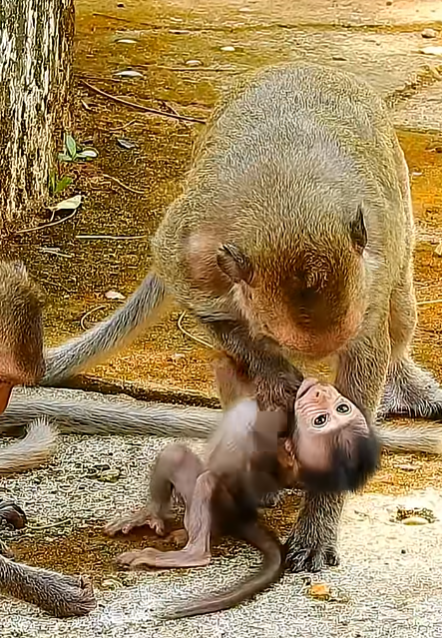
Hyperactivity is not merely a behavioral quirk; it is a window into the cognitive and emotional development of the young monkey. Play, exploration, and high-energy activity strengthen muscles, improve coordination, and foster problem-solving skills. When a mother allows controlled exploration, she contributes to the intellectual and physical growth of her child. The challenge is ensuring that the freedom to learn does not expose the young to unnecessary harm.
The social dynamics of monkey troops further complicate maternal vigilance. Young monkeys must learn to interact with siblings, cousins, and unrelated peers. Conflicts, teasing, and dominance struggles are common. Mothers often mediate these situations, intervening when fights escalate but also allowing minor scuffles to teach lessons in resilience and social etiquette. The hyperactivity of the young magnifies the need for careful observation and selective intervention.
Environmental factors such as seasonal changes also influence the level of hyperactivity. During fruiting seasons, when food is abundant, young monkeys tend to be more energetic, bouncing from tree to tree in pursuit of ripe fruit. During harsher seasons, when food is scarce, they may become more subdued but still exhibit bursts of restlessness, often stimulated by play or curiosity. Mothers adjust their vigilance accordingly, monitoring energy expenditure and providing guidance tailored to the current circumstances.
Over time, the cumulative effects of maternal vigilance shape the behavior and survival skills of the offspring. Young monkeys learn boundaries, understand danger, and develop the physical capabilities required to thrive independently. Mothers who balance supervision with freedom successfully raise offspring capable of navigating the complex social and environmental landscapes of their world.
Despite the exhaustion and constant attention required, the maternal role is instinctual and deeply rewarding. Observing a young monkey successfully navigate a difficult leap, make a new social connection, or find food brings satisfaction akin to pride. The hyperactivity that once caused anxiety becomes a source of joy, signaling growth, resilience, and learning.
In conclusion, the life of monkeys is a delicate interplay of care, energy, and survival. Mother monkeys must always be vigilant about their offspring’s hyperactivity because it is through movement, play, and exploration that young monkeys learn to live fully and safely in their environment. This vigilance is not just protective—it is nurturing, shaping the next generation and ensuring the continuity of the species. Hyperactivity is a natural and necessary part of development, and a mother’s attentiveness transforms potential chaos into structured growth, balancing safety with freedom, protection with independence.
Life in the wild is never simple, but through maternal care and unwavering vigilance, young monkeys learn to channel their energy, explore their world, and grow into strong, capable adults. Mothers may tire, but their dedication ensures that the playful, hyperactive spark in each young monkey becomes a guiding force for survival and adaptation in the complex and ever-changing world of the forest.