In a quiet corner of the forest, where sunlight danced through the canopy in warm, golden beams, a small troop of monkeys made its home. Among them was a mother, wise and protective, and her baby, tiny and wide-eyed, still clinging to the comfort of her presence. The mother had been observing her little one carefully. She knew the time would come when her baby must start learning independence. But as she watched, she began to wonder: was her baby ready, or would the push toward self-reliance be too much too soon?
The baby monkey clung to its mother’s fur, arms wrapped tightly around her as she moved gracefully through the branches. Every leaf that rustled, every sound from the underbrush, made the little one tighten its grip. The forest was a place of endless wonder but also hidden danger. To the baby, the world was enormous, and every swing from branch to branch required courage it had yet to fully develop.
Mother monkey knew that independence was essential for survival. One day, her baby would need to find food, escape predators, and navigate the complex social structure of the troop without her guidance. She remembered her own lessons as a young monkey—lessons learned through trial, error, and careful observation. But teaching these lessons required patience, and perhaps a gentle push.
The mother began with small steps. She placed a piece of fruit a few feet away from her baby while keeping her eyes on it. “You can do this,” she seemed to signal, her eyes soft yet firm. The baby looked at the fruit and then back at its mother. Doubt clouded its expression. Its tiny hands trembled as it reached forward, only to retract and cling once more. The mother sighed quietly, understanding that fear was natural.
Over the next few days, the mother tried again, subtly encouraging the baby to explore the world around it. Sometimes she would step back as the baby ventured toward a low branch or a clump of leaves. Other times, she would watch silently as the little one attempted to pick fruit or investigate a strange sound. Each time, the baby hesitated, unsure of its abilities. Its legs wobbled, and its eyes darted nervously, seeking reassurance.
The other monkeys in the troop watched these attempts with curiosity. Some older juveniles had already learned the art of climbing, foraging, and social negotiation. They occasionally approached the baby, offering playful nudges or gentle teasing. The baby, however, wasn’t quite ready to join in the games. Its world was still defined by the safety of its mother’s arms.
One afternoon, the mother decided to try a new approach. She climbed to a higher branch, just out of reach, with a juicy fruit dangling near the edge. Her baby watched from below, eyes wide with curiosity and anxiety. The mother made no move to help, only encouraging the little one with a soft call. “You can reach it,” her posture seemed to say. “I am close, but you must try yourself.”
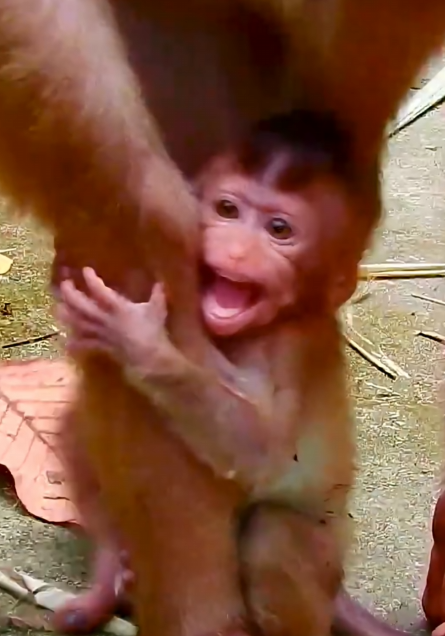
The baby took a deep breath—or as deep as a tiny monkey could—before tentatively reaching toward the fruit. Its tiny fingers brushed it, only to slip off. Panic flashed across its face as it looked up at the mother. The mother’s eyes were calm, steady, full of reassurance. “Try again,” they seemed to say. Heart pounding, the baby adjusted, stretched again, and finally grasped the fruit. Triumph and relief flooded its expression.
But independence was not only about reaching for food. It was about understanding limits, learning from mistakes, and facing fear. The mother observed closely as her baby explored further, climbing slightly higher than before, testing its balance, and learning the rhythm of the branches. Each small success was a victory, but each stumble was a lesson in resilience.
Despite these careful steps, there were moments when the baby’s independence did not look okay. Once, it tried to jump between two branches and missed, landing awkwardly on a lower limb. The mother rushed to its side, checking for injuries. Fortunately, there were none, but the incident reminded her that the path to independence was fraught with risk. The forest was unforgiving, and mistakes could have consequences. The mother’s heart ached, knowing that she could not protect her baby forever.
She began to realize that independence was a process, not a single moment of courage. Some days, the baby would venture farther and show more confidence. Other days, it would cling tightly, retreating from any challenge. Patience was key. The mother adjusted her teaching style, alternating between encouragement and gentle distance. She learned to read the baby’s cues, understanding when to step back and when to provide reassurance.
Social interactions were another area where independence was essential. The baby had to learn how to engage with other members of the troop, negotiate play, and even understand subtle social cues. At first, the baby was hesitant, avoiding eye contact and retreating when approached. The mother observed, sometimes intervening to prevent bullying or accidents. Gradually, the baby began to respond to the calls of peers, imitating their movements, and joining in brief moments of play. Each interaction built confidence and social understanding, crucial for survival in a complex group.
As days turned into weeks, the baby’s growth was evident. Its climbing improved, leaps became more confident, and it began to explore new areas of the forest with cautious curiosity. But there were still moments of uncertainty. Sometimes it froze mid-branch, looking around for the mother’s reassuring presence. Sometimes it dropped a piece of fruit it had worked so hard to grasp, looking disappointed and frustrated. These moments reminded the mother that independence was not linear. Progress came in waves, with successes and setbacks intertwined.
One evening, as the sun dipped low and painted the forest in shades of orange and pink, the mother sat with her baby in her arms. They watched the troop move through the trees, younger monkeys swinging playfully, older monkeys foraging efficiently. The baby clung, but less tightly than before. Its eyes were wide, alert, curious. It was learning. Slowly, tentatively, it was finding its place in the world.
The mother knew that one day, the baby would no longer need her constant guidance. It would leap confidently from branch to branch, forage independently, and interact with the troop without fear. That day was still ahead, but the foundation was laid. The baby had learned courage, patience, and resilience. And even in moments when independence didn’t look okay—when the baby stumbled, hesitated, or fell—it was learning. Every challenge was a lesson, every misstep a step toward growth.
Mother and baby shared a quiet moment, a soft embrace that spoke of love, protection, and trust. Independence did not mean abandonment. It meant guidance, support, and the freedom to learn from the world. The baby monkey, though small and vulnerable, was discovering its strength, one day, one climb, one leap at a time.
The forest around them was alive, a constant reminder that life is a mixture of challenges, growth, and opportunity. For the mother, watching her baby learn independence was both heart-wrenching and beautiful. She understood that letting go was part of love, that nurturing strength sometimes meant allowing fear to exist. And for the baby, each small success, each lesson, each climb brought confidence, skill, and resilience.
In the end, the baby monkey’s independence was not immediate. It was messy, uncertain, and sometimes alarming. But it was also natural, essential, and full of life. The mother knew that with patience, encouragement, and love, the little monkey would thrive. The journey toward independence was not easy, but it was worth every step, stumble, and leap.
Life of monkeys is a story of survival, growth, and love. In this small troop, in the heart of the forest, a mother’s desire for her baby to become independent was met with the baby’s hesitant curiosity. It didn’t always look okay, but it was real, authentic, and necessary. And with each passing day, the little monkey learned to balance fear and courage, dependence and autonomy, creating a path toward strength and confidence in the wild world it would one day fully navigate.
The mother monkey continued to watch, patient and proud, knowing that someday, her baby would swing through the trees with confidence, able to face the challenges of life independently. Until then, she would guide, support, and love—because independence, like all growth, is nurtured through care, patience, and the freedom to learn.