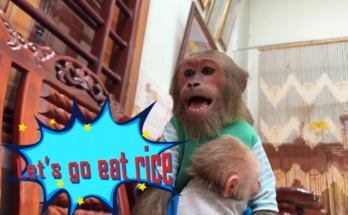
In the vast, sun-drenched savannas and rocky outcrops where baboons make their homes, life is a complex mix of social dynamics, survival instincts, and maternal care. Among these fascinating creatures, one of the most compelling aspects of daily life is the relationship between a mother baboon and her baby. It is a bond defined by love, guidance, discipline, and sometimes anger when lessons are not learned. One particularly striking scene observed in the wild is that of a mother baboon expressing frustration when her baby fails to follow her guidance or show the initiative to explore and learn—a behavior that underscores the vital role of encouragement in the growth of young baboons.
From the moment a baby baboon is born, it is entirely dependent on its mother for protection, nourishment, and learning. The mother carries her baby close, keeps it safe from predators, and introduces it to the complex social world of the troop. Every movement, every interaction, and every lesson is crucial for the baby’s development. The baby observes, imitates, and experiments, learning essential survival skills such as climbing, foraging, and navigating social hierarchies. In this context, maternal encouragement is not just kindness—it is a necessity.
However, baboon mothers are not passive caregivers. They are keen observers of their offspring’s abilities and often become visibly frustrated when their baby does not respond to their guidance. A mother may snap, grunt sharply, or use a firm nudge when the baby hesitates to climb a tree, reach for food, or engage in social interactions. This apparent anger is not cruelty; it is an instinctual method of teaching. By expressing disapproval when her baby shows reluctance, the mother motivates it to push beyond fear, laziness, or uncertainty, fostering confidence and resilience in the young baboon.

One common scenario involves the baby hesitating to explore a new branch or climb a tree to reach fruit. The mother, having assessed the situation, encourages her baby with gentle prods, vocal cues, and sometimes a stern glare. If the baby hesitates or retreats, she may growl or slap the branch near it, signaling that hesitation is not acceptable. Though it may seem harsh to human observers, this behavior is critical for the baby’s development. In the wild, hesitation can mean missed opportunities for food or exposure to danger. The mother’s anger is a form of tough love—a survival strategy honed by evolution to ensure the young baboon develops the skills and confidence needed to thrive.
Social learning plays a key role in these interactions. Baboons live in troops with complex social hierarchies, and young baboons must quickly learn to navigate these relationships. A baby who fails to engage with peers, respond to social cues, or assert itself may be at a disadvantage. The mother’s impatience is a natural response to these situations. By encouraging or even scolding the baby, she helps it learn the importance of interaction, communication, and observation. Every correction, every vocalization of frustration, and every physical nudge serves as a lesson in social competence.

Encouragement, even when coupled with anger, is not devoid of affection. After moments of sternness, mothers often soothe their babies with grooming, cuddling, or gentle vocalizations. These actions reinforce the bond between mother and child and ensure that discipline does not break the trust and attachment that are essential for the baby’s emotional security. The cycle of encouragement, frustration, and reassurance is a delicate balance, shaping the baby’s growth while maintaining the protective, nurturing relationship necessary for survival.
Interestingly, the intensity of maternal anger varies depending on context and temperament. Some mothers are more patient, using subtle cues to guide their babies, while others are more assertive, displaying open frustration when the baby is slow to respond. Environmental factors also play a role. Scarcity of food, presence of predators, or social tensions within the troop can heighten maternal responsiveness, leading to more frequent displays of anger. These behavioral adjustments reflect the mother’s instinct to optimize her baby’s chances of survival in a challenging and unpredictable world.
The baby baboon, for its part, gradually learns to respond to maternal guidance. Hesitation gives way to confidence, fear to curiosity, and dependence to emerging independence. A baby that once clung timidly to its mother may begin to explore branches, forage for small fruits, or interact assertively with peers. These milestones are not achieved without trials, and the mother’s occasional anger is an integral part of the learning process. It is a reminder that life in the wild is not always gentle,