At first, everyone thought it was strange.
The door was open. The sun was warm. The leash lay on the floor, waiting. But the dog stayed where he was—pressed against the corner of the room, eyes wide, body stiff, paws glued to the ground as if the floor itself were the only thing keeping him safe.
He would not go outside.
Not because he didn’t like fresh air.
Not because he was stubborn.
Because he was afraid.
To him, “outside” didn’t mean walks or freedom. Outside meant loss. It meant being left behind. It meant the moment when humans walked away and never came back.
Outside was where his world had ended before.
A Past Written in Silence
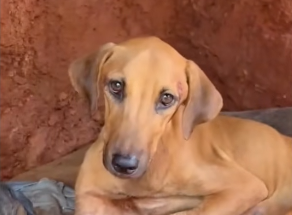
No one knew exactly how long he had been homeless. He was found wandering near an empty road, thin and exhausted, with fur matted from months of dirt and rain. There was no collar. No chip. No one searching for him.
But his fear told a clear story.
When someone reached for a leash, his body trembled. When a door opened, he froze. When footsteps moved too far ahead of him, he panicked and tried to retreat.
He had learned, through experience, that following humans outside meant being abandoned.
Once, maybe twice—perhaps more—someone had taken him somewhere, opened a door, and left. Each time, he had waited. And waited. And waited.
No one came back.
Safety Behind Closed Doors

Inside the shelter, he chose the smallest space he could find. Corners. Crates. Under tables. Places where nothing could sneak up behind him. He slept lightly, waking at every sound, always checking to make sure he was still there.
Staff tried to encourage him gently. They knelt. They spoke softly. They offered treats.
He wanted the food. He wanted the affection.
But the door stood between him and everything he feared.
Sometimes he would take a step forward, heart racing, then suddenly drop to the floor and refuse to move. Other times, he tried to pull backward, nails scraping against the tile, eyes pleading in a way that broke everyone’s heart.
Please don’t make me go.
The First Attempt
One volunteer decided to sit with him instead of pulling.
She sat on the floor, leaning against the wall, the leash resting loosely in her hand. She didn’t tug. She didn’t talk much. She just stayed.
Minutes passed. Then more.
Slowly, he crawled closer, sniffing the leash like it might bite. When it didn’t, he rested his chin on her knee. His breathing was shallow, uneven, but he stayed.
That was the first small victory.
Understanding His Fear
Behaviorists explained what he was showing: abandonment trauma. Dogs remember. Especially the ones who have been left behind more than once. For them, transitions are terrifying. Doors mean endings. Walks mean being lost again.
He wasn’t refusing to go outside.
He was refusing to be forgotten.
Once everyone understood that, everything changed.
Rewriting What “Outside” Means

They stopped forcing him.
Instead, they brought the outside to him.
Fresh air through open windows. Sunlight spilling onto the floor. Grass on a blanket. New smells carried in gently, safely.
They practiced near the door—just sitting beside it, feeding him treats, praising calm behavior. Some days, that was enough. Other days, he couldn’t handle even that.
And that was okay.
Healing doesn’t move in straight lines.
The Day He Chose to Try
Weeks later, something shifted.
The same volunteer opened the door and stepped outside—then stopped. She didn’t pull the leash. She didn’t call his name.
She waited.
He watched her carefully. She didn’t leave. She didn’t disappear. She stayed right there, in view, breathing calmly.
After a long moment, he stood.
One paw forward.
Then another.
When he reached the doorway, he froze again. His body shook so hard his collar jingled. He looked up at her, eyes full of questions.
She knelt down.
“I’m not going anywhere,” she whispered.
And somehow—somehow—he believed her.
One Step at a Time
He stepped outside.
Just barely. Just enough for the sun to touch his face.
The world didn’t end.
No one walked away.
They stood together for only a few seconds before going back inside. That was enough for that day. It wasn’t about distance. It was about trust.
From then on, they practiced every day.
Sometimes they made it to the grass. Sometimes just the doorway. Sometimes not at all.
Progress came in inches, not miles.
Learning That Staying Is Possible
Eventually, he learned something new.
Outside didn’t always mean goodbye.
Sometimes it meant walks and coming back.
Sometimes it meant play and safety.
Sometimes it meant returning to the same bed, the same people, the same care.
His tail began to lift. His steps became steadier. His eyes softened.
The fear didn’t disappear completely—but it no longer controlled him.
A Home That Moves at His Pace
When he was adopted, his new family was warned. They were told about the door fear, the freezing, the trauma.
They didn’t mind.
They moved slowly. They celebrated tiny victories. They never pulled. They never rushed.
On his first day home, he chose not to go outside.
And that was okay.
He curled up on the floor, finally sleeping deeply, knowing this place didn’t disappear when doors opened.
What His Story Teaches Us
This homeless dog didn’t refuse to go outside because he was difficult.
He refused because he remembered pain.
His story reminds us that healing is not about pushing forward—it’s about building safety. About showing, again and again, that love doesn’t vanish when doors open.
Some dogs need time.
Some need patience.
Some need proof that this time, they won’t be left behind.
And when they finally step outside—not because they’re forced, but because they trust—it’s nothing short of a miracle.
Because for them, that step isn’t just a walk.
It’s hope.