
In a small, quirky lab on the edge of the city, where sunlight streamed through dusty windows and colorful wires hung from the ceiling like jungle vines, a rather unusual experiment was underway. Dr. Cedric Thompson—or CT, as everyone called him—was hard at work. Known for his eccentricity and curious mind, CT had recently begun exploring what he termed the “Flip-Flop Phenomenon,” a series of experiments designed to challenge assumptions, provoke laughter, and, occasionally, defy common sense.
Today, CT’s lab was buzzing with anticipation. The latest experiment had caught the attention of both his colleagues and a growing online audience who eagerly awaited updates on his bizarre but entertaining work. This particular test involved a series of objects arranged in odd formations, a few robotic prototypes, and, of course, the ever-present flip-flops that CT insisted were key to understanding the universe—or at least the principles of chaos in domestic settings.
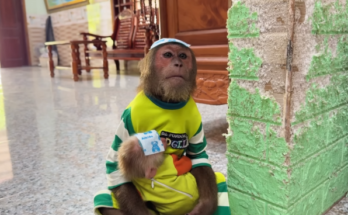
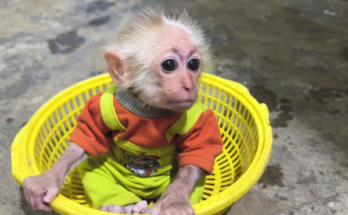
The setup was simple, yet deceptively chaotic. On a long table in the center of the lab, CT had placed two seemingly unrelated figures: a mannequin he affectionately called “Bob” and a life-sized plush toy that looked vaguely like a baby, which CT had labeled “Junior.” Both figures were propped up in unusual positions, with flip-flops dangling precariously from their feet. At first glance, an observer might have assumed the scene depicted a mother and child moment. But, as CT liked to emphasize with a dramatic wave of his hand, “This is not a mother and child!” 😅
He laughed, a hearty, slightly manic chuckle, and adjusted his glasses. “Perception is everything, people! What looks familiar can be completely misleading. Today, we explore misidentification, balance, and the uncanny effects of flip-flops in structured environments!”
CT’s assistant, Lila, raised an eyebrow. She had been with him through countless odd experiments, from “The Great Spaghetti Resonance Study” to “The Cat Nap Synchronization Project,” but even she found today’s work unusually absurd. “So… we’re proving that these aren’t mother and child figures?” she asked, her tone half-amused, half-bewildered.
“Exactly!” CT replied, pacing around the table like a conductor before a symphony. “Observe carefully. Junior is not held by Bob. In fact, the only connection is the subtle magnetic pull between flip-flops and floor friction. This is pure physics masquerading as emotion.”
He picked up one of the flip-flops, dangling it over Junior’s tiny plush foot. “Watch closely.” He dropped it, and the flip-flop wobbled, rotated, and landed in a perfect arc across the table. Junior toppled over slightly, and CT clapped his hands in delight. “Success! Misalignment achieved! The illusion is complete!”

Lila shook her head, trying not to laugh. “So… what exactly are we learning here?”
CT’s eyes sparkled. “We’re learning that context creates narrative. People see what they expect to see. A mannequin next to a plush toy? Boom—instant mother and child. But with a few flip-flops and a little imbalance, reality is revealed: these are just objects, obeying physics, not familial bonds!”
He then brought over a small camera, setting it to capture slow-motion footage of the flip-flops in action. “And for the grand finale, we document the chain reaction!” He dropped both flip-flops simultaneously, and they collided mid-air before knocking over Junior and sending Bob leaning against a stack of textbooks. Lila burst out laughing at the ridiculous scene captured on camera.
“Honestly,” she said, still chuckling, “I’ve seen some strange experiments, but this one… this one takes the cake. It’s like… slapstick physics.”
CT nodded solemnly, as if the comparison elevated his work to the level of classical science. “Precisely, my dear Lila. Slapstick is science in motion! Observe how gravity, momentum, and perception interact. What looks like a tender moment is actually chaos theory in disguise.”
He then grabbed a whiteboard and began diagramming the entire setup. Lines, arrows, and doodles of flip-flops filled the board. “We must account for the angles of approach, the center of gravity, and the emotional misinterpretation factor,” he explained. Lila peeked over his shoulder, seeing stick figures labeled with terms like “Not Mother” and “Definitely Not Child.”
“Emotional misinterpretation factor?” she asked skeptically.
CT nodded vigorously. “Yes! Humans are wired to assign narratives. Two objects, a pair of flip-flops, a precarious lean—instantly, we project relationships where none exist. This experiment quantifies that tendency!”
They spent the next hour fine-tuning the positions of Bob and Junior, adjusting the flip-flops to optimize the illusion-to-reality ratio. Sometimes Bob would tip too far, and Junior would slide off the table entirely. Other times, the flip-flops wouldn’t land where CT wanted them. Every failure, however, was meticulously noted and celebrated as a new data point.
By late afternoon, the experiment reached its peak. CT called it the “Flip-Flop Alignment Paradox.” Lila watched in amazement as Junior teetered on the edge of the table, a flip-flop dangling from one foot, while Bob leaned forward slightly, perfectly positioned to create the illusion of protective embrace—but, as CT proudly reminded her, “It is not a mother and child. I repeat, it is not a mother and child!” 😅

They recorded the final slow-motion footage, which captured every wobble, every collision, and every near-fall. In post-analysis, CT and Lila reviewed the clip, pointing out the exact frames where the illusion was strongest and where gravity had betrayed their careful calculations.
“This is going to go viral,” Lila said, shaking her head. “People are going to see this and think you’re just being ridiculous.”
CT’s smile widened. “Ridiculous is the point! But beyond that, it’s science. We’re teaching critical thinking through absurdity. If people question their perceptions because of flip-flops and plush toys, then we’ve succeeded.”
As evening fell, the lab was quiet except for the soft hum of the cameras and the occasional squeak of a flip-flop rolling across the table. CT leaned back, satisfied. “Another successful series of experiments,” he declared. “We have proven once again that appearances are deceiving. This is not a mother and child. And the flip-flops? They were the key all along.”
Lila laughed. “Only you could turn flip-flops into a scientific breakthrough.”
CT’s eyes twinkled. “And yet, the world needs such breakthroughs, Lila. In a society full of assumptions, we must show that reality can be stranger than perception. The Flip-Flop Alignment Paradox teaches humility, patience, and the beauty of chaos.”
Finally, as they packed up for the day, CT placed Bob and Junior back on a shelf, each with a single flip-flop hanging off their feet. “Rest now, my subjects,” he said with a grin. “Tomorrow, we explore the next phase: the Velcro Sock Experiment. But remember—never forget today’s lesson. This is not a mother and child.”
Lila shook her head one last time, smiling. “Tomorrow will be even crazier, I’m sure. I can’t wait.”
And so, in the quirky lab at the edge of the city, amidst laughter, wobbling mannequins, and flying flip-flops, the world’s most unusual experiments continued—proving, once and for all, that sometimes the line between science, art, and pure chaos is just a flip-flop away. 😅