The nights had grown bitter in the small village, where winter winds crept through every narrow alley and swept across every doorstep. It was the kind of cold that made even the strongest shiver, wrapping itself around bones like icy fingers. But for the little dog tied to the old wooden pole behind an abandoned warehouse, the cold was more than discomfort—it was a silent punishment she could not escape.
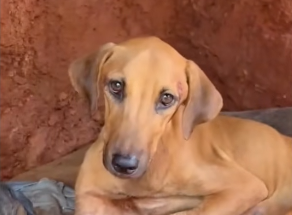
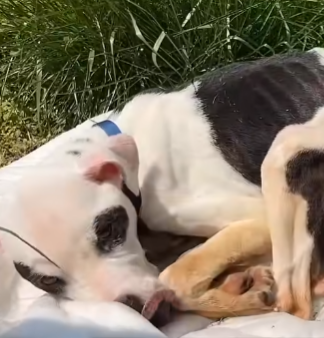
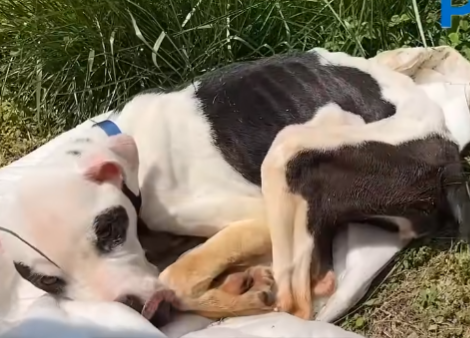
She was small, barely more than a year old, with fur once soft and golden but now matted from rain, dust, and neglect. Her ribs showed through her thin frame, and her eyes—large, dark, and glistening—reflected a mix of fear and hope. Every time the wind howled, she curled tighter into herself, pressing close to the wooden pole as if it might offer her warmth. It never did.
She didn’t understand why she was tied there. She had once belonged to a family—children who played with her, a woman who fed her scraps, and a yard where she learned to chase butterflies. But one day, the family moved away, and she was left behind, tied as if someone meant to return… but no one ever did.
Days passed. Nights grew colder. Hunger gnawed at her like an unending ache. She cried softly—not loud enough to disturb the world, just enough to release her longing, her confusion, her fear. A soft whimper. A breathy cry. A tiny plea that disappeared into the wind.
But pain always leaves traces, even when the world tries to ignore them.
On the fifth night, when the moon was only a faint silver scratch in the sky, a stranger walked down the path near the warehouse. He was a simple man named Dara, returning from a long shift cleaning floors at a nearby factory. His hands were rough, his clothes worn, and his steps slow from exhaustion. He hardly noticed the world around him anymore—life had demanded too much from him lately.
But that night, as he passed the silent warehouse, something tugged at his weary senses. A sound. Faint. Fragile. Not quite a bark, not quite a cry. More like a broken whisper.
He stopped.
There it was again—a soft, trembling whimper.
He turned his head toward the sound, squinting into the darkness. “Hello?” he called out gently.
Silence.
Then, a tiny cry.
Compassion stirred inside him, stronger than fatigue. He stepped off the path, moving slowly, careful not to frighten whatever creature was calling for help. As he approached the back of the warehouse, the dim amber glow of a distant streetlight revealed a small shape curled by the pole.
A dog. A trembling dog.
“Oh no…” Dara whispered, kneeling down. “What happened to you, little one?”
The dog lifted her head weakly. Her eyes met his—eyes full of sadness so deep it struck him like a blow. She tried to wag her tail but lacked the strength; it only twitched.
He gently touched her fur, shocked at how cold and thin she was. The rope around her neck was tight, rough, and knotted as if someone had tied it in haste and never cared to loosen it.
“Who left you here like this?” he murmured.
She only lowered her head again, as if apologizing for being a burden.
Dara tried to unknot the rope, but it was too tight, soaked from rain and dirt, hardened by days of tension. He pulled at it, fingers numb from the cold. No use. So he reached into his bag and took out a small utility knife he used at work. Carefully—very carefully—he cut through the rope.
The moment the last fiber snapped, the dog staggered forward, collapsing weakly into his lap. She didn’t run. She didn’t bark. She simply pressed her head against his knee and released a tiny sigh, as if realizing she was finally safe.
“You poor thing,” he said, voice breaking. “How long have you been alone?”
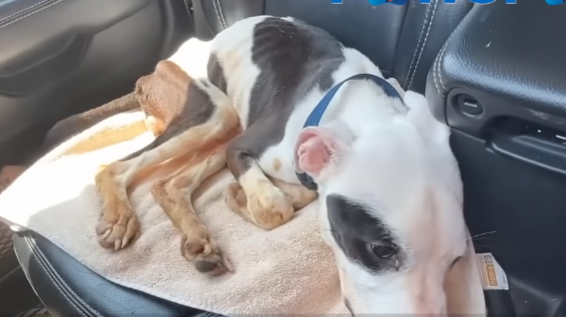
He wrapped her in his old work jacket, lifting her gently into his arms. She was feather-light, almost weightless. As he carried her home, she tucked her face into the crook of his arm, absorbing the warmth she had been denied for so long.
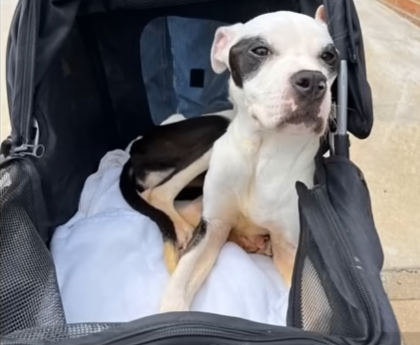
Dara lived in a modest one-room rental, but it felt like a palace compared to the cold emptiness she had endured. He placed her on a soft blanket near his small heater, then warmed a bowl of water and some leftover rice. She ate slowly, carefully, as if afraid the food might disappear.
That night, for the first time in days, she slept without shivering.
And for the first time in months, Dara felt a strange warmth in his heart—something he had forgotten existed.
The next morning, he woke to find her sitting beside him, watching him with those round, grateful eyes. Her tail wagged timidly when he reached out to pet her.
“Well,” he said with a smile he didn’t even realize he still knew how to make, “I guess we belong to each other now.”
He named her Sreypov—meaning “precious girl.”
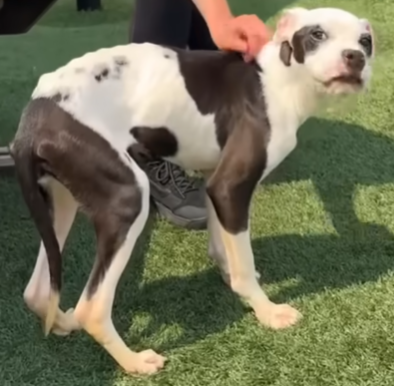
Over the next weeks, Sreypov grew stronger. Her fur regained its shine, her ribs became less visible, and her tail wagged more boldly each day. She followed Dara everywhere—into the kitchen, to the doorstep, even sitting beside him while he mended his worn shoes or prepared a simple meal.
She became his shadow, and he became her safe place.
The villagers soon noticed the gentle dog who walked proudly beside the quiet man who had once kept to himself. Children called out to her, and she wagged her tail happily. Even neighbors who rarely spoke to Dara greeted him now; Sreypov seemed to bring out kindness from everyone she met.
She had been discarded, forgotten, left to face the cold alone—but now she was loved, protected, cherished.
One favorite moment came every evening after Dara returned from work. Sreypov would race to the door, her ears perked, her eyes bright with joy. She would jump into his arms, showering him with affection. To her, he was the hero who had heard her pain when no one else listened.
And to him, she was the miracle who reminded him that even in a world full of indifference, compassion could still bloom unexpectedly.