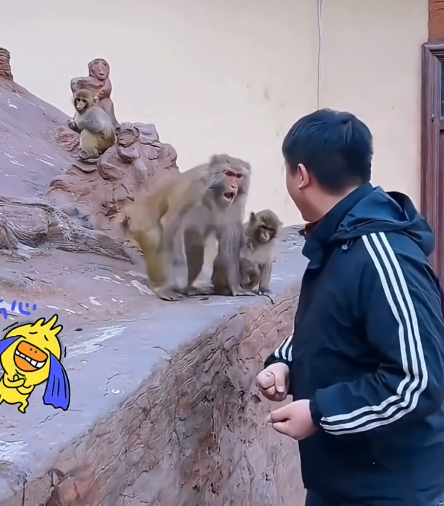
In a quiet village nestled between the mountains and a dense forest, the villagers had long learned to respect the creatures that lived nearby. Monkeys, with their mischievous antics, had always been a part of everyday life. Most of the time, they were playful, harmless, and even amusing to watch as they swung from tree to tree or stole fruit from the market stalls. But one particular monkey had earned a reputation unlike any other.
The villagers called him Raju, and Raju was not your ordinary monkey. While others played and foraged calmly, Raju had a fiery temper. It wasn’t unusual for him to chase away smaller monkeys or snatch food aggressively from humans who got too close. He had survived numerous conflicts with larger animals and humans alike, but over time, the villagers learned that provoking him could lead to chaos. His fury was legendary.
Warnings were everywhere. Signs were posted near his favorite trees, and locals would whisper to newcomers, “🚫🐒 Warning: Angry Monkey Ahead! 😡💣.” People knew that Raju’s anger wasn’t random—it was triggered by a sense of territory being threatened, disrespect, or anything he perceived as a slight. Unlike other monkeys, he did not forgive easily.
The story of Raju’s temper began long ago when he was just a young monkey. Unlike others in his troop, he had been forced to fend for himself from a very young age. His mother disappeared under mysterious circumstances, leaving him alone in a harsh world. Hunger and danger shaped his personality, making him aggressive and hyper-alert. Every sound in the forest made him twitch, every movement nearby put him on edge. He learned to fight, to scare off competitors, and to survive. Over time, his anger became both a weapon and a shield.
One summer, the villagers noticed a spike in Raju’s aggression. Bananas disappeared from stalls within seconds, chickens were chased across yards, and his screeches echoed through the village like a warning bell. Parents would call their children indoors at the first sign of him, and shopkeepers would barricade their produce at the sound of his distant yell. Even dogs gave him a wide berth, knowing that Raju’s fury was unmatched.
But what triggered such anger? It wasn’t just hunger—it was disrespect. Monkeys like Raju had a sense of pride and a need for recognition. If humans ignored their presence or tried to dominate them, it provoked a reaction. One villager, Mr. Sharma, learned this the hard way. He had accidentally stepped too close to Raju’s favorite mango tree while carrying a basket of fruits. Within moments, Raju appeared like a blur of fur and teeth, snatching the basket and sending Mr. Sharma stumbling backward. Fortunately, he was unharmed, but the basket of mangoes was gone—and with it, the lesson that no human should cross Raju lightly.
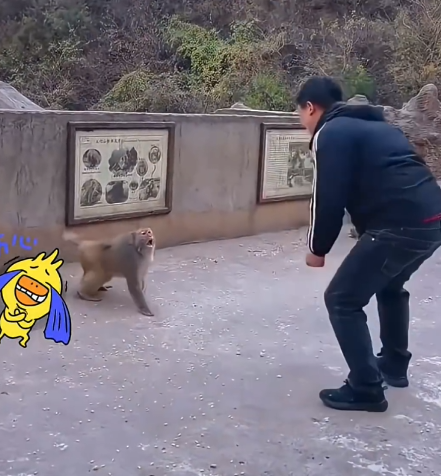
Visitors to the village were often warned not just by signs but by the villagers themselves. “Stay on the path,” they said. “Do not feed him. Do not stare. And never, ever try to chase him.” But curiosity is a human trait, and some tourists, unaware of Raju’s reputation, found themselves face-to-face with the infamous monkey. Some were lucky—he would snatch a snack and disappear into the trees, leaving only chaos behind. Others, less fortunate, experienced full-blown fury: screams, scratches, and the terrifying sound of a monkey’s rage echoing through the forest.
The village council eventually took notice. They organized a team of wildlife experts to study Raju’s behavior. They learned that while he was indeed aggressive, his anger had patterns. He became especially hostile during mating season or when he sensed that his territory was shrinking due to human activity. Experts suggested that respect and distance were key to coexisting with him, and that no one should ever try to corner or trap him.
Despite his fearsome reputation, Raju wasn’t all bad. He had a strange sense of fairness among his troop. Smaller monkeys that respected his territory were left alone, and young monkeys often observed his behavior to learn survival skills. Some villagers even noticed moments of unexpected gentleness: Raju once protected a lost baby monkey from a stray dog, chasing the predator away with a fearsome display that made the villagers tremble in awe. It became clear that his anger was not blind—it was calculated, defensive, and protective.
One day, a boy named Aarav decided to test his courage. He had grown up hearing stories of Raju and wanted to see him for himself. Ignoring the warnings, he wandered near the tree where Raju was known to hang out. He carried a shiny snack pack, hoping to entice the monkey with food. As he approached, Raju emerged silently from the branches, his golden eyes locked on Aarav. The air seemed to still; even the birds went quiet.
Raju’s stare was enough to make Aarav freeze. He remembered the warning signs flashing in his mind: “🚫🐒 Warning: Angry Monkey Ahead! 😡💣.” But his curiosity got the better of him. He held out the snack pack slowly. Raju’s ears twitched. His body tensed. The villagers watching from afar held their breath.
Then it happened. Raju leapt from the branch with the precision of a predator, landing a few feet from Aarav. The boy froze completely. But instead of attacking immediately, Raju sniffed the snack pack, tilted his head, and then—unexpectedly—snatched it gently and retreated into the trees without a scratch. Aarav let out a breath he didn’t realize he had been holding. It was a small victory: respect and caution had prevented disaster.
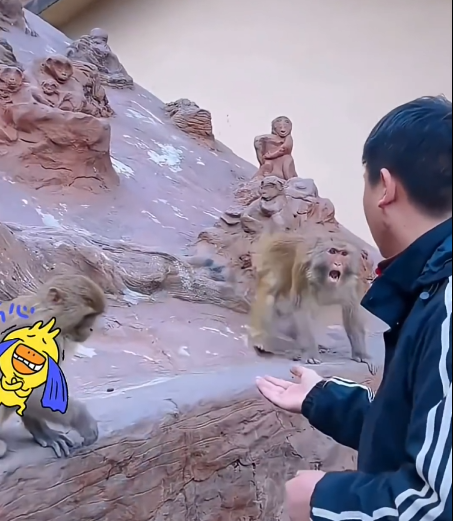
Raju’s reaction that day became a story in itself. It taught the villagers a vital lesson: the monkey’s anger could be controlled or avoided through understanding and respect. He was not evil or cruel by nature—he was a creature shaped by circumstances, forced to fight to survive, and always ready to defend himself when he felt threatened.
Over the years, the villagers developed a unique relationship with him. They left fruit in designated areas, never approached him directly, and treated his presence as a part of daily life rather than a nuisance. Signs still read, “🚫🐒 Warning: Angry Monkey Ahead! 😡💣,” but there was an understanding: coexistence was possible if humans respected boundaries.
Raju continued to patrol his territory with pride. Travelers who ignored the warnings found themselves on the receiving end of his wrath, while those who observed patience and caution were often left unscathed. His legend grew beyond the village, with stories of his fury—and occasional mercy—traveling to nearby towns. People would come to witness him, fascinated by the rare sight of a monkey whose anger was as powerful as his intelligence.
Yet for all his anger, there were moments of quiet that revealed another side of Raju. At dusk, he would sit atop a branch, watching the sunset. Sometimes he would groom younger monkeys or rest quietly by a stream, his fierce exterior softening in the golden light. These moments reminded the villagers that even the angriest creatures had layers—emotions, instincts, and desires that deserved respect.
And so, Raju’s presence became more than just a warning; it became a symbol. He reminded humans that the wild is not ours to control, that anger is often a response to fear or past hardship, and that understanding is always more powerful than confrontation.
The villagers never forgot the day Aarav faced him, nor the countless times Raju’s fury had reminded them of the delicate balance between humans and wildlife. And though his anger remained formidable, his story was no longer just one of fear—it was also one of survival, intelligence, and the enduring spirit of a monkey who would not back down.
So, whenever someone approached the forest or wandered near the edge of the village, the signs flashed clearly in their mind:
🚫🐒 Warning: Angry Monkey Ahead! 😡💣
And they remembered: respect, caution, and understanding were the only ways to coexist with a creature as fierce—and as remarkable—as Raju.
Because sometimes, anger is not a threat—it’s a signal. And sometimes, behind that anger, is a story of resilience that commands awe and respect.