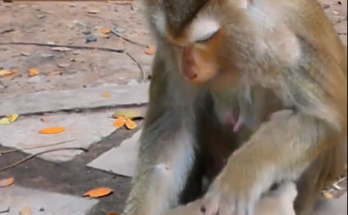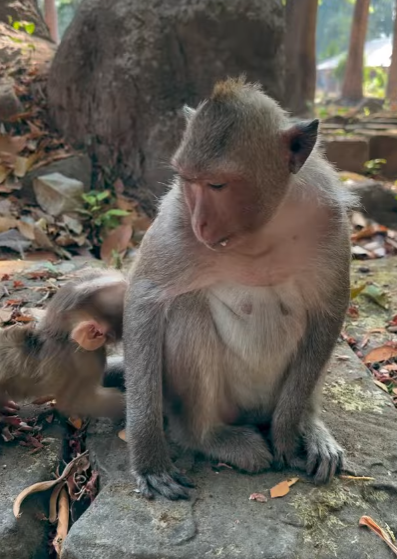
From the very beginning, the young monkey’s life was defined by dependence. In the dense jungle, where sunlight filtered in patches through the towering trees and the air was heavy with the scent of wet earth and leaves, the infant monkey clung tightly to its mother. Its tiny hands gripped her fur, finding comfort in her warmth, in her heartbeat, in the rhythm of her movements. Every action, every instinct, every survival strategy of the young monkey was intertwined with the mother’s presence. Without her, life would have been chaotic, uncertain, and dangerous.
Dependence is a natural state in the early stages of life. For the young monkey, it meant more than simply being fed; it meant being guided through the complexities of the jungle. The mother taught it which fruits were safe to eat, which plants to avoid, and where to find water. She showed it how to move nimbly through the branches, how to leap from one tree to another, and how to hold on tightly when the wind shook the canopy. Each lesson was a combination of observation and direct teaching, and every day, the young monkey absorbed these lessons as naturally as it breathed.
Protection was perhaps the most vital aspect of this dependence. Predators lurked everywhere — snakes coiled among roots, leopards prowled silently, eagles circled overhead, and even rival monkeys could attack the young and weak. The mother was vigilant, always scanning the surroundings, ready to intervene at a moment’s notice. She would position herself between the infant and danger, offer a loud warning, or, if necessary, physically shield her young. For the young monkey, these protective actions were a lifeline. Without them, the harshness of the wild would have become apparent immediately, and survival would have been uncertain.
Guidance, too, was constant and multifaceted. The young monkey learned social norms by watching the mother interact with other troop members. She modeled grooming behaviors, conflict resolution, and submission to dominant individuals. Through these interactions, the infant learned how to communicate, when to assert itself, and when to retreat. Social skills were not optional; they were essential for acceptance within the troop and for survival in a competitive environment. Every interaction with its mother reinforced lessons about behavior, safety, and belonging.
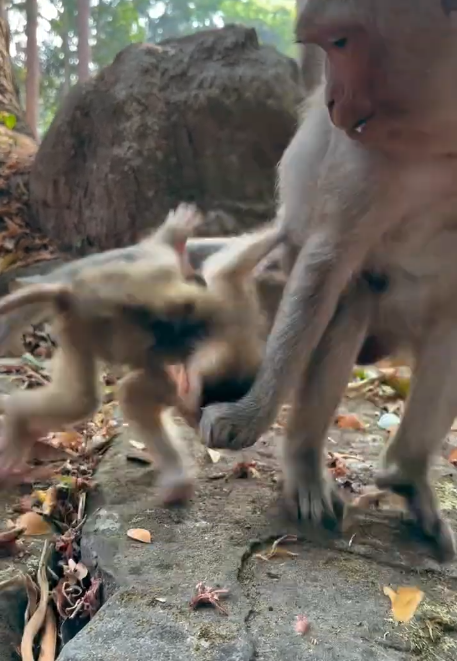
At first, dependence seemed total. The young monkey rarely ventured far from its mother, its every movement coordinated with hers. If she moved, it moved; if she stopped, it paused. Its world was limited to the mother’s immediate surroundings, and this limitation was both safe and comforting. Hunger, fatigue, and fear were mitigated by her presence. Life, for the infant monkey, was predictable because the mother made it so.
However, dependence is not permanent. It is a phase, a stage designed to prepare the young for eventual independence. The mother knew this instinctively. She began to encourage small explorations, letting the infant venture a few feet away while keeping watch from a safe distance. She would allow brief moments of trial, letting the young monkey discover its strength, test its balance, and experience the thrill and risk of movement. When mistakes happened — a slip from a branch, a misjudged leap — she intervened, but gradually, she allowed the infant to face the consequences of its actions. This delicate balance between protection and challenge is crucial in development, for it fosters resilience while maintaining safety.
Nourishment was the foundation of this early dependence. The mother’s milk provided the essential nutrients needed for growth, health, and energy. Feeding times were moments of bonding and reassurance. Beyond milk, she introduced solid foods gradually, showing the young monkey how to select, peel, and consume fruits, leaves, and insects. Each meal was a lesson in survival: which foods were edible, how to extract nourishment, and how to eat safely in a world full of predators and competition. Food, then, was not merely sustenance; it was education, and through it, the infant monkey began to understand the patterns and rhythms of its environment.
Dependence also created emotional security. The young monkey’s attachment to its mother provided a stable base from which it could explore the world. Fear and anxiety were mitigated by the knowledge that the mother was nearby, ready to offer comfort or guidance. This sense of security allowed the young monkey to take risks, to play, and to engage with its surroundings in ways that fostered physical, cognitive, and social growth. Without this emotional anchor, the jungle would have seemed overwhelming, and the young monkey’s early development might have been stunted.
Yet, dependence is not without challenges. The young monkey had to learn to balance reliance with self-initiative. Observing its mother meant recognizing patterns but also interpreting them. Learning to climb, jump, and forage required trial and error. Each misstep was an opportunity for growth, and each success reinforced competence and confidence. The process of guided learning — being dependent but gradually gaining autonomy — is essential for survival in any complex environment.
The mother’s vigilance extended beyond immediate threats. She modeled long-term survival strategies, teaching the young monkey to anticipate seasonal changes, recognize sources of water during drought, and understand the behaviors of predators and prey. This foresight, passed down through careful observation and mimicry, was critical. The young monkey’s dependence was not passive; it was active learning, a continuous engagement with the mother as both teacher and protector.
As days turned into weeks, and weeks into months, the young monkey’s skills improved. Climbing became more confident, leaps more precise, and decisions more calculated. Dependence gradually transformed into interdependence — the young monkey could now rely on the mother for guidance but also contribute to the troop’s dynamics through play, grooming, and alerting others to danger. Growth, in this sense, is a continuum: from total dependence to cautious independence, and eventually, to mature self-sufficiency.
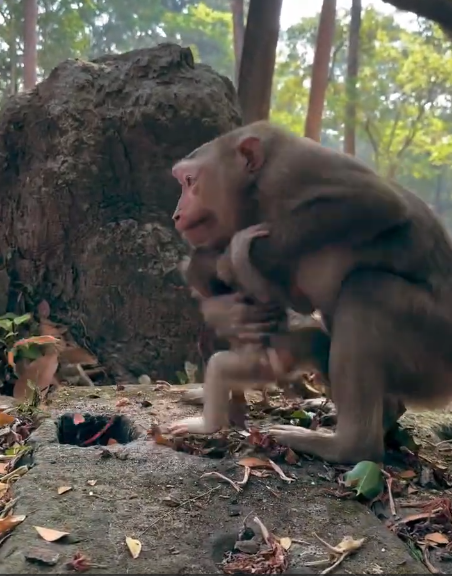
Ultimately, the story of the young monkey highlights the essential balance between protection and autonomy. Dependence is not weakness; it is a necessary stage of life. Nourishment, guidance, and protection from the mother equip the young monkey with the tools to survive, adapt, and thrive. The lessons learned in these early stages — about food, safety, social behavior, and environmental awareness — shape the individual for a lifetime.
From the very beginning, the young monkey’s life was defined by dependence, and yet, within that dependence lay the seeds of independence. The nurturing presence of the mother, the careful teaching of survival skills, and the gradual exposure to challenges formed a foundation upon which the young monkey would build resilience, competence, and confidence. This story is not only about the life of one monkey in the jungle; it is a reflection of universal principles of growth, learning, and the interplay between dependence and autonomy.
In essence, dependence is the beginning of life’s broader journey. Through reliance on caregivers, mentorship, and supportive relationships, young beings of all species acquire the skills, knowledge, and confidence needed to face the world. The young monkey’s story reminds us that early dependence is not a limitation but a crucial stage, preparing the individual to navigate the complexities of life with strength, wisdom, and self-assurance.
The mother’s care, the lessons in nourishment, protection, and guidance, all converge to create not just survival, but thriving. And as the young monkey grows, leaps from branch to branch, and explores the vast jungle beyond the safety of maternal presence, it carries with it the enduring imprint of those first days — a testament to the profound importance of early dependence in shaping a life capable of resilience, growth, and success.