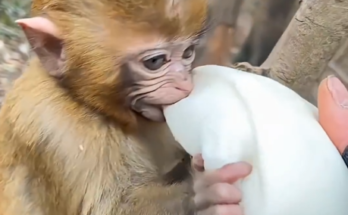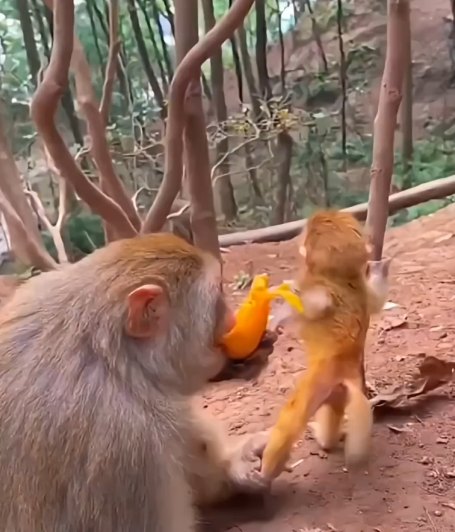
In the quiet village on the edge of a dense forest, life moved slowly. Children ran barefoot along dirt paths, laughing and chasing one another, while women carried baskets of vegetables home from the market and men worked in the fields, their hands calloused and strong from years of labor. Amid this simple life, a curious little monkey had become an unusual and beloved presence in the village—a creature whose affection for the children was nothing short of astonishing.
The monkey, a small brown capuchin named Momo, had lived near the village for as long as anyone could remember. Unlike other monkeys, Momo was not wild in the usual sense. He had been rescued as an infant after his mother had been lost to hunters in the forest. A kind-hearted villager named Lila had found him trembling on a tree branch, crying desperately for warmth and food. From that day, Momo had grown under the gentle care of humans, but unlike most captive monkeys, he had never lost his wild instincts completely. He loved climbing trees and exploring the forest’s edges, but his heart always remained close to the children of the village.
It was a love that went far beyond simple companionship. Momo followed the children everywhere—through the dusty village lanes, along the fields where they played soccer, and even into the small schoolhouse where the teacher often had to shoo him out with a broom. His presence was never unwelcome for long, because Momo had a way of knowing exactly when a child needed comfort, protection, or companionship.
The children loved him, of course. But their affection was rooted in curiosity and amusement. What no one expected, not even the adults, was the depth of Momo’s devotion and care. For example, there was little Anya, a shy six-year-old girl who had always been afraid of the forest. One afternoon, while chasing a butterfly near the forest edge, Anya tripped and twisted her ankle. She cried out, unsure of what to do. Within moments, Momo appeared, leaping gracefully from the trees, landing beside her with a concerned chatter. He nudged her gently with his head, wrapping his small arms around her legs in a protective embrace. Then, with a chirping call, he ran toward the village, glancing back repeatedly to ensure she followed.
The villagers marveled at Momo’s behavior. No one had ever seen a monkey show such concern, such intentional care for human children. It was as though Momo understood the vulnerability of a child in a way only a mother or a parent could. And Momo did not discriminate. He loved every child in the village with the same intense devotion. Whether it was feeding them small fruits he had gathered, warning them of approaching dangers, or simply playing beside them during long, lonely afternoons, Momo’s presence became a constant source of joy and comfort.
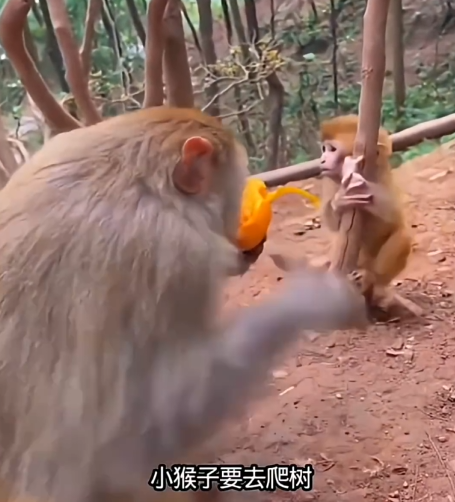
But love, as the villagers soon realized, was not always simple. Momo’s protective instincts sometimes led him into conflict with the village’s other animals and even with adults. There was the time a stray dog approached the children while they played near the riverbank. Momo’s fierce chatter and fearless leaps drove the dog away before it could get too close. Another time, when a large snake slithered near the school’s courtyard, Momo’s warning cries alerted everyone, saving several children from harm. It was as though he had become more than just a companion; he was a guardian.
Yet, Momo’s love was gentle, too. He would sit quietly beside a crying child, resting his tiny head on their lap, offering warmth and comfort without ever demanding anything in return. During the hot afternoons, he would carefully fetch leaves and make small fans to help shade children from the sun. On rainy days, he would lead them to shelter, often standing guard until the rain stopped. His devotion was tireless and unwavering.
The villagers began to question how it was possible for a monkey to feel such profound affection for humans, especially children. After all, in the wild, monkeys were instinct-driven. They cared for their own offspring and followed the rules of social hierarchies. They were mischievous, clever, and occasionally aggressive. But love? Human-like, selfless love? That seemed extraordinary.
Experts who visited the village later suggested that Momo’s upbringing had played a role. Being rescued as an infant had likely imprinted on him a strong bond with humans. Yet, even those who understood the psychology of animal behavior admitted that the intensity of his devotion was rare, perhaps even unique. For Momo, the children were not merely companions—they were family. They were his tribe. And he demonstrated, in ways both subtle and dramatic, that he would go to any lengths to ensure their safety and happiness.
One of the most extraordinary displays of Momo’s love came one summer when the village faced a flood. The river, swollen by weeks of heavy rain, burst its banks, threatening homes, livestock, and the children playing near its edges. Panic erupted as families rushed to secure their belongings. In the chaos, several children became stranded on small patches of land surrounded by fast-moving water.
Momo did not hesitate. He darted into the shallow currents, leaping from stone to stone, reaching the frightened children one by one. He climbed onto the back of each child, guiding them to safer ground while chattering loudly to draw the attention of nearby villagers. Parents watched in amazement and gratitude as this small monkey, drenched and trembling, carried out what seemed like impossible feats to save their little ones. His love, once again, became a lifeline.
Even after such adventures, Momo remained humble. He did not seek praise, nor did he seem to expect anything in return. He returned to the village, grooming himself meticulously, then sat quietly beside the children, offering gentle touches, playful gestures, and comforting words in his chattering voice. Love, for him, was action, not performance.
The children, too, responded to Momo in ways that spoke to the depth of the bond. They included him in their games, shared their food with him, and sought his approval. If Momo was upset with them—for mischief or carelessness—they respected his signals, learning lessons about boundaries and respect. In many ways, the monkey became a teacher as well as a guardian.
However, Momo’s affection was not blind. He had a keen sense of judgment. If he sensed danger, he did not hesitate to intervene. Once, when a child wandered too close to the forest’s edge where snakes and wild animals prowled, Momo’s sharp cries and swift nudges forced the child back to safety before any harm could occur. Villagers began to understand that his love carried responsibility—a combination of protection, guidance, and loyalty that went far beyond what they had seen in domestic animals.
The question, then, arose naturally: can a monkey love children so much? The answer, watching Momo in action, seemed undeniably yes. But it was not just affection; it was an intricate, profound understanding of connection, vulnerability, and care. Momo’s love combined instinct, learned behavior, and a deep emotional intelligence rarely acknowledged in humans’ understanding of animals.
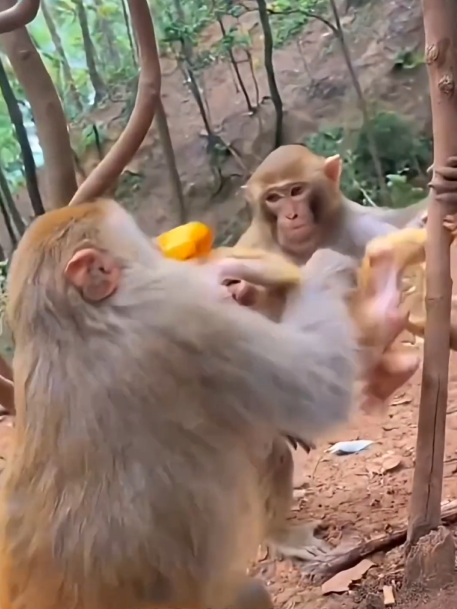
As years passed, Momo continued to grow alongside the children. They matured, and so did he, though his playful spirit never faded. Even as some children reached adolescence and ventured further into the forest or to school in nearby towns, they always returned to Momo, seeking comfort, guidance, and a connection to their childhood.
Momo’s story spread beyond the village. People traveled from nearby towns to witness this extraordinary bond. Some came expecting entertainment but left with wonder and reflection, realizing that love transcended species, age, and boundaries. Scientists, while documenting behavior, were astonished by the intuitive care, empathy, and protection he displayed.
The most remarkable aspect of Momo’s love was its constancy. Through sickness, injury, or scarcity of food, he remained devoted. When a child fell ill, he refused to leave their side, offering warmth and gentle chattering until recovery began. When storms came, he guided the children to safety. When loneliness struck, he became a companion, never judgmental, never harsh.
Momo also had a subtle way of teaching lessons. Through his actions, children learned empathy, responsibility, and the importance of caring for others. They understood that love is not just a feeling but a practice—a series of choices to protect, comfort, and nurture. Watching Momo, they learned that true affection sometimes requires courage, sacrifice, and attentiveness.
In this small village, it became impossible to ignore the truth: monkeys could love children—not in the limited sense of simple attachment or companionship, but in a deep, transformative, and protective way. Momo demonstrated that love could transcend biology, species, and instinct. It could be conscious, deliberate, and morally significant.
On quiet evenings, when the sun dipped behind the forest, Momo would sit beside the children he had grown up with, grooming them gently, resting his small hand on their shoulders, and chattering softly. It was a ritual, an affirmation of connection. And the children would respond in kind, speaking softly, stroking his fur, and laughing at his playful antics.
This ritual reminded everyone that love, in its truest form, is not measured by words alone. It is measured by actions, by the willingness to protect, to comfort, and to invest in another’s well-being. And Momo, in his small, furry form, embodied this truth perfectly.
So, can a monkey love children so much? The answer, for those who have seen Momo in action, is undeniably yes. He loved them with courage and patience, with attentiveness and understanding, with the kind of devotion that can teach even humans a profound lesson. His life, though small in physical stature, was vast in emotional depth—a reminder that love is not confined by species but expressed wherever hearts are willing to connect.
Even now, when new children come to the village, Momo greets them, watches over them, and teaches them the gentle ways of the world. He remains a living testament to the power of love—a love that defies expectation, transcends species, and endures against all odds.
In the forests and villages of the world, perhaps there are other monkeys like Momo. Perhaps other creatures have the capacity for care, devotion, and selfless love that humans have long underestimated. But for this village, for the children who grew up alongside him, Momo will always be the living answer to the question: can a monkey love children so much?
The answer is clear.
Yes. And sometimes, that love is deeper and more enduring than anything we could imagine.