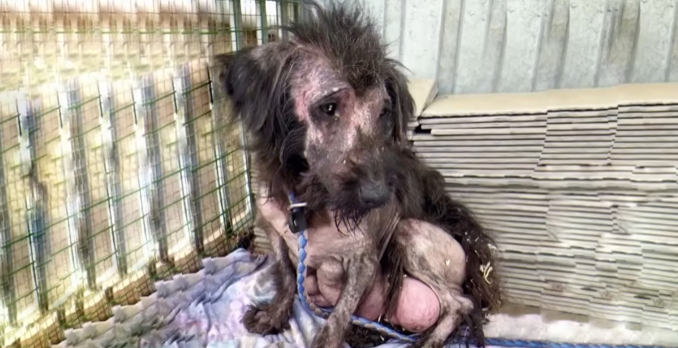
The rain had just stopped, leaving the streets slick and shining under the weak morning sun. People hurried past, stepping around puddles, focused on their own lives, their own destinations. Almost no one noticed the thin, trembling dog crouched beside a broken cardboard box near the gutter. Her fur was matted with dirt, her eyes sunken with exhaustion, and her body shook not only from the cold, but from fear and pain.
She had given birth only hours earlier.
Her body was still weak, milk heavy in her swollen belly, her legs unsteady beneath her. Every instinct inside her screamed the same message: find my puppies. But the place where she had delivered them was gone. The familiar smells, the warmth, the tiny bodies pressed against her—all vanished.
Sometime during the night, while she lay exhausted and half-conscious after labor, someone had dragged her away. Perhaps they were afraid of the mess. Perhaps they didn’t want the responsibility of newborn lives. Or perhaps they simply didn’t care. She was lifted, carried, and thrown onto the street like a useless object, her puppies left behind somewhere unknown.
When she woke, panic tore through her.
She staggered to her feet, whimpering softly, nose to the ground. Her cries were low and broken, not loud enough to bother the people passing by, but full of desperate meaning. To anyone who understood animals, it was the sound of a mother calling for her babies.
She walked a few steps, then stopped, confused. The street was loud and unfamiliar. Motorbikes roared past, horns blared, and strangers’ shoes surrounded her. Every smell overlapped, drowning out the delicate scent of her newborn puppies. She turned in circles, tail tucked tightly, eyes wide.
Then she cried again.
It wasn’t just a sound—it was a plea.
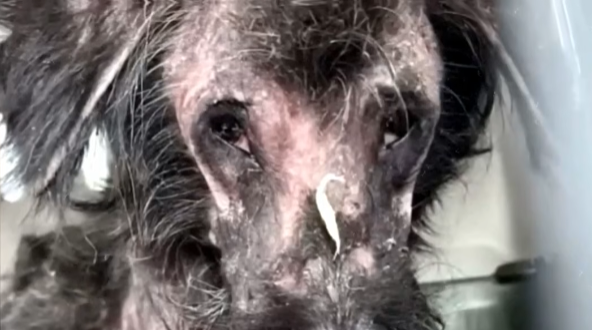
She searched the alleyways first, hobbling into narrow spaces between buildings, pushing her nose into piles of trash and old sacks. Her body ached, but she ignored it. She checked corners, doorways, under parked cars. Each time she found nothing, her breathing grew faster, her movements more frantic.
Milk dripped from her teats onto the ground as she walked. Her body was ready to feed her babies, but her babies were gone.
At one point, she stopped in the middle of the road, overwhelmed. She sat down hard, head lowered, and let out a long, broken cry that echoed between the buildings. A few people glanced over, annoyed. One man waved his hand, shooing her away as if she were nothing more than a nuisance.
She stood again and kept going.
Hours passed. The sun climbed higher, heating the asphalt beneath her paws. Hunger gnawed at her stomach, but she couldn’t think about food. Her world had narrowed to one single purpose. She followed faint scents that led nowhere, doubling back again and again, retracing her steps as if the ground itself might suddenly remember where her puppies were.
Her strength began to fail.
Her legs trembled more violently now, and her breaths came in shallow gasps. She lay down in the shade of a closed shop, panting heavily. Her eyes fluttered shut for a moment, then snapped open again in panic. Rest felt dangerous. What if her puppies needed her right now?
She forced herself back up.
That was when someone finally noticed.
A woman carrying groceries slowed her steps, watching the dog wobble and cry. She noticed the swollen belly, the milk-stained fur, the way the dog kept scanning the area and whining softly. Something clicked. This wasn’t just a stray. This was a mother who had lost her babies.
The woman crouched down a few meters away, careful not to scare her. “Hey… easy, mama,” she whispered.
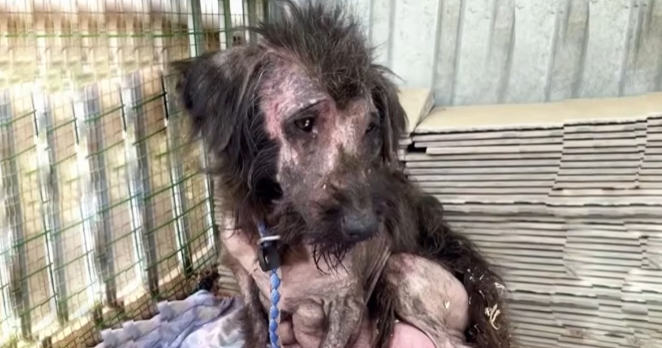
The dog froze, unsure. Her ears flattened, but she didn’t run. Instead, she looked at the woman with eyes so full of pain it made the woman’s chest tighten. Slowly, the woman extended her hand, not to grab, but to let the dog smell.
The dog sniffed, then cried again, a short, urgent sound, as if explaining everything in one breath.
The woman understood.
She called a local rescue group, her voice shaking as she described the situation. “She’s just given birth. She’s searching for her puppies. I don’t know where they are, but she’s desperate.”
Within an hour, rescuers arrived. They brought water, food, and a soft towel. The dog barely touched the food. She drank a little, then tried to walk away again, pulling against the gentle hold of the rescuer. She wanted to keep searching.
They decided to follow her.
Slowly, carefully, they let the mother lead the way. She walked with renewed urgency now, as if hope had flickered back to life. She turned down an alley, then another, nose working furiously. Suddenly, she stopped.
She began to dig at the ground near a stack of old crates behind a restaurant.
Her cries grew louder.
The rescuers rushed forward and moved the crates aside. Beneath them, hidden from view, was a shallow box lined with rags. Inside, huddled together, were five tiny puppies—cold, hungry, but alive.
The moment the mother saw them, she let out a sound that was half-cry, half-sob. She lunged forward, sniffing each puppy frantically, nudging them, licking their faces. Her whole body shook as she lay down, curling around them protectively.
The puppies squeaked weakly, rooting instinctively toward her belly. When they latched on and began to nurse, the mother finally relaxed. Her eyes closed, and for the first time that day, her breathing slowed.
She had found them.
The rescuers watched in silence, many with tears in their eyes. This fragile dog, thrown away like trash, had never given up. Even when her body was broken and her heart was terrified, she had kept going.
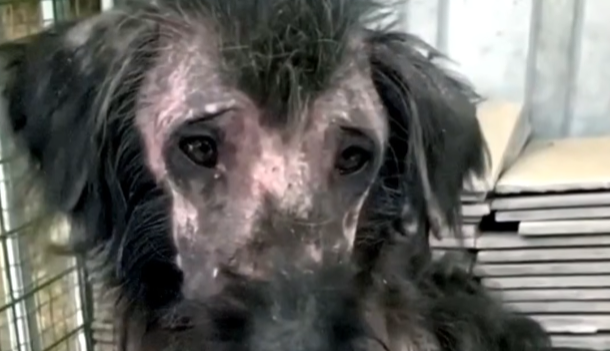
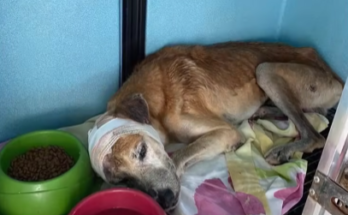
They carefully transported the little family to a safe shelter that afternoon. The mother was given clean blankets, nutritious food, and a quiet space where she could rest without fear. The puppies were warmed, checked by a vet, and monitored closely.
In the days that followed, the transformation was slow but beautiful. With proper care, the mother’s strength began to return. Her fur grew cleaner, her eyes brighter. She watched over her puppies constantly, rarely leaving their side. Every time one of them squeaked, she responded instantly, licking, adjusting, comforting.
She still startled easily at loud noises. She still flinched when someone moved too quickly. Trauma doesn’t disappear overnight. But she was safe now.
And she was no longer alone.
Her story spread quickly among volunteers and supporters. People were angry at what had been done to her, heartbroken by her suffering, and deeply moved by her devotion. Donations poured in to help care for her and her babies. Messages arrived from people wanting to adopt when the puppies were old enough.
But for now, all that mattered was that she could be a mother.
Sometimes, when the shelter was quiet, volunteers would watch her sleeping with her puppies piled against her chest, tiny paws twitching in dreams. In those moments, it was hard to imagine that she had once been crying alone on the street, searching desperately for something the world had taken from her.
Her story is a reminder.
Animals feel pain. They feel fear. They feel love just as deeply as we do. And even when humans fail them, their capacity to love never fades.
She was thrown onto the street right after giving birth. She cried, searched, and suffered in silence. But because someone finally stopped and listened, her story did not end in tragedy.
It ended in hope.