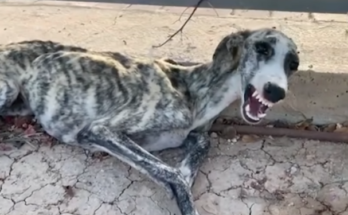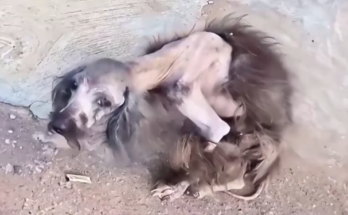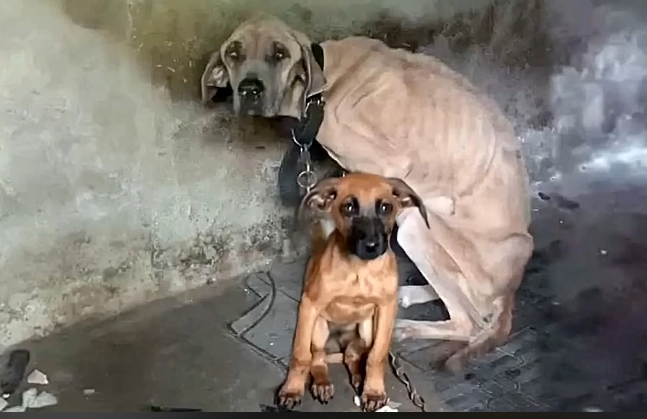
At the edge of an abandoned construction site, where broken concrete slabs lay scattered like forgotten memories, a mother dog curled her thin body around her pup. The wind carried dust and the sharp smell of rusted metal, but she did not move. Her eyes stayed fixed on the small, trembling life pressed against her chest. Every breath she took was shallow, labored, as if her body itself was slowly giving up—but her resolve had not.
No one knew how long she had been there. Days, perhaps weeks. The site was silent most of the time, except for distant traffic and the occasional shout from passersby who never looked closely enough to see what lay hidden behind the rubble. The mother dog had chosen this place because it offered one thing she desperately needed: a corner to hide.
Her fur was matted and thin, clinging to a body weakened by hunger and illness. Old wounds marked her sides, some healed badly, others still raw. Yet when her pup whimpered, she lifted her head at once, licking the tiny face with a tongue that had barely tasted food in days. She shifted her body, placing herself between the pup and the open world, as if her fragile frame could still shield him from everything dangerous.
The pup was barely old enough to walk. His legs shook when he tried to stand, and his eyes were still learning how to focus. He didn’t understand why his mother no longer chased insects or wagged her tail. He only knew the warmth of her body and the comfort of her heartbeat, slow and uneven though it was.
When hunger struck, the mother dog searched. Each morning, she forced herself to stand, ignoring the dizziness that blurred her vision. She walked the edges of the site, nose low, hoping for scraps, for anything. Often she returned with nothing. Sometimes she found a crust of bread or a torn plastic bag smeared with old food smells. She chewed carefully, then brought it back, nudging it toward her pup, refusing to eat until he had taken his share.
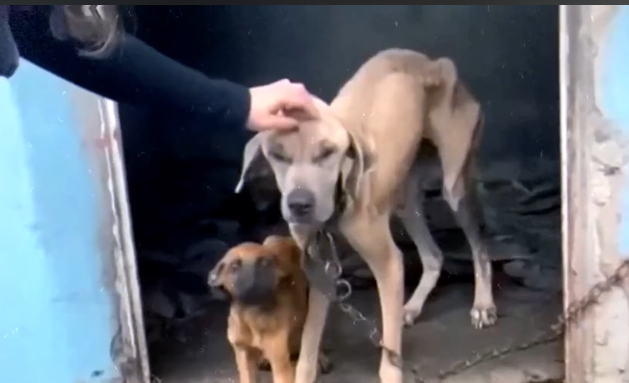
Her body was failing, but her instincts were fierce.
On the day the rescuers found them, the sun was harsh, beating down on the concrete until the air shimmered. A volunteer had noticed movement while passing by—a faint twitch, a shape that didn’t belong. As she approached, she heard a low growl, weak but determined.
The mother dog lifted her head and bared her teeth, though they shook with exhaustion. She pulled her pup closer, her eyes filled not with anger, but with fear. She had learned that humans often meant danger. Even now, with her strength nearly gone, she was ready to fight.
“It’s okay, mama… we’re here to help,” the rescuer whispered, kneeling slowly.
The mother dog did not believe her. She couldn’t afford to.
When the rescuer reached out, the mother dog snapped—not in aggression, but in desperation. It was the last defense she had. Her body trembled violently, and she collapsed forward, still trying to keep herself between the human and her pup.
That was when they saw how bad it was.
Her breathing was shallow, her gums pale. Flies circled wounds hidden beneath her fur. She was starving, dehydrated, and suffering from an untreated infection that had been eating away at her strength for weeks. Yet even as she lay there, barely conscious, her paw stretched out, resting protectively over her pup’s back.
The rescuers moved fast. One gently wrapped the pup in a towel, keeping him within the mother’s sight. Another carefully lifted the mother dog, supporting her fragile body. She whimpered softly, eyes fluttering open and closed, but she did not struggle as long as her pup stayed close.
At the veterinary clinic, the truth became impossible to ignore.
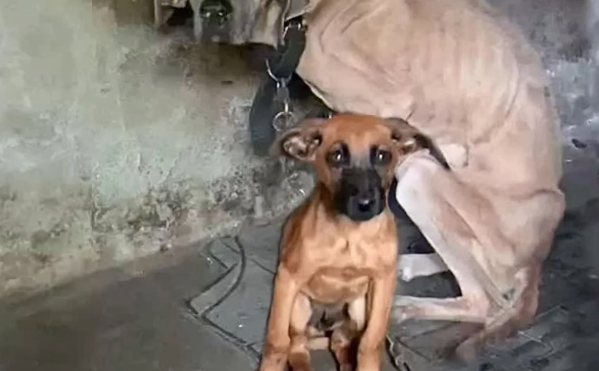
The vet worked quietly, efficiently, but her face grew heavier with every examination. The mother dog’s organs were failing. Severe anemia. Advanced infection. Her body had given everything it had, and there was almost nothing left to save.
“She’s been dying for a while,” the vet said softly. “She stayed alive for one reason.”
The pup.
They cleaned the mother dog’s wounds, placed her on warm blankets, and started supportive care, though everyone in the room knew it was a race against time. The pup was examined next—malnourished but stable, frightened but alive. He cried when they moved him away, and at the sound of his voice, the mother dog stirred.
She lifted her head, just a little.
They brought the pup back to her side at once.
For the next hours, the clinic was quiet. Volunteers took turns sitting beside the mother dog, speaking softly, stroking her head. She no longer growled. She no longer feared. Her eyes followed her pup wherever he moved, and when he crawled closer, she sighed, a long, shaky breath that sounded like relief.
That night, the mother dog stopped trying to fight.
Her breathing slowed, each rise of her chest taking more effort than the last. One volunteer held her paw, another supported the pup as he nestled against her. The mother dog licked his head once, twice, her tongue weak but gentle.
She had done her job.
As dawn approached, the room filled with a soft, golden light. The mother dog’s eyes opened one final time. They rested on her pup, warm and steady, free of fear at last. Then she exhaled slowly—and did not inhale again.
She died quietly, surrounded by kindness, her pup safe beside her.
The volunteers cried openly. Even the vet turned away, wiping her eyes. In rescue work, loss was familiar, but this kind of love—this kind of sacrifice—never stopped hurting.
The pup was named Hope.
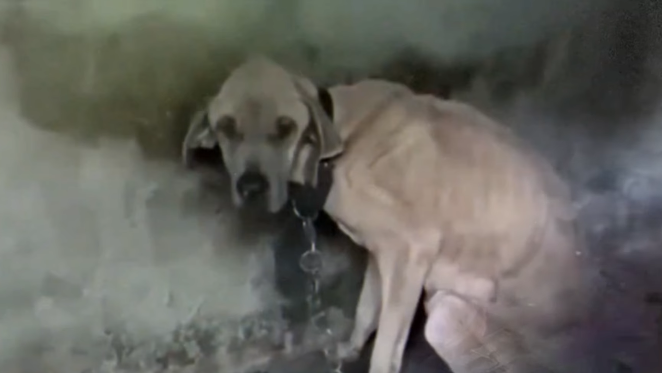
In the days that followed, Hope searched for his mother. He cried at night, crawling into corners, looking for the warmth he had known all his short life. The volunteers stayed with him, holding him close, whispering stories about the brave mother who had given him everything.
As Hope grew stronger, his body filled out, his fur softened, and his eyes brightened. But there was something else, something deeper—a quiet resilience, as if his mother’s strength had passed into him.
Weeks later, Hope learned to run. He chased leaves, tumbled over his own paws, and discovered the joy of play. Sometimes, when he curled up to sleep, he pressed himself against a blanket, as if remembering the shape of the body that once protected him from the world.
His story spread among the rescue community. People spoke of the mother dog who had refused to let go, who had endured hunger, pain, and sickness just to keep her pup alive one more day. Donations came in. More rescues were made. Her sacrifice rippled outward, touching lives she would never know.
Eventually, Hope found a home—a quiet place with a family who understood his fragile beginning and promised him a gentle future. On the day he left the shelter, a volunteer knelt beside him and whispered, “Your mama would be so proud.”
Hope wagged his tail, as if he understood.
The mother dog’s life had been short and filled with hardship, but it was not meaningless. In her final days, she showed a love so pure and powerful that it defied pain, fear, and even death.
She died slowly, yes—but she lived fiercely.
And because of her, her pup lived on.