At dawn the sea looks like a held breath. The horizon is a soft line of silver, and the water carries the faint memory of night—cool, quiet, waiting. This is the hour when R comes to practice, when the beach belongs only to the gulls and the tide, and the world feels wide enough to listen. Barefoot, she steps onto the sand with the calm of someone greeting an old friend. Salt air settles into her lungs. Today, like every day, she offers her body to the sea and asks for nothing but honesty in return.
R’s practice is not about spectacle. It is about conversation. The ocean speaks in rhythms—rise, fall, pause—and R answers with her spine, her breath, her patience. She warms slowly, drawing circles with her shoulders, waking the small muscles that protect the larger ones. Each movement is deliberate. The sand under her feet shifts, reminding her that balance is a living thing, not a fixed point. Flexiblenia, as she likes to call her state of being, is not merely flexibility. It is a philosophy: bend without breaking, open without emptying, strength that flows instead of hardens.
When the sun lifts higher, R begins the backbends. She stands tall, feet rooted, arms floating upward like sea grass. The first arc of her spine is modest, a greeting bow to the elements. Breath in—lengthen. Breath out—yield. The curve deepens gradually, vertebra by vertebra, until her chest opens toward the sky and her gaze meets the blue. The ocean answers with a sigh of foam. In this moment, R is neither performer nor audience. She is a bridge between gravity and grace.
People often misunderstand contortion. They think it is about pushing limits, forcing shapes, chasing extremes. R knows better. She learned early that the body keeps its own calendar. Some days it blooms, other days it rests. On the sea, she has learned to listen. The waves do not rush the shore; they arrive when they are ready. R mirrors that wisdom. Each backbend is a negotiation, a careful balance between courage and care.
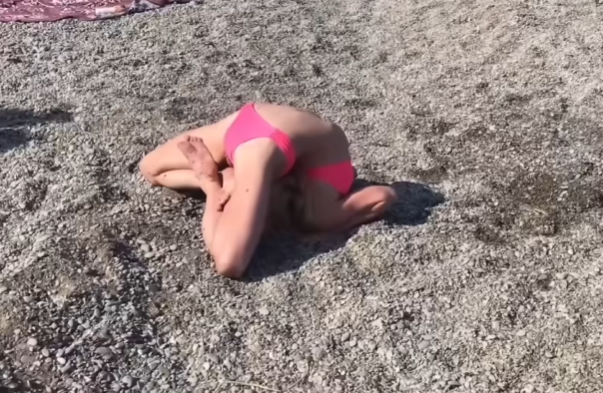
She lowers into wheel pose on the warm sand, palms pressing down, arms steady, legs alive. The arc of her back echoes the curve of a breaking wave. Here, the work is subtle: lift the heart, soften the throat, keep the breath smooth. Sand clings to her skin, grounding her, reminding her that even in the deepest bend, there is earth beneath her. She feels strong—not in spite of her flexibility, but because of it. Strength and suppleness are not opposites; they are partners.
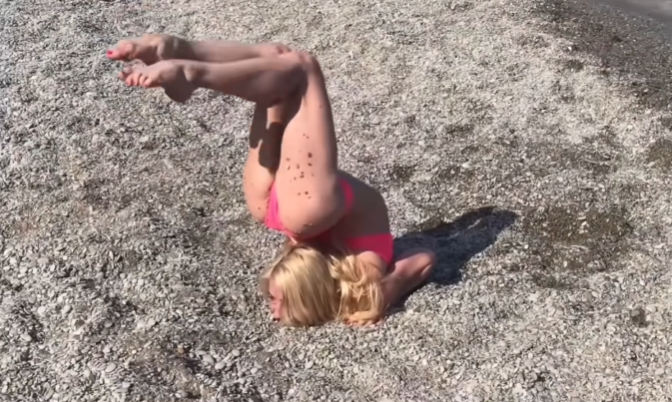
As the morning grows brighter, the sea changes color, and so does R’s practice. She moves through variations—forearms anchoring, one leg lifting, the spine extending into a crescent that feels both daring and serene. Each shape tells a story of patience. Years ago, R struggled with stiffness born of fear—fear of injury, fear of failure, fear of being seen. The ocean helped unteach that fear. It taught her to trust gradual change, to respect the days when the tide pulls back as much as the days it surges forward.
Flexiblenia is not just physical. It lives in the mind. R trains her thoughts to bend like her body, to soften where they once clenched. When a pose resists, she doesn’t argue. She breathes. She adjusts. She waits. This mental elasticity carries into the rest of her life. When plans shift, she adapts. When challenges appear, she arches around them, finding new pathways through familiar terrain.
A breeze picks up, cool and playful, brushing R’s hair across her face. She laughs quietly and transitions into a standing backbend, arms wide, chest lifted. The sea glitters now, each wave a small mirror catching the sun. R feels expansive, as if her ribcage could cradle the sky. Yet there is humility here too. The ocean is vast, and she is small. That contrast brings relief. She doesn’t have to be everything. She only has to be present.
Her practice continues, flowing into deeper expressions. In a controlled descent, she reaches back, fingertips brushing the sand behind her heels, then palms find the ground. The bridge becomes a bow, the bow becomes a circle. Movement feels less like effort and more like remembering. The body remembers how it wants to move when fear loosens its grip. The spine remembers its ancient language, written long before words.
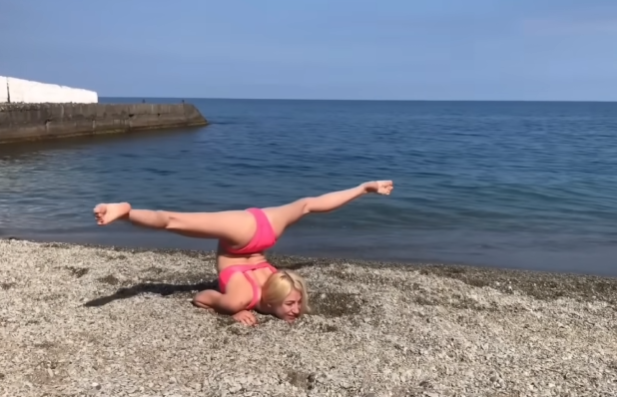
R pauses between sets, kneeling to sip water, watching the horizon. She notices the fishermen far out at sea, their boats small against the expanse. She thinks of the countless lives shaped by these waters, of stories folded into the tides. Her own story feels lighter here. Problems that seemed heavy inland lose their weight by the shore. The sea has a way of rearranging priorities, of whispering that there is time enough for healing if one is willing to move with it.
When she returns to practice, it is with renewed intention. She explores asymmetry—twists woven into backbends, one side opening a fraction more than the other. This is where truth lives, in the uneven places. Perfect symmetry is a myth; real bodies tell richer stories. R honors her own contours, the scars and strengths that shape her. Flexiblenia means embracing the unique map of one’s body, not forcing it to match someone else’s.
As the sun climbs, beachgoers begin to appear—joggers, families, curious onlookers. Some pause to watch, surprised by the elegance of R’s arcs against the endless blue. She feels their presence but does not perform for them. Her focus remains inward, anchored by breath. If her practice inspires someone to move, to stretch, to breathe a little deeper, that is a gift—but not a requirement. The true reward is the quiet alignment she feels within.
Toward midday, R slows. She transitions into gentle counterposes, honoring the spine by neutralizing and lengthening. Child’s pose with the ocean at her side feels like a conversation closing softly. She lies back on the sand, arms open, letting the sun warm her face. The sea continues its endless practice beside her, wave after wave, never bored, never finished.
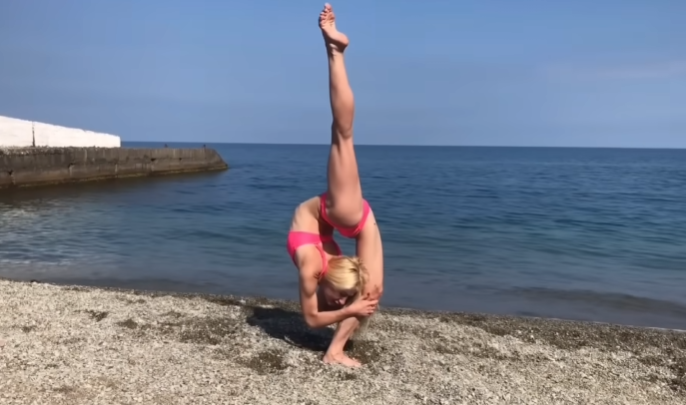
In rest, insights arrive unannounced. R reflects on how far she has come—not in degrees of bend, but in trust. She trusts her body to speak, trusts her mind to listen, trusts the process to unfold without force. Backbend Flexiblenia is not a destination; it is a relationship. Like the sea, it changes daily, shaped by weather, mood, time. Some days it is calm, others demanding. All days are valid.
When she finally stands to leave, R bows to the water, a small ritual of gratitude. The sea does not bow back, but its waves kiss the shore as if in acknowledgment. She walks away lighter, carrying salt on her skin and clarity in her chest. The practice will ripple through her day—into how she sits, how she listens, how she responds to the bends life asks of her.
R knows she will return tomorrow, and the next day, and the next. The sea will be different each time, and so will she. That is the beauty of it. In the meeting of spine and horizon, effort and ease, R finds a simple truth: to bend is not to weaken, and to open is not to lose oneself. On the edge of the world, with the ocean as witness, she practices becoming—one breath, one backbend, one wave at a time.