He didn’t come to people because he wanted attention.
He didn’t come because he was noisy, greedy, or troublesome.
He came because his stomach hurt.
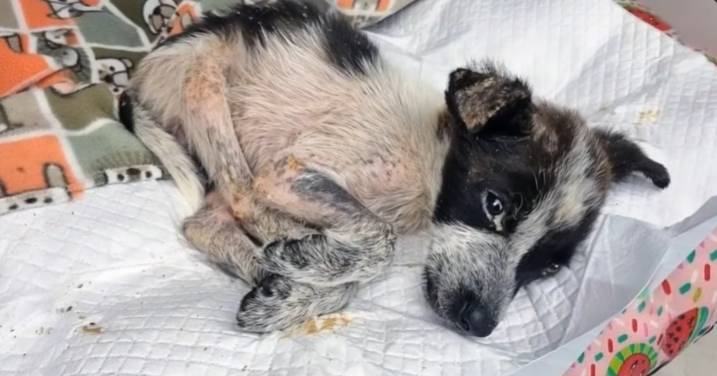
The small dog appeared one afternoon at the edge of a crowded street, where the smell of fried food and warm rice floated through the air. His ribs pressed sharply against his thin skin, each breath visible. His fur was matted with dust, and one ear bent strangely, as if it had been injured long ago and never healed properly. He walked slowly, carefully, as though every step had been rehearsed to avoid pain.
Hunger teaches animals humility.
Hunger teaches silence.
The dog stopped near a group of people eating on low plastic stools outside a small shop. He didn’t bark. He didn’t jump. He simply sat down a short distance away and waited, eyes fixed not on the people, but on the ground near their feet—where crumbs might fall.
Someone noticed him.
“Shoo! Go away!” a man shouted, waving his hand. The dog flinched but didn’t move. His tail stayed low, barely twitching, hope still alive despite fear.
Another man stood up suddenly. “These street dogs are everywhere,” he complained. “Dirty and useless.” He kicked toward the dog—not even hard enough to injure, but hard enough to humiliate.
The kick landed.
The dog yelped, a sharp sound that cut through the noise of traffic and conversation. He scrambled backward, nails scraping the pavement, heart racing. For a moment, he thought of running. His body screamed at him to flee.
But hunger pulled him back.
He circled slowly, carefully, returning to the edge of the group. He lowered his head even more, making himself small, invisible. He just wanted food. Just a bite. Anything.
This time, there was no warning.
A foot struck his side.
A plastic bottle was thrown.
Someone laughed.
“Get out of here!”
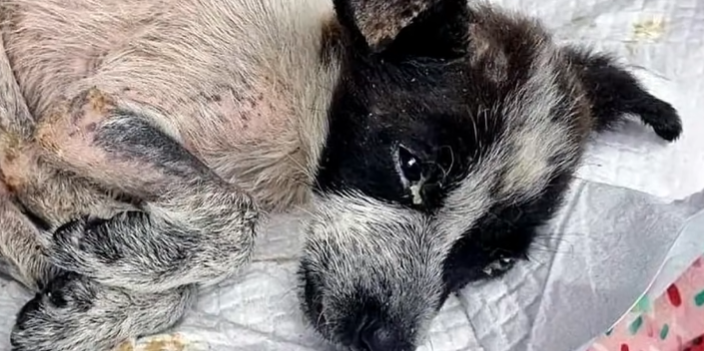
The dog stumbled into the street, narrowly missing a passing motorbike. He collapsed near the curb, trembling, his chest heaving. Pain burned through his body, but worse than pain was confusion. He had come in peace. He had asked without words. Why was he being punished?
He lay there for a long time.
Cars passed. People stepped around him as if he were trash. Some looked down briefly, then looked away. Others didn’t look at all. To most of the world, he was just another stray—another problem that didn’t belong to anyone.
But he had once belonged.
Long ago, before the streets hardened him, the dog had a home. He remembered hands that smelled of soap. A voice that used to call him by a name he no longer remembered. He remembered sleeping near a doorway, feeling safe. Then one day, the door never opened again. Or maybe it did—but not for him.
Life on the street taught him quickly: food was never guaranteed, kindness was rare, and humans could be unpredictable. Still, he believed. He always believed. Because giving up belief would mean giving up entirely.
As evening approached, the air grew cooler. Hunger gnawed harder now, mixing with pain. The dog dragged himself toward a quieter alley, away from the noise. He found a spot near a pile of cardboard and curled up, trying to conserve warmth. His body shook, not just from cold, but from exhaustion.
He slept lightly, waking at every sound.
At dawn, he tried again.
Hunger does not allow pride.
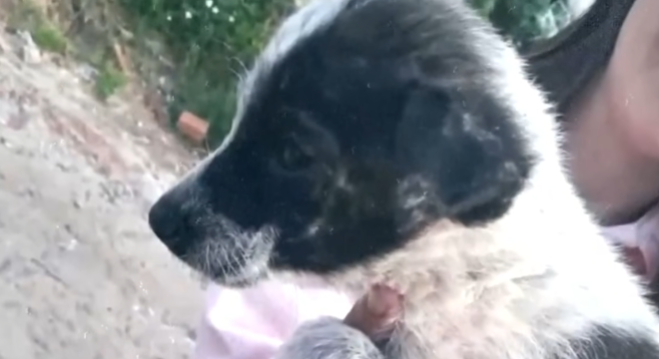
The dog limped toward another shop where people were preparing food. The smell was overwhelming. His legs felt weak, but his eyes still held that same soft plea. He stood at the edge this time, farther away, afraid to get too close.
A woman noticed him.
She frowned at first, clearly annoyed. “Why is it always dogs?” she muttered. She reached for a broom.
The dog saw the movement and backed away instantly, tail tucked, body low. He didn’t want trouble. He just wanted to survive.
Then something unexpected happened.
A child—no more than seven years old—pulled at the woman’s shirt. “Mom,” he said quietly, “he looks hungry.”
The woman hesitated.
The broom lowered slightly.
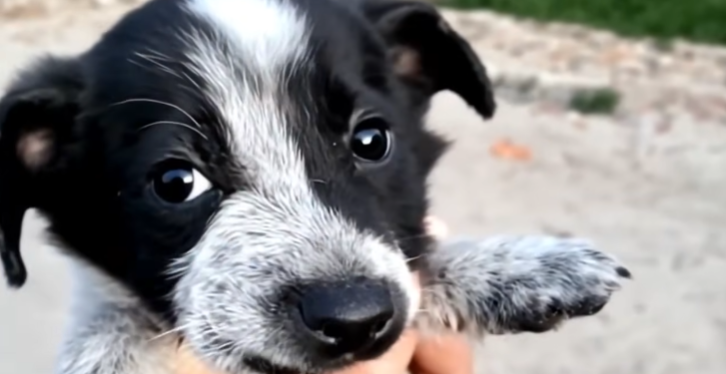
The child walked closer, slowly, carefully, the way children sometimes understand animals better than adults do. He crouched down and placed a small piece of bread on the ground, then stepped back.
The dog stared at it.
He didn’t rush forward. Experience had taught him that sudden movements could bring pain. He waited, eyes flicking between the bread and the people. No one moved. No one shouted.
Finally, he crept forward and took the bread gently, barely touching it with his teeth.
He ate slowly.
Tears filled the child’s eyes. “He’s shaking,” he whispered.
The woman sighed, something heavy shifting inside her. She brought out a bowl of water and placed it nearby. “Just this once,” she said, mostly to herself.
The dog drank as if the water were life itself.
For the first time in days, his stomach felt a little less empty. His body relaxed just a fraction. He lay down nearby, careful not to be in the way. He didn’t ask for more.
But kindness, when it appears, can be fragile.
Another man came out of the shop and saw the dog. His face hardened instantly. “Why is that thing still here?” he snapped. Without waiting, he grabbed the broom and charged forward.
The dog didn’t wait this time.
Fear exploded through him, and he ran—ran as fast as his injured body would allow. He bolted into the street, dodging vehicles by instinct alone. A horn blared. Tires screeched. He slipped, rolled, and finally collapsed on the far side of the road.
Pain screamed through his legs.
He couldn’t stand anymore.
The street didn’t stop for him. People passed. Life moved on. The dog lay there, breathing shallowly, eyes half-open. He wondered, in the simple way animals do, if this was the end.
Then footsteps slowed.
A young woman knelt beside him. Her face tightened when she saw his injuries, the fear still etched into his expression. “Hey… hey, it’s okay,” she whispered, though she wasn’t sure if it was.
She gently touched his side. He flinched but didn’t snap. He was too tired for anger.
She called someone on her phone.
Within an hour, the dog was wrapped in a blanket and lifted into a small vehicle. The street faded away as exhaustion finally pulled him under.
At the rescue clinic, they cleaned his wounds. The vet shook her head. “He’s been kicked more than once,” she said quietly. “He came to people for help.”
The woman swallowed hard. “Will he survive?”
“He’s weak,” the vet replied. “But he hasn’t given up. That matters.”
The dog woke up on a soft surface. The pain was still there, but it was different now—controlled, dulled. A hand stroked his head gently. No shouting. No sudden movements. Just warmth.
His tail moved weakly.
Days passed. Then weeks. Food came regularly. Water was always there. People spoke softly around him. Slowly, his body healed. Slowly, his eyes changed. The fear didn’t disappear completely, but it loosened its grip.
One day, he stood on his own again.
The woman who had found him visited often. She sat beside him, telling him stories, calling him “Brave.” He didn’t know what the word meant, but he liked the way she said it.
When the time came, she took him home.
He still flinched at loud noises. He still hesitated before approaching people. But he no longer went to strangers begging for food.
He had someone now.
Somewhere out there, people still eat and kick away hungry animals without a second thought. The street still remembers the sound of his yelp. But his story didn’t end where cruelty tried to stop it.
He came to people seeking food—and found pain.
But because one person chose compassion instead of cruelty, he also found something else:
A second chance.