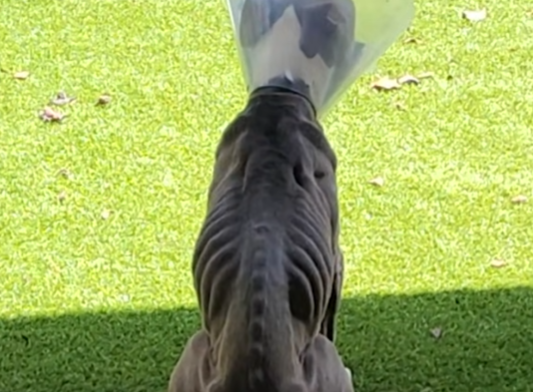
The pittie didn’t look like a survivor when people first saw him. He looked like a ghost—thin, quiet, and barely holding himself together. His ribs pressed sharply against his skin, each breath visible as his chest rose and fell with effort. His coat, once meant to shine under the sun, was dull and patchy, clinging weakly to a body that had known hunger far too long. He moved slowly through the neighborhood, as if he had learned that taking up too much space in the world was dangerous.
Most adults noticed him and felt a familiar ache of sadness mixed with helplessness. Some assumed he was aggressive because of his breed. Others believed he was sick beyond saving. A few thought it was better not to get involved at all.
But a little girl named Emma saw him differently.
Emma was seven years old, with scraped knees, curious eyes, and a heart that hadn’t yet learned how to ignore pain it didn’t understand. She saw the pittie one afternoon while riding her bike down the sidewalk. When she noticed him standing near a trash bin, head low and tail still, she stopped pedaling. Something about the way he stood—so quiet, so unsure—made her chest feel tight.
“Dad,” she said softly, pointing. “That dog looks lonely.”
The pittie didn’t bark or move closer. He just watched. His eyes followed Emma carefully, not with fear, but with cautious hope. It had been a long time since anyone looked at him without judgment. Longer still since someone looked at him with concern.
Emma’s father approached slowly, keeping his body relaxed. He knelt and spoke gently, careful not to startle the dog. The pittie stepped back at first, but hunger kept him close. Emma sat down on the curb and placed a granola bar on the ground between them.
“You can have it,” she whispered. “I won’t take it back.”
The dog sniffed the air, then the food, then Emma’s small hands resting on her knees. Finally, he ate—slowly, carefully, as if expecting it to disappear at any moment. Emma smiled, but she didn’t reach out. Somehow, she seemed to understand that trust needed space to grow.
That was the beginning.
The pittie came back the next day. And the day after that.
Emma made it her mission to check for him every afternoon after school. She left bowls of water near the fence. She saved bits of her lunch. She talked to him about her spelling tests, her favorite books, and the games she played at recess. The pittie listened, his ears twitching at the sound of her voice, his body slowly relaxing in her presence.
Her parents watched carefully. They noticed how the dog never jumped, never growled, never acted unpredictably. He was gentle to the point of being fragile. Still, they knew kindness alone wouldn’t save him. He needed medical care. He needed safety.
Emma named him Buddy.
Because, she said, “That’s what he is.”
Buddy’s condition became more obvious with time. Beneath his quiet demeanor were signs of deep neglect: sores on his paws, scars along his sides, and a limp that worsened when he was tired. Some days he didn’t show up at all, and those nights Emma cried herself to sleep, afraid that something terrible had happened.
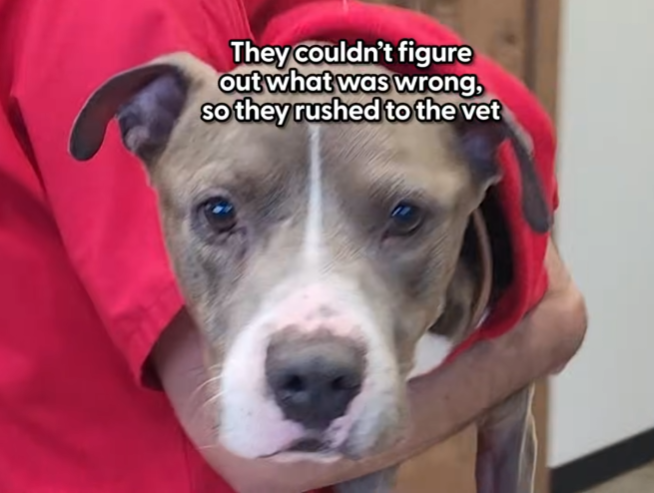
One morning, after a night of heavy rain, Emma found Buddy lying under a bush near their house, barely moving. His breathing was shallow. His eyes were open, but unfocused.
Emma didn’t hesitate.
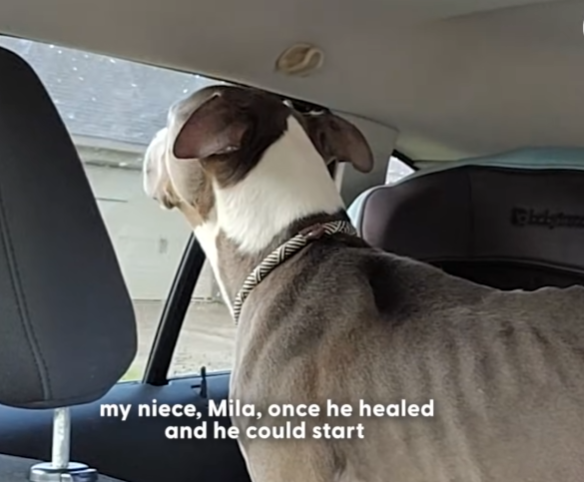
She ran inside, shouting for her parents. Within minutes, they wrapped Buddy in blankets and rushed him to a veterinary clinic that worked closely with a local rescue. Emma rode in the back seat, holding Buddy’s head in her lap, whispering over and over, “You’re okay. I’m here. Please don’t go.”
Buddy didn’t resist.
At the clinic, the news was serious but not hopeless. Buddy was severely underweight, anemic, dehydrated, and suffering from untreated infections. The vet explained that recovery would take time, patience, and commitment. There would be setbacks. Progress would be slow.
Emma nodded solemnly, as if she fully understood.
“Can I help?” she asked.
And she did.
Every day after school, Emma visited Buddy at the rescue foster home where he was recovering. She brought him drawings taped with hearts and stick-figure dogs. She read aloud to him, her small voice filling the room with warmth. She celebrated tiny victories—the day he finished a full meal, the first time he stood without shaking, the moment his tail wagged when he saw her walk in.
Buddy responded in ways no one expected.
Though weak, he became fiercely loyal to Emma. When she sat on the floor, he rested his head against her legs. When she laughed, his ears perked up. When she left, he watched the door long after it closed. The foster volunteers said he barely ate if Emma missed a visit.
Slowly, Buddy began to change.
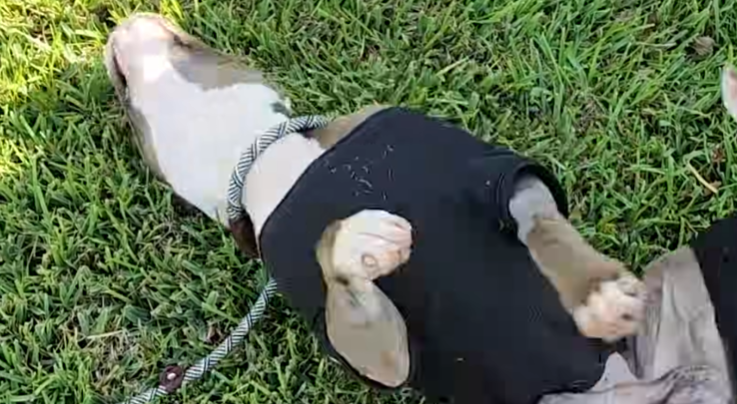
His body filled out. His coat grew soft and glossy. His limp faded as his muscles strengthened. He learned how to play, how to run, how to enjoy the world instead of merely surviving it. But even as he transformed physically, it was his emotional healing that amazed everyone most.
Buddy trusted again.
He no longer flinched at sudden movements. He greeted new people with curiosity instead of fear. He slept deeply, no longer jolting awake at every sound. And through it all, Emma remained his anchor—the constant presence that reminded him he was safe.
Emma changed too.
She became more responsible, more aware of others’ feelings. She learned that helping someone didn’t always mean fixing everything right away. Sometimes it meant showing up. Sometimes it meant staying.
When the rescue began discussing adoption, Emma’s parents already knew the answer.
Buddy wasn’t just a dog they helped.
He was family.
The day the adoption papers were signed, Emma hugged Buddy so tightly that he leaned into her, closing his eyes with a deep, contented sigh. It was the kind of sigh that said, I don’t have to be afraid anymore.
Now, Buddy is almost unrecognizable from the skinny pittie who once wandered the streets. He sprawls across the couch, belly full and heart at ease. He runs through the yard with confidence, his tail a blur of happiness. But no matter where he is, he keeps one eye on Emma.
She is his miracle.
Their story spread quickly—shared by friends, neighbors, and eventually across the internet. People were moved not just by Buddy’s transformation, but by the quiet power of a child’s compassion. A little girl saw a dog the world had overlooked and chose to care.
And in doing so, she saved him.
Buddy’s journey is a reminder that healing doesn’t always start with resources or expertise. Sometimes it starts with noticing. With kindness. With a small voice saying, “You matter.”
Because sometimes, the biggest transformations begin with the smallest hearts.